

Audio By Carbonatix
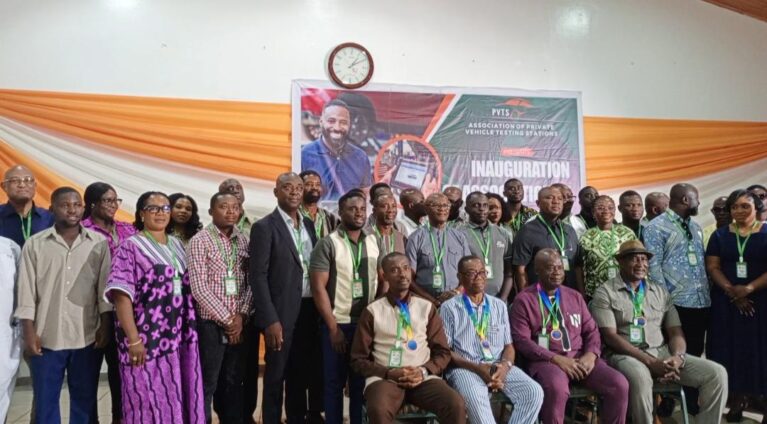
The Association of Ghana Private Vehicle Testing Stations (AGPVTS) is calling on the government to adopt machine-based vehicle testing nationwide and review what it describes as an unfair revenue-sharing model that is threatening the survival of private testing centres.
Chairman of the Association, Robert Adomako, says the Driver and Vehicle Licensing Authority (DVLA) must urgently phase out manual inspections in favour of automated systems to improve road safety and reduce road crashes.
He appealed the inauguration of the association in Kumasi, describing machine-based testing as the most reliable method for assessing vehicle roadworthiness.
“Our primary goal is to curb road accidents by ensuring only roadworthy vehicles operate on our roads. We therefore call on the government to transition from manual inspections to machine-based testing and inspection,” Mr Adomako said.
He argued that human-led inspections are increasingly unreliable and open to inconsistencies and compromise.
“We cannot continue to rely on human judgment alone when technology gives us precision. Manual inspections are prone to inconsistency, fatigue, and in some cases, compromise. These gaps put lives at risk,” he added.
The AGPVTS says it is also tightening internal discipline among members, warning against the issuance of roadworthy certificates to unfit vehicles, which it says undermines road safety efforts.
However, beyond safety concerns, members of the association say many Private Vehicle Testing Stations (PVTS) are struggling financially due to what they describe as an imbalanced revenue-sharing arrangement.
One member, Sampson Asiamah, explained that the bulk of fees collected from roadworthy certificates does not remain with the stations that conduct the actual inspections.
“The current arrangement leaves testing stations with very little to cover operational costs. At present, the roadworthy fee for a two-wheeled motorcycle is ¢104.25. From this amount, PVTS receives a share of ¢11, out of which we must pay 10% to the DVLA and also cover VAT. Many stations are struggling to stay afloat,” he said.
He further argued that recent increases in roadworthy charges by the Driver and Vehicle Licensing Authority have not been matched with adjustments to the portion retained by private stations.
“That is unfair. If charges are reviewed upward, the stations doing the actual testing should also see a corresponding adjustment in their service fees,” he added.
The association is therefore calling for a comprehensive review of the revenue-sharing structure to ensure financial sustainability for private operators while maintaining safety standards.
The DVLA introduced private participation in vehicle testing under the Driver and Vehicle Licensing Authority (Private Vehicle Testing Station) Regulation, 2012 (L.I. 2192), as part of efforts to decongest public testing centres and improve efficiency in vehicle inspections nationwide.
Latest Stories
-
‘We are waiting for the delegates’ – NPP explains delay in voting at Kumasi conference
10 minutes -
Drug fight will yield results as Mahama steps up action – Dzimega
18 minutes -
‘It’s bizarre’ – Freddie Blay questions EOCO’s handling of Baffour Awuah case
20 minutes -
NPP conference to reinforce support for Bawumia ahead of 2028 – Evans Nimako
29 minutes -
France and Ghana’s Gender Ministry explore cooperation on women’s economic empowerment
37 minutes -
Ghana’s growing drug trafficking links are deeply troubling – Victoria Bright
40 minutes -
‘The MP’s tears are crocodile tears’ – Kofi Bentil on La Pleasure Beach demolition
42 minutes -
Freddie Blay alleges Mahama ordered demolition of son’s Polo Beach Club at La Beach
53 minutes -
‘We’ve complied with all the rules’ – NPP assures transparency in national elections
1 hour -
‘Who is financing all this?’ – Victoria Bright questions networks behind Ghana-linked drug trade
1 hour -
If we don’t know Baffour Awuah’s charge, there’s a fishing expedition going on – Kofi Bentil
1 hour -
Parliament questions continued detention of Baffour Awuah by EOCO, demands due process
2 hours -
Baffour Awuah did not report to EOCO voluntarily; an arrest warrant forced him – Theophilius Dzimega
2 hours -
Baffour Awuah case risks looking like a display of state power – Sulemana Braimah
2 hours -
Campaign posters, billboards take over Kumasi as NPP goes to polls
2 hours