

Audio By Carbonatix
Researchers from the Forestry Research Institute of Ghana of the Council for Scientific and Industrial Research (CSIR-FORIG), have embarked on a mission to revive one of the most iconic trees in the history of Ghana, the 300-year-old Okomfo Anokye Cola tree, after it was felled by an unknown person.

According to legend, the Cola tree at Feyiase grew from a seed spat by Okomfo Anokye, the chief priest of the Asante Kingdom at the site of the Battle of Feyiase against the Denkyira in the early 1700s in the struggle for Ashanti independence.
“The tree’s presence served as a tangible link to the region’s history and cultural heritage,” the Director of Research at Manhyia Palace, Osei-Bonsu Safo Kantanka, had emphasized the historical importance of the tree’s location in the Ashanti Kingdom’s narrative.
Local beliefs attribute healing properties to the black and white seeds of the Cola tree.
A scientist from CSIR-FORIG, Dr Akwasi Duah-Gyamfi identifies the Okomfo Anokye Cola tree as Cola nitida which has its root from Ghana and Sierra Leone.
Road to restoration
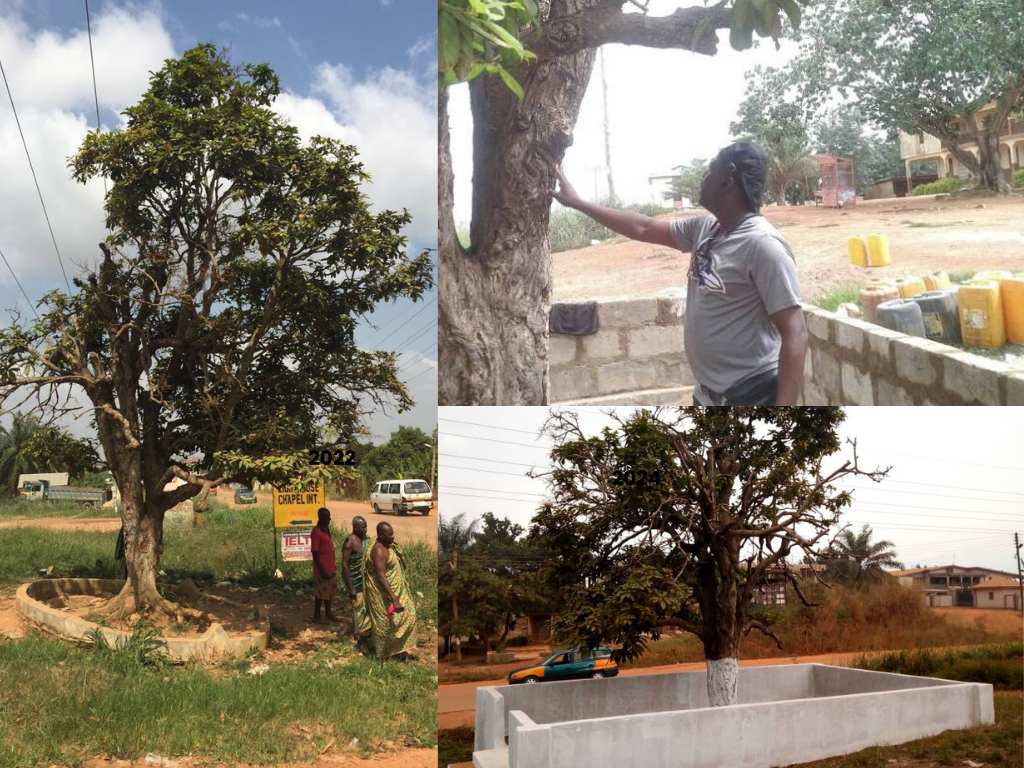
The tree, situated in the middle of a major road connecting Kumasi to Lake Bosomtwe, was a prized tourist attraction. But now, tourists are personas non grata.
As we approach the site, the enclosure made from corrugated roofing sheets constructed by Nana Addae Gyamera to shield it from the eyes of would-be intruders greets us amidst the mid-morning sun. Top parts of the severed shoot with its withered leaves could however be seen breathing its last.
As a codifier in the forest kingdom of Ashanti, Okomfo Anokye was a lover of nature. According to reports, he had planted several oil-palm trees in a couple of towns. Sadly, one of the trees planted at his birthplace of Awukugua in the Eastern region of Ghana was felled by some disgruntled elders. The tree eventually died.
A week after the Cola tree was cut, it almost suffered the same fate as life gradually oozed out of it.
“A portion of it was dead, some other part was alive. We inspected the roots and noted the root was also alive,” said Prof Daniel Ofori, Director of the CSIR-Forestry Research Institute of Ghana and leader of the team.
Inducing sprouting through wounding, grafting and budding
As the ‘half-paralysed’ stump stands in front of the scientists, Prof. Daniel Ofori thinks of several methods of restoration.
He has therefore employed a four-pronged approach. They can’t take any chance.
“At least one will be successful,” he stressed.
With the shoots only waiting to be dismembered for fuel, the scientists have gone for young twigs and buds from a healthy cola plant.
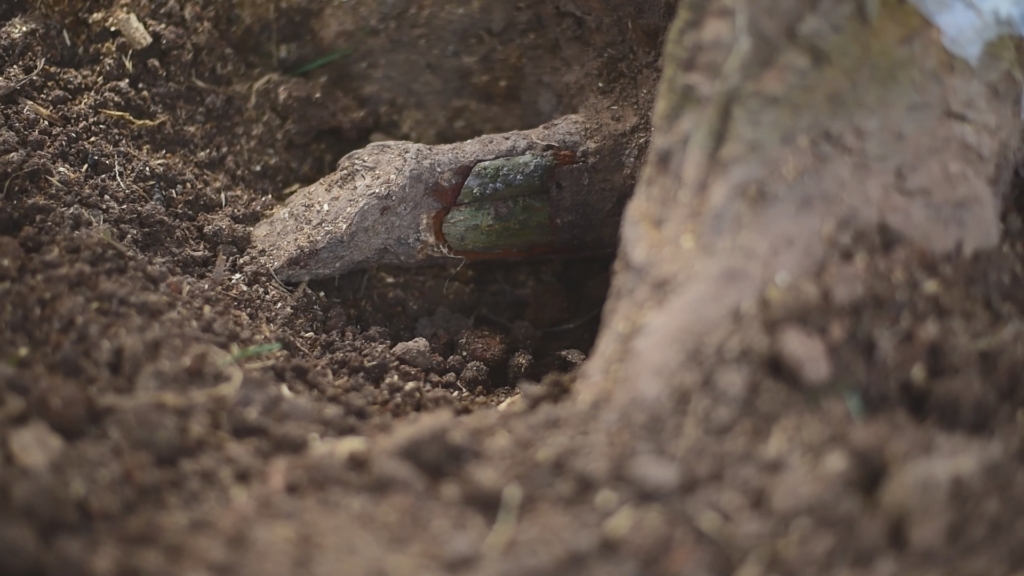
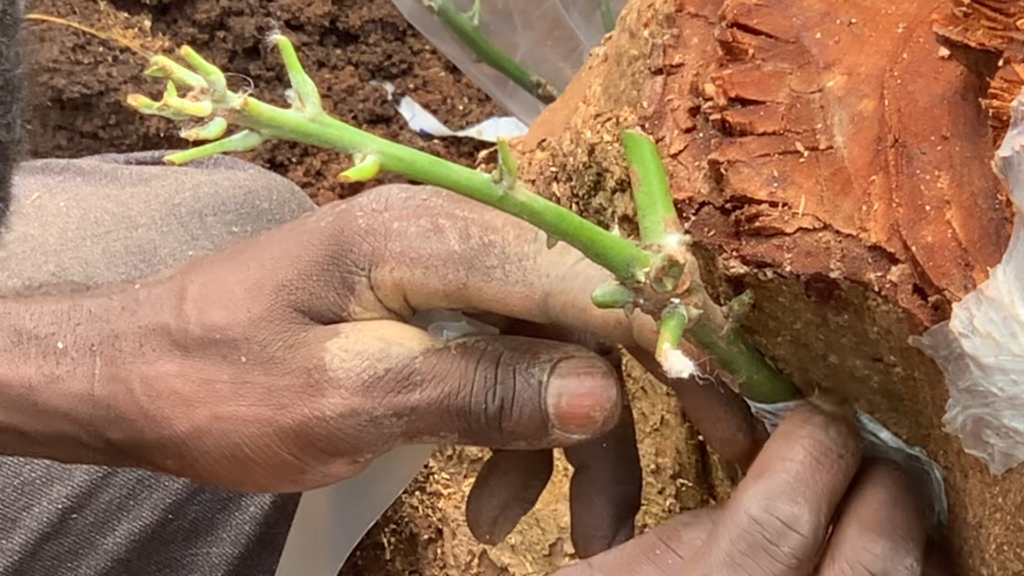
The roots were also given another treatment as the team intentionally creates wounds on it, ouch! Yes, this procedure is meant to trigger the stump to bring out new shoots.
“Grafting involves taking a scion from a healthy plant and inserting on a stump and when the wound heals, the scion will grow and become a new plant and that means the root stock or the original stump will not die.
“A small bud is taken from a healthy plant and inserted on a stump or the root and when the wound heals, the buds will grow and become a new plant.
“We create wounds on the stump or on the roots and this will trigger the buds to grow and become new plant,” he explained.

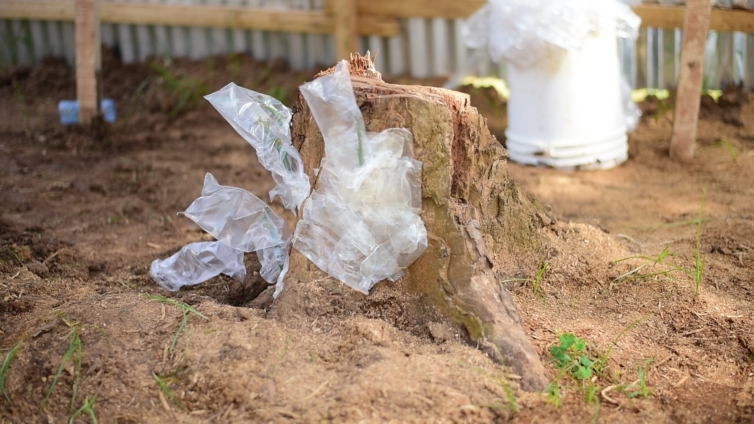
The scientists then spread moist sawdust around the stem to serve as mulch to protect the roots and the stump from heat or evaporation, and a shade provided by palm fronds to protect it (grafts, buds and potential new shoots) against the raging dry spell and evapotranspiration.
After two weeks, the young shoots covered in protective transparent plastic like ice-cream cones are still green and showing signs of growth. It might take some months or years to nurture the tree back to its former glory.

There are several clones of the original Isaac Newton apple tree that have been planted around the world.
Perhaps, Ghanaian scientists can also emulate this, by having clones of the restored Okomfo Anokye cola tree at several places in Ghana and West Africa.
A word out there is suggestive of a magical regenerative prowess of the legendary tree, but Okomfo Anokye himself must be proud watching scientists from the CSIR-Forestry Research Institute of Ghana restore his name using science and technology.
Latest Stories
-
Knights and Ladies of Marshall group backs Catholic Bishops’ stance on anti-LGBTQ+
12 minutes -
Bright Simons writes: All the Filla in the Ibrahim Mahama/E&P – Gold Fields Saga
37 minutes -
Monetise Idiocy In Ghana
44 minutes -
The Ghanaian prophet and the mysterious death of his scottish wife Charmain Speirs
1 hour -
Nearly 400 sentenced in Nigeria for links to militant Islamists
2 hours -
Ghana’s recovery supported by gold strength despite global oil price pressures – Standard Bank Research
2 hours -
‘Excellence is our inheritance’ – Nana Sam Brew-Butler hails Mfantsipim’s 150-year reign in leadership
2 hours -
Kwaku Azar writes: A-G vs OSP
3 hours -
Mfantsipim–Adisadel rivalry built excellence, not division – Sam Jonah
3 hours -
Vice President launches Mfantsipim’s 150 years of shaping Ghana’s greatest mind
3 hours -
I assure Otumfuo, Mahama will join him to commission KNUST Teaching Hospital by end of this year – Haruna Iddrisu
4 hours -
Barcelona dominate derby to extend La Liga lead
4 hours -
Gov’t to roll out free special education for persons with disabilities from July 1 – Education Minister
4 hours -
Importers and Exporters Association declares full support for Publican AI port system
5 hours -
“We used it to test our officiating officials’ readiness” – Bawah Fuseini after CAA Athletics event
5 hours