

Audio By Carbonatix
Moscow's denial comes after Germany says Navalny had been poisoned with a Novichok nerve agent in a bid to murder him.
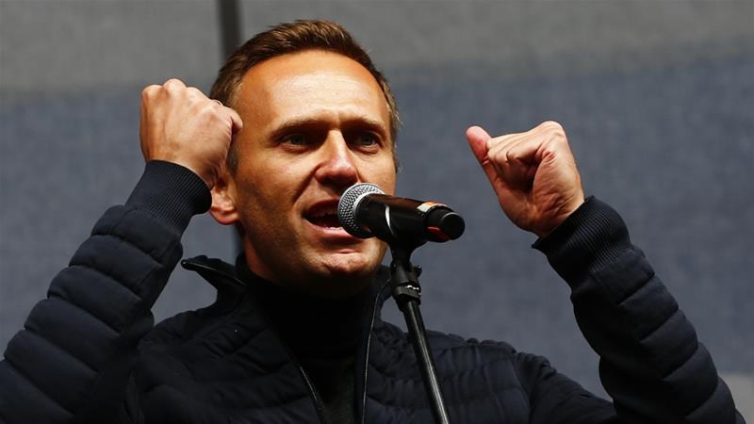
Russia has rejected accusations that Moscow was to blame for the poisoning of opposition leader Alexey Navalny, saying it saw no grounds for sanctions to be imposed against it over the case.
The Kremlin's denial came on Thursday, a day after German Chancellor Angela Merkel said Navalny had been poisoned with a Soviet-style Novichok nerve agent in an attempt to murder him.
Kremlin spokesman Dmitry Peskov said Moscow rejected any suggestion that Russia was responsible and warned other countries against jumping to hasty conclusions.
He said there was no reason to discuss measures against Moscow after Merkel said Germany would consult its NATO allies about how to respond to the poisoning.
The Charite hospital in Berlin, where Navalny is lying in intensive care, has reported "some improvement" in his condition, but he remains in a medically induced coma and on a ventilator.
In a statement on Wednesday, Merkel's spokesman Steffen Seibert said testing by a special German military laboratory had shown "proof without doubt of a chemical nerve agent from the Novichok group".
"It is a dismaying event that Alexey Navalny was the victim of an attack with a chemical nerve agent in Russia," Seibert said.
Merkel later told a news conference: "This is disturbing information about the attempted murder through poisoning against a leading Russian opposition figure."
German Foreign Minister Heiko Maas urged Moscow to investigate the poisoning, and said the Russian ambassador had been summoned to explain the evidence.
"This makes it all the more urgent that those responsible in Russia be identified and held accountable," Maas told reporters. "We condemn this attack in the strongest terms."
Novichok - a military-grade nerve agent - was used to poison former Russian spy Sergei Skripal and his daughter in the United Kingdom.
'European response'
Navalny, 44, a politician and anti-corruption crusader who is one of Russian President Vladimir Putin's fiercest critics, fell ill on a flight back to Moscow from Siberia on August 20 and was taken to a hospital in the Siberian city of Omsk after the plane made an emergency landing.
He was later transferred to Charite hospital, where doctors last week said there were indications he had been poisoned.
The Russian doctors who treated Navalny in Siberia have repeatedly contested the German hospital's conclusion, saying they ruled out poisoning as a diagnosis and their tests for poisonous substances came back negative.
Al Jazeera's Aleksandra Stoyanovich-Godfroid, reporting from Moscow, said Russia's response was so far "cautious and restrained".
"The Russian doctors released Navalny with a 'metabolic disorder' diagnosis. Two labs in Russia didn't find anything suspicious and a pre-investigation didn't find anything leading to foul play," she said.
"On the other hand, the opposition is saying, 'We knew [it was Novichok] - all the symptoms are there.'"
Novichok is a cholinesterase inhibitor, part of the class of substances that doctors at the Charite initially identified in Navalny.
Navalny's allies said the German government's identification of the poison used against him suggested the Russian state had been behind the attack.
"Only the state [FSB, GRU] can use Novichok. This is beyond any reasonable doubt," Ivan Zhdanov, director of Navalny's Anti-Corruption Foundation, said on Twitter, referring to the FSB internal security and GRU military intelligence services.
Meanwhile, Norbert Roettgen, head of Germany's parliamentary foreign affairs committee, told Deutschlandfunk radio on Thursday that "there must be a European response" when asked whether work on the NordStream 2 pipeline from Russia to Germany should stop in the wake of Navalny's poisoning.
"We must pursue hard politics, we must respond with the only language [Russian President Vladimir] Putin understands - that is gas sales," said Roettgen, a member of Merkel's ruling conservatives.
Latest Stories
-
Badminton: Ghana wins bronze, two silver medals at All Africa U-19 Champs
3 minutes -
Black Star Experience announces national choral music contest to discover new Ghanaian talent
14 minutes -
Melcom serves 1,000 meals to children in selected orphanage homes
15 minutes -
Miracles Aboagye questions Mustapha Gbande’s authority to direct EOCO arrest of Manhyia South MP
16 minutes -
My music is a true reflection of who I am – Nigerian singer Ladé
16 minutes -
Activa International Insurance Ghana reinforces culture of compliance and customer protection
23 minutes -
Mining must prove its impact, not just publicise it — Chamber of Mines
32 minutes -
NDC disqualifies Dzifa Gunu from La Dadekotopon contest
39 minutes -
Togbe Afede XIV opposes proposed 5-year presidential term
43 minutes -
World Vision targets 90 percent universal WASH access in Asunafo North, Asutifi North
1 hour -
I told EOCO to arrest Manhyia South MP – Mustapha Gbande
1 hour -
2028 election will be a combination of strategy and ‘buga’ – Miracles Aboagye
1 hour -
Bombs preventing rescue of kidnapped youths, Nigerian police say
2 hours -
Flydubai co-pilot planned to crash plane into Tel Aviv airport or building, reports say
2 hours -
National security must be built beyond Accra – Muntaka
2 hours