

Audio By Carbonatix
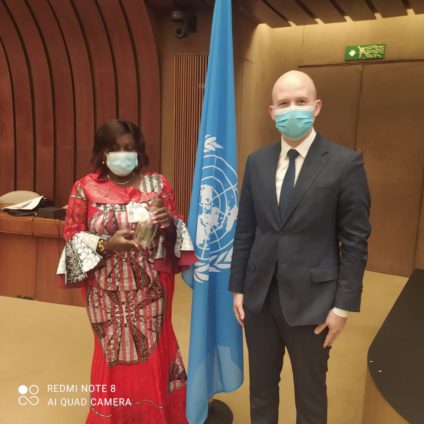
Minister for Sanitation and Water Resources, Cecilia Abena Dapaah has been sharing the success stories of the country’s transboundary water with neighbouring countries, to global stakeholders.
The Minister stressed that “Water has proven to be a catalyst for cooperation, fostering trust, and peace.
"We cannot take peace or our shared precious and fragile water resources for granted. The Water Convention is a vital instrument for managing and developing transboundary waters in peace and in trust”.
She made this statement at the ongoing 9th session of the meeting of parties to the convention on the protection and use of the transboundary watercourses and international lake (Water Convention) in Geneva, Switzerland.
The session, organised by the United Nations Economic Commission for Europe (UNECE) brought together more than 500 representatives of Ministries responsible for water, environment, foreign affairs and development cooperation and provided a platform for reviewing and accelerating progress towards achieving target 5 of the Sustainable development Goal 6.
Addressing a panel discussion on the role of the water convention in fostering peace, the Minister shared Ghana’s story on how trans-boundary water cooperation between Ghana and neighbouring countries has contributed to peace and sustainable development in the sub-region and why Ghana acceded to the Water Convention.
She explained that Ghana’s accession and implementation of the two International Water Conventions i.e., the 1992 Water Convention and the 1997 Water courses Convention has contributed immensely to peace and stability as well as sustainable development, especially in the Volta Basin – due to the fact that the country shares the trans-boundary Volta River Basin with five other riparian countries - Benin, Burkina Faso, Cote d’Ivoire, Mali and Togo.
A notable contribution of Ghana’s accession, she reiterated, is the sending of signals to her riparian neighbors and to international water actors, of the country’s willingness to cooperate and enhance trust in terms of good governance, support the implementation of obligations, especially that of prior notification of planned measures and actions that are aimed at prevention, control and reduction of significant impacts to other riparian States.
According to her, Ghana is balancing community-based practices and mechanisms in conflict resolution with international mechanisms for negotiation, mediation, arbitration, and other modes of conflict management in water resources at all levels, and is extending the design and implementation of her national water policies and strategies to cross-sectorial inter-linkages and inter-sectorial actors to sustain programmes and initiatives at the national and trans-boundary levels.
This she said, will promote trans-boundary cooperation and peace on water.
The Ghanaian population largely depends directly on the natural resource base of the Volta Basin, which provides substantial domestic water supply, hydropower, irrigation and industrial needs and produces significant socioeconomic interdependencies among the riparian countries.
Also, about 30% of Ghana’s freshwater flows from outside the country’s international borders, and these explain Ghana’s accession to the Water Convention.
The Minister has assured that the Government, led by President Akufo-Addo, has developed an Implementation Plan for the application of the Water Convention and its principles which provides key strategic actions and measures.
The focus is on strengthening the policy, regulatory and institutional frameworks for managing and protecting water resources, strengthening financing of water resources management to enhance trans-boundary cooperation and improving the knowledge base.
Latest Stories
-
Ablakwa receives Presidential Special Envoy on Reparations to advance global agenda
2 minutes -
Christina Koch becomes first woman to travel around the moon on Artemis II
12 minutes -
Epstein survivors’ calls to meet King Charles and Queen harder to ignore as US visit approaches
18 minutes -
UN Secretary-General names Ghana’s Anita Kiki Gbeho as South Sudan envoy
20 minutes -
Mali withdraws recognition of Sahrawi Republic, backs Morocco’s autonomy plan
24 minutes -
Gov’t distributes over 8,500 laptops to One Million Coders project
25 minutes -
Julius Debrah, ‘man to beat’ as NDC’s James Agbey dismisses Musah Dankwah’s polls
31 minutes -
GPRTU in Savannah Region to protest alleged eviction in Damongo
1 hour -
Re: Reinsurance does not replace process — A response to the SIGA–SIC defence
1 hour -
Gender Ministry supports Harriet Amuzu in ongoing abuse case
1 hour -
AG joins plaintiff to scrap OSP ?: We should be mindful of the mischief in this – Bobby Banson
2 hours -
Samson Lardy Anyenini questions willingness of Attorneys-General to prosecute political colleagues
2 hours -
It is only fair the OSP is heard in Supreme Court case – Bobby Banson
2 hours -
Asiedu Nketia resumes Ashanti tour, second leg kicks off on Sunday
2 hours -
NLA denies salary cut claims, threatens legal action over reports
2 hours