

Audio By Carbonatix
The Saudi authorities, I am told, are currently working flat out to collate everything they have on the Magdeburg market suspect, Taleb al-Abdulmohsen, and to share it with Germany's ongoing investigation "in every way possible".
Inside the imposing sand-coloured and fortress-like walls of the Saudi Ministry of Foreign Affairs in Riyadh there is a perhaps justifiable sense of pique.
The ministry previously warned the German government about al-Abdulmohsen's extremist views.
It sent four so-called "Notes Verbal", three of them to Germany's intelligence agencies and one to the foreign ministry in Berlin. There was, the Saudis say, no response.
Part of the explanation for this may lie in the fact that Taleb al-Abdulmohsen was granted asylum by Germany in 2016, one year after the former Chancellor Angela Merkel threw open her country's borders to let in more than a million migrants from the Middle East, and 10 years after al-Abdulmohsen had taken up residence in Germany.
Coming from a country where Islam is the only religion permitted to be practised in public, al-Abdulmohsen was a very unusual citizen.
He had turned his back on Islam, making himself a heretic in the eyes of many.
Born in the Saudi date palm oasis town of Hofuf in 1974, little is known about his early life before he decided to leave Saudi Arabia and move to Europe at age 32.
Active on social media, on his Twitter (later X) account he labels himself as both a psychiatrist and founder of a Saudi rights movement, together with the tag @SaudiExMuslims.
He founded a website aimed at helping Saudi women flee their country to Europe.
The Saudis say he was a people trafficker and the Ministry of Interior's investigators, the Mabaatheth, are said to have an extensive file on him.
There have been reports in recent years of dissident Saudis coming under hostile surveillance from Saudi government agents, in Canada, the US and in Germany.
There is no question that the German authorities, both federal and state, have made some serious errors of omission in the case of al-Abdulmohsen.
Whatever their reasons for not responding, as the Saudis claim, to the repeated warnings about his extremism, he was seemingly a danger to his adopted host country.
There is also, separately, the failure to close off, or at least guard, the emergency access route to Magdeburg Alter Markt that allowed him to allegedly drive his BMW into the crowds.
German authorities have defended the market's layout and said an investigation into the suspect's past is ongoing.
But a complicating factor here is that Saudi Arabia, although considered a friend and ally of the West, has a poor human rights record.
Until June 2018 Saudi women were forbidden to drive and even those women who publicly called for that ban to be lifted before then have been persecuted and imprisoned.
Saudi Arabia's Crown Prince Mohammed bin Salman, still only in his 30s, just, is immensely popular in his own country.
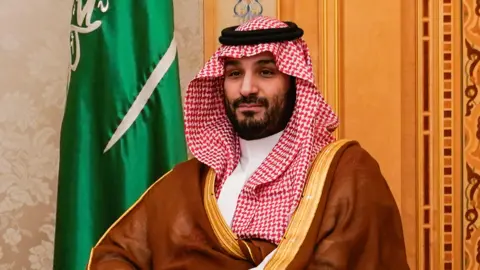
While Western leaders largely distanced themselves from him after his alleged involvement in the grisly murder of the Saudi dissident Jamal Khashoggi in 2018, which the crown prince denies, at home his star is still in the ascendant.
Under his de-facto rule, Saudi public life has transformed for the better, with men and women allowed to associate freely, and cinemas reopening, along with big, spectacular sports and entertainment events, even gigs performed by Western artists like David Guetta and the Black Eyed Peas.
But there is a paradox here.
While Saudi public life has flourished there has been a simultaneous crackdown on anything that even hints at more political or religious freedom.
Harsh prison sentences of 10 years or more have been handed down for simple tweets.
No one is permitted to even question the way the country is run.
It is against this backdrop that Germany appears to have dropped the ball with Taleb al-Abdulmohsen.
Latest Stories
-
LA 2028: Black Queens hold final training session ahead of second leg against Mauritius
9 minutes -
Standards are not Seasonal: What the EC appointments teach both sides
23 minutes -
King Mohammed VI urges private sector to create youth jobs and spread benefits of growth
24 minutes -
KGL U17 Colts 2026: Greater Accra win title after penalties win over Western Region
24 minutes -
UK Investment Roadshow opens in London to advance UK-Ghana growth partnership
35 minutes -
Assemblies of God requires pastors to resign before entering partisan politics – Rev. Wengam
45 minutes -
Ghana targets 20% annual reduction in maternal deaths – Health Minister
50 minutes -
Cyber attacks in Africa grow faster than global rate, report finds
52 minutes -
Ghana signs UAE deal to create 5,000 overseas jobs
59 minutes -
One Million Coders Programme targets 100,000 digital jobs in two years – Sam George
1 hour -
John Jinapor, Italian Ambassador explore opportunities for energy sector investment
1 hour -
NHIA seeks legal reforms to support Free Primary Healthcare
1 hour -
Beatrice Annan defends Afi Agbenyo’s EC appointment, cites record of gender advocacy
1 hour -
Ghana seeks investment deals in Bangkok amid global economic crises
1 hour -
IMF raises Ghana’s 2026 growth forecast to 5.7%, sees inflation falling to 4.8%
1 hour