

Audio By Carbonatix
For decades, heavy rainfall and climate change have been blamed for the devastating floods that repeatedly affect communities across Ghana. But some young environmental advocates believe the real problem begins long before the rains arrive.
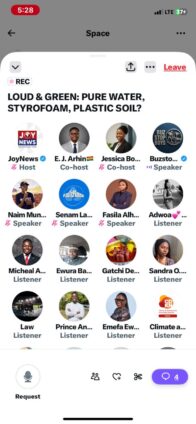
Speaking during the second edition of the Loud and Green XSpaces hosted on the JoyNews X platform, they argued that recurring floods are increasingly the result of human behaviour, poor waste management practices and weak environmental consciousness.
According to them, indiscriminate waste disposal, poor sanitation habits, and a growing dependence on single-use plastics have turned what should be manageable rainfall events into annual disasters that destroy homes, livelihoods and infrastructure.
For Heneba Koduah Saforo of Bus Stop Boys, the focus should not be on plastic itself but on how people dispose of it.
“Plastic is not the enemy for me. The enemy is the guy who drops it anywhere,” he said.
Mr Saforo argued that Ghana's flood challenges stem largely from attitudes towards the environment and a lack of sustained public education.
“If you look at everything we are talking about in terms of pollution today, it started from mindset. There was news about flooding in 1960, and we are still here today talking about flooding. We are not actually trying to delve into how exactly the mindset of the people is contributing to the persistent flooding issue,” he said.
He added that many Ghanaians continue to view sanitation and environmental protection as the sole responsibility of the government.
“In most cases, citizens feel it is only the responsibility of politicians or leaders who are supposed to fix everything. But we all have a common thing to build, and that is Ghana,” he stated.
His comments come weeks after heavy rains submerged parts of Accra and other communities, once again exposing longstanding challenges with drainage systems and waste management.
Youth climate advocate Fasila Alhassan said the impact of plastic pollution becomes evident whenever floods occur in her community of Aboabo.
“Whenever it rains and the place gets flooded, if you look at the surface of the water, the only thing you find are plastics,” she said.
She attributed the problem largely to the widespread use of disposable plastic products, including sachet water bags and plastic bottles.
“Plastics have become part of us. Everybody is using them. If we can encourage things that people can use over and over again, it will help reduce the number of plastics we have,” she noted.
National Geographic Society Young Explorer and Founder of the Ocean Harmony Project, Abdul Na-eem Muniru, warned that the consequences of plastic pollution go beyond flooding.
“Plastic pollution affects everywhere, ecosystems, wildlife, livelihoods, humans and the ocean,” he said.
According to him, plastics discarded on land often end up in rivers and oceans, where they pose a threat to marine life and eventually find their way back to humans through the food chain.
“When fish ingest plastics and humans consume them, those plastics eventually enter the human body,” he explained.
The advocates maintained that while climate change may increase the intensity of rainfall events, human actions often determine whether those rains result in disasters.
Their message was that tackling Ghana's flood crisis requires more than improving drainage infrastructure. It also demands a change in attitudes, stronger environmental education and greater individual responsibility for waste management.
As the country continues to grapple with recurring floods, they argue that the solution lies not only in responding to disasters but in addressing the behaviours that make communities vulnerable in the first place.
Latest Stories
-
Oil prices climb as traders weigh Saudi supply risk, Russian diesel flow
15 minutes -
Zimbabwean author denies using AI to write award-winning story
24 minutes -
Bank of America hit with $1.2bn fine for money laundering failings
33 minutes -
Robot seized by German police after allegedly groping teenage girl
44 minutes -
Subject EC appointment to ‘Akufo-Addo test’ – Kwapong
54 minutes -
English football’s independent regulator would quit over Man City interference
1 hour -
Anthropic seeks rehearing of case over Pentagon’s security risk branding
1 hour -
Torrential rains in Libya’s Tripoli kill two
2 hours -
Guinea-Bissau says it has not approved hepatitis B vaccine trial in newborns
2 hours -
NDC Deputy National Organizer Aspirant Hamza Umar targets grassroots mobilisation
2 hours -
Partisan appointment cycle will persist without meaningful reforms – Osae-Kwapong
3 hours -
‘This cycle is not going to be broken any soon’ – Osae-Kwapong on partisan appointments
3 hours -
Partisan appointments won’t help restore trust in EC – Osae-Kwapong
4 hours -
Villarreal fight back to beat Napoli and end losing run
4 hours -
Tresoldi nets hat-trick as Club Brugge win Inter thriller
4 hours