

Audio By Carbonatix
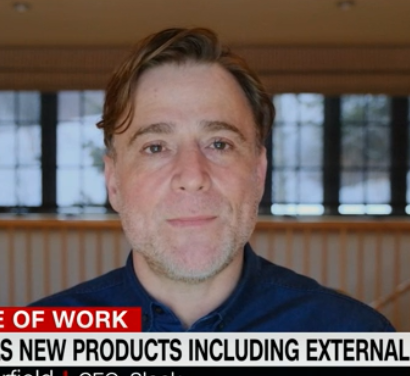
Slack CEO Stewart Butterfield knows he screwed up.
Slack rolled out a feature to let customers message Slack users at other companies. After a host of complaints, Slack made changes Wednesday afternoon.
Customers noted that the new system, called Slack Connected, could be used to send unsolicited DMs and perhaps even abusive emails.
First Move's Julia Chatterley spoke to Butterfield Thursday.
Butterfield: The announcement yesterday was making it easier for people to send direct messages outside of shared channels. There was a lot of confusion. There was an unforced error on our part of how the communication system worked and that was confused with the ability to send the messages themselves.
It's a double opt-in on both sides, and people have complete control over who is able to message them. So it's actually a pretty big step up from things like text messages, WhatsApp, email and so on.
Could a client replace email entirely and just use Slack to communicate?
Butterfield: Absolutely. To be clear, you can't get rid of email entirely, and we have no intention to do that because it serves many purposes, but that's the downfall in internal communication. But there's many -- probably thousands of organizations that don't use email for internal communication.
But of course, they still have to use it for getting receipts from online purchases and resetting passwords and receiving calendar invites and other stuff.
Emails remain incredibly vulnerable if they're hacked. Is this another argument for perhaps a system like Slack as an alternative?
Butterfield: Well, we're a pretty big target. We have an incredible security team and many active programs that, you know, work to prevent that.
We work with governments in 20 different countries and large financial service firms and customers and we're often chosen on the basis of the increasing security. Email has the virtue of being a system that anyone can use, but it's a much harder system to control.
There's problems with phishing and spam, and I think email is useful and will continue to be used probably for tens of thousands of years at this point. In that open and decentralized way, but where you have control and you have a choice to communicate that's the internal case, people are much better choosing a tool like Slack.
The sheer percentage of companies within some of the biggest indexes in the world are using your services and paying for it. How high can these percentages get? What's the ambition?
Butterfield: I think we can get to 100%. I mean -- I'm not sure we are for the US. Maybe 70% of the Fortune 100, but it's not just used by 156,000 businesses around the world, and obviously there's, you know, 500 in this index and 100 in this index, and 156,000 is a much larger number.
That includes all kinds of businesses. It includes people operating small retail store of, you know, plumbers, repairmen, but also the biggest issuer of credit cards in the US, and the largest contract. And you're right to point out the international growth though because we had revenue growth this year.
Fantastic result, but if you look at France for example, it's 49%. If you look at Japan, it was 76%, and looking at the growth of customers, it was the leading indicator of revenue in the future, much bigger numbers. Australia: 93%, UK was 94%, and Germany was 94%.
Latest Stories
-
Innovative Teachers threatens legal action over exclusion from Collective Bargaining Agreement negotiations
5 minutes -
17-member committee formed to address concerns over Adipa landfill
8 minutes -
Team Volta wins NPA 2026 Staff Welfare Week Quiz
20 minutes -
Team Eternity Ghana releases new album “The Promise – Phase 1”
24 minutes -
Inside the human genome: Why scientists are still discovering who we are
27 minutes -
PAC grills Central Regional Coordinating Council over GH¢14.9m payments processed outside GIFMIS
35 minutes -
Ghana’s industrial dream at risk? How the Yuan policy could deepen China dependence
36 minutes -
Teachers’ strike: Government has funds, but processes are causing delays – Education Committee Vice Chair
42 minutes -
Afenyo-Markin urges Christian Council to intervene over arrests linked to free speech
42 minutes -
GCB Bank urges MSMEs to formalise businesses for easier access to finance
43 minutes -
Criminal cases must be tried in ordinary courts – Prof. Oquaye opposes tribunals
44 minutes -
Ghana, India sign MoUs to deepen cooperation in agriculture, healthcare, railways and ICT
1 hour -
Pete Edochie becomes first Pan-African honouree of Ghana’s Legacy Project
1 hour -
GCB MSME Caravan Clinic unfolds in Accra, boosting support for Ghanaian small businesses
1 hour -
AMA urged to crack down on unauthorised billboards in Accra
1 hour