

Audio By Carbonatix
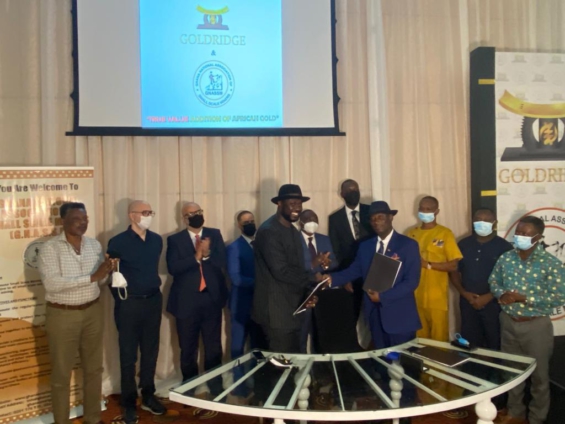
Goldridge Ghana Limited (Goldridge) and the Ghana National Association of Small-Scale Miners (GNASSM) signed an agreement aimed at bringing Ghanaian small-scale mined gold to international markets.
Under the agreement and working in collaboration with local and international experts, Goldridge and GNASSM will provide support to small-scale gold miners to formalize their activities and adopt internationally recognized responsible mining practices.
In addition, Goldridge will provide equipment for miners to operate in an environmentally-friendly way while increasing their productivity and production volumes, and will also facilitate access to finance.
GNASSM members who decide to take advantage of the Program under the Agreement will, in return, channel their gold to the Goldridge refinery.
The Ghanaian gold trading and export will then export the refined gold to legal international markets.
Ghana has produced and exported gold for centuries. It is the largest gold producer in Africa and the seventh-largest in the world (142T annual production in 2020).
Artisanal and small-scale mined gold accounts for an estimated 40 per cent of Ghana’s total gold production, 70 to 80 per cent of which is informal, or not produced to internationally-recognised responsible standards.
This means thousands of miners producing an estimated 45tons of Ghana’s gold cannot access global markets and sell their gold at international market prices.
“Ghana has a population of hard-working and highly-skilled miners,” says Mr Akufo , GNASSM President.
“The GNASSM’s membership comprise close to 2,000 mining operations, involving an estimated 1.8 million individual miners in total. They are all willing to further improve their practices so they can access international markets under fair conditions, and improve their working conditions and livelihood.
"But they lack access to training, equipment and finance and this is what we are going to provide them through the Program. GNASSM is thrilled to partner with Goldridge. Dr Sledge is highly respected by miners, governments and Ghanaian institutions.
He brings leadership, the vision to transform the sector and the means to make it happen. Already many non-members are looking to join the Association to enrol in the Program. This is going to be transformational.”
Goldridge is already actively involved in Small-Scale Gold Mining (SSGM) sourcing from more than 5 mines in Western Region, and has been named as ‘Ambassador for zero mercury in gold mining in Ghana and Across Africa.
“All Ghana gold miners deserve to be recognized and receive fair pay,” comments Dr.Sledge Duodu , Founder and CEO of of Goldridge.
“I have made it Goldridge’s mission to unlock the full value of our gold sector through driving formalisation of mining operations, responsible practices, propelling in-country refining and accessing global markets. The signature of this agreement paves the way to the realisation of this important transformation.
"Together with GNASSM, we have set up the perfect partnership where the Association brings the miners and Goldridge brings the means to set up the entire value chain.”
A key component of the Program is the refining in-country of the gold produced by the miners. To this end, Goldridge is setting up the first wholly owned Ghanaian refinery.
The state-of-the-art plant, due to start operation in the first half of 2022 and to meet international environmental refining standards, and produce finished products of 999.9 purity.
“Goldridge is taking a lead role in Ghana’s transition from raw gold producer to refined gold producer,” says Dr Sledge.
“This is a key component for the country to fully benefit from its precious resources.”
Underpinning the Agreement and the Program is traceability and due diligence system from the mine site to the global market that the partners are developing according to international standards, and with which the miners and Goldridge will have to comply.
“Each and every single one of the Program’s components is crucial to its success: formalisation; responsible mining practices; due diligence; traceability; in-country refining; and export to global markets, all up to internationally recognized standards.” comments Dr Sledge.
“If one component is missing or not up to standard, the value chain cannot be recognised internationally and fails. When it all works, it will fully benefit gold miners and their communities.
"The SSGM will become a significant contributor to Ghana’s socio-economic development, and the country will reap the full value of its precious resources.”
Latest Stories
-
ICU urges GHABA members to transform hairdressing skills into sustainable enterprises
12 minutes -
Ghana eyes stronger trade ties as Australia hosts multicultural trade and investment forum
21 minutes -
Margaret-Marie Krakue
24 minutes -
Ayariga announces plans for live broadcast of MMDAs’ meetings on local radio stations
27 minutes -
Mrs Anna Tackie
29 minutes -
Ghana links Afghan heroin and Brazilian cocaine to global drug markets – Global Organised Crime Index
36 minutes -
NHIA launches nationwide inter-school quiz to deepen students’ knowledge of NHIS
43 minutes -
Political protection could be masking Ghana’s cocaine trade – Global Organised Crime Index
48 minutes -
AFCON 2027Q: ‘We have to dissolve the GFA’ – Effia MP after Black Stars lose to Gambia
50 minutes -
NPP announces voting schedule and ID requirements for October 3 national elections
52 minutes -
Lupus can mimic HIV symptoms and damage kidneys if untreated – KNUST expert
55 minutes -
Focus on Sickle Cell Foundation seeks to introduce sickle cell education through comics in Ghanaian schools
1 hour -
NPP rewrites the campaign playbok as opposition reality shapes National Executive contest
1 hour -
Road safety education will fail without enforcement – NRSA boss
1 hour -
Daily Insight for CEOs: Finishing Q3 strong and entering Q4 with purpose
1 hour