

Audio By Carbonatix
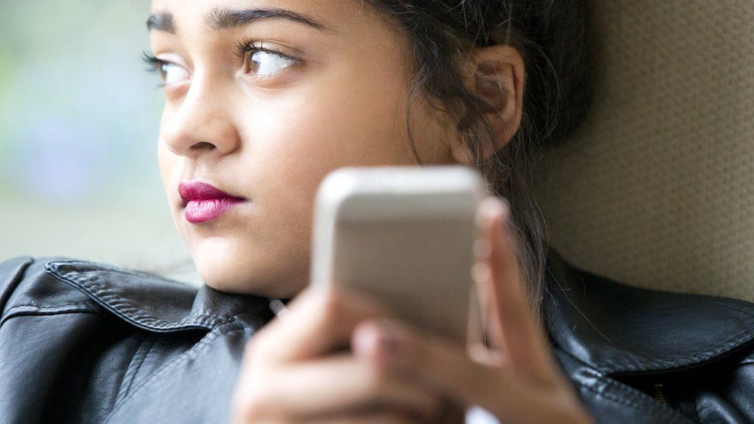
Teenagers' mental health is being damaged by heavy social media use, a report has found.
Research from the Education Policy Institute and The Prince's Trust said wellbeing and self-esteem were similar in all children of primary school age.
Boys and girls' wellbeing is affected at the age of 14, but girls' mental health drops more after that, it found.
A lack of exercise is another contributing factor - exacerbated by the pandemic, the study said.
According to the research:
- One in three girls was unhappy with their personal appearance by the age of 14, compared with one in seven at the end of primary school
- The number of young people with probable mental illness has risen to one in six, up from one in nine in 2017
- Boys in the bottom set at primary school had lower self-esteem at 14 than their peers
The wellbeing of both genders fell during adolescence, with girls experiencing a greater decline, the report said.
However, it recognised that girls' self-esteem and wellbeing stabilises as they move into their late teens, whereas it continues to drop for boys.
'Solace or community'
Heavy social media use was linked to negative wellbeing and self-esteem, regardless of a young person's mental state, with more girls experiencing feelings of depression and hopelessness.
“Those who feel worse may turn to social media for solace or community,” Dr Amy Orben, research fellow at Emmanuel College, University of Cambridge, said of the research.
“It’s not a vacuum, it works both ways."
The research uses data from 5,000 young people in England from the Millennium Cohort Study.
Focus groups were also carried out in November to examine the effect of the coronavirus pandemic on these ages.
Family income, exercise and poor maternal health also contributed to young people’s mental state, the study found.
But regular exercise had a positive impact on both genders, the report said.
“Participation in activities and sports will have fallen considerably due to school closures and lockdown, likely adversely affecting mental health and wellbeing,” it added.
It also made several recommendations, including a £650m package to schools for wellbeing funding after the pandemic and an increase in mental health teaching in schools.
Young people should also have better access to resources for mental health support and physical activity, it said.
“The transition from childhood to adolescence can be turbulent, and the findings of this report underline why addressing and supporting young people’s mental health will only become more crucial as the impact of the pandemic unfolds,” said Jonathan Townsend, UK chief executive of The Prince’s Trust.
“Young people are among the hardest hit by the pandemic, so it is more important than ever that they can access support with their mental health during this critical time in their lives.”
Latest Stories
-
WAFU Zone B: Black Starlets seal semifinal place with 3-1 win over Benin
5 minutes -
Kaizen as a strategic pathway for micro business scale-up in Ghana
18 minutes -
Minister orders suspension of Obuasi SHS headmaster over alleged sexual misconduct following JoyNews investigation
22 minutes -
Over 38,000 commercial, 150,000 residential customers unbilled – Ghana Water MD
51 minutes -
Several injured as Sprinter bus collides with ‘trotro’ at Odorkor
52 minutes -
Ghana records progress on reparatory justice agenda – Ablakwa
1 hour -
Mahama commissions Christian Tetteh Yohuno Ward Complex at Police Hospital
1 hour -
Vice President calls for wider access to Ghana’s political party histories
1 hour -
Republic Bank JoyNews Habitat Fair to connect prospective homeowners with exhibitors in Ho from October 16 to 18
2 hours -
Obaasima Summit: ‘AI is not a spiritual attack’ — Rev. Dr. Ofori-Boateng urges young women to embrace technology
2 hours -
GHS to distribute 80,000 pairs of locally-made protective footwear to health workers
2 hours -
GoldBod boosts local jobs as 90% of gold undergoes refining in Ghana – Sammy Gyamfi
2 hours -
The search for the politically unblemished: Are we asking the impossible of public appointees?
2 hours -
Ghana seeks climate finance access for debt-restructuring countries
2 hours -
Afenyo-Markin urges stronger media scrutiny of public institutions
2 hours