

Audio By Carbonatix
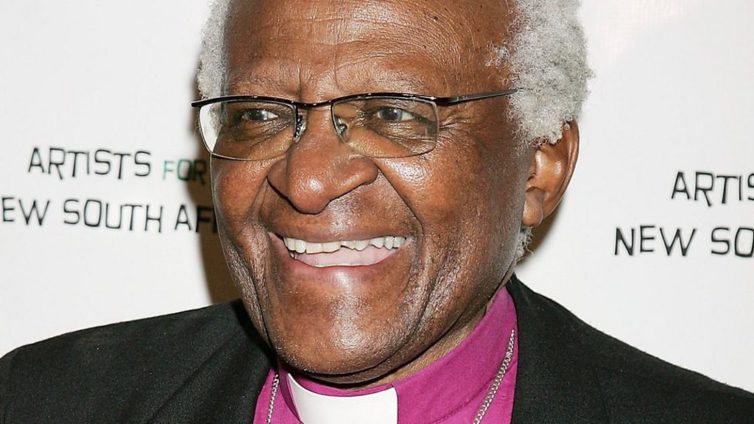
South Africa is holding a week of events to mark the passing of the anti-apartheid leader Archbishop Desmond Tutu, who died on Sunday aged 90.
The plans include two days of lying in state before an official state funeral on 1 January in Cape Town.
Tributes have been pouring in from leaders around the world, including Queen Elizabeth II, US President Joe Biden and Pope Francis.
Tutu was one of the country's best-known figures at home and abroad.
South African President Cyril Ramaphosa said in a statement that Tutu had helped bring about "a liberated South Africa".
A contemporary of Nelson Mandela, Tutu was awarded the Nobel Peace Prize in 1984 for his role in the struggle to abolish the apartheid system enforced by the white minority government against the black majority in South Africa from 1948-91.
On Sunday, South Africans of all ages and backgrounds stopped by Cape Town's St George's Cathedral to lay flowers and pay tribute to the country's national hero.
"His significance supersedes the boundaries of being an Anglican," mourner Brent Goliath told AFP news agency, breaking down in tears.
"I was very emotional this morning when I heard that he'd passed away. I thank God that he has been there for us," Mr Goliath said, adding that he had met Tutu several times.
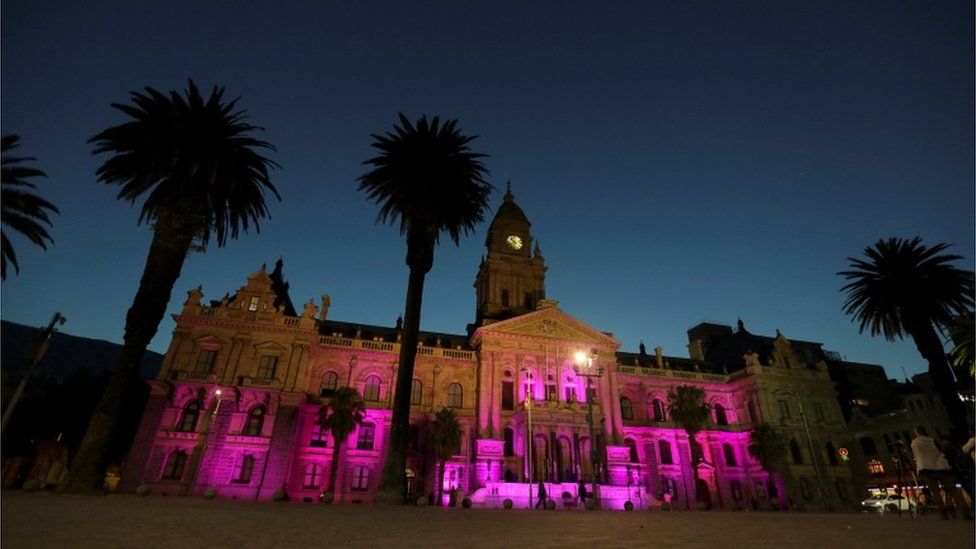
World leaders from across the globe have also paid tribute.
President Biden said he was "heartbroken to learn of the passing of a true servant of God and of the people", adding that Tutu's "legacy transcends borders and will echo through the ages".
Former US President Barack Obama meanwhile described Tutu as "a mentor, friend and moral compass".
In a message of condolence, Queen Elizabeth II said she remembered with fondness her meetings with him, and his great warmth and humour.
"Archbishop Tutu's loss will be felt by the people of South Africa and by so many people in Great Britain, Northern Ireland and across the Commonwealth, where he was held in such high affection and esteem."
The Vatican said in a statement that Pope Francis offered "heartfelt condolences to his family and loved ones".
"Mindful of his service to the gospel through the promotion of racial equality and reconciliation in his native South Africa, his holiness commends his soul to the loving mercy of almighty God."
The Nelson Mandela Foundation said Tutu's "contributions to struggles against injustice, locally and globally, are matched only by the depth of his thinking about the making of liberatory futures for human societies".
"He was an extraordinary human being. A thinker. A leader. A shepherd."
Tutu's death comes just weeks after that of South Africa's last apartheid-era president, FW de Klerk, who died at the age of 85.
Known affectionately as The Arch, Tutu was instantly recognisable, with his purple clerical robes, cheery demeanour and almost constant smile.
He was not afraid to show his emotions in public, including memorably laughing and dancing at the opening ceremony of the football World Cup in South Africa in 2010.
Despite his popularity, though, he was not a man who was loved by all. He was very critical of the African National Congress (ANC) government in the post-apartheid era, when, at times, he felt it was misrepresenting South Africa - even warning in 2011 that he would pray for its downfall over a cancelled visit by the Dalai Lama.
In response, the national police commissioner Gen Bheki Cele told Tutu to "go home and shut up".
"He is not a vice-Jesus Christ," he said.
Ordained as a priest in 1960, Tutu went on to serve as bishop of Lesotho from 1976-78, assistant bishop of Johannesburg and rector of a parish in Soweto. He became Bishop of Johannesburg in 1985 and was appointed the first black Archbishop of Cape Town the following year. He used his high-profile role to speak out against oppression of black people in his home country, always saying his motives were religious and not political.
After Mandela became South Africa's first black president in 1994, Tutu was appointed by him to a Truth and Reconciliation Commission set up to investigate crimes committed by both whites and blacks during the apartheid era.
He was also credited with coining the term Rainbow Nation to describe the ethnic mix of post-apartheid South Africa, but in his latter years he expressed regret that the nation had not coalesced in the way in which he had dreamt.
Latest Stories
-
From despair to dance: Family of nurse Salomey Baffoe rejoices after GH¢100k bail granted
57 minutes -
Kejetia Phase III pricing talks loom as government moves to restart stalled works
2 hours -
Nchiraa Yam festival: Two killed, 14 injured as police restore calm
2 hours -
I draw inspiration for my songs from Reggae music – Lyrical Joe
2 hours -
AI must not replace human judgment in public spending – BoG Governor
2 hours -
Ghana should withdraw from 2027 AFCON – Kojo Addae Mensah
2 hours -
Team Ghana departs Accra for Angola ahead of Karting Africa Trophy
2 hours -
AIT President Prof Clement Dzidonu urges lifelong learning as AI reshapes work and education
2 hours -
FWSC to meet striking teacher unions on Tuesday
2 hours -
NPP won’t force candidates to step down – Miracles Aboagye
2 hours -
Black Stars: Building in the sinking sands
2 hours -
Low inflation on paper, high cost of living: How Presidents Mahama and Trump are facing stark economic reality
2 hours -
NPP will negotiate with popular non-politicians to secure winnable candidates – Miracles Aboagye
3 hours -
Only 5% of Ghanaians can afford housing without support – Gov’t
3 hours -
Nigeria launches rescue after military plane crashes with 32 aboard
3 hours