

Audio By Carbonatix
An impending September 30 deadline issued by an anti-immigration movement has ignited profound anxiety across migrant communities in South Africa. The group, known as March and March, has spearheaded protests throughout the year demanding that undocumented foreign nationals leave the country.
Organisers warn of further demonstrations if their demands remain unmet. For many refugees, however, official paperwork provides little solace. The hostility unfolding on the streets rarely begins with a request for identification documents. Instead, foreign nationals find themselves caught in a climate of escalating fear as the nation approaches local government elections.
Pavement Lives and Desperate Conditions
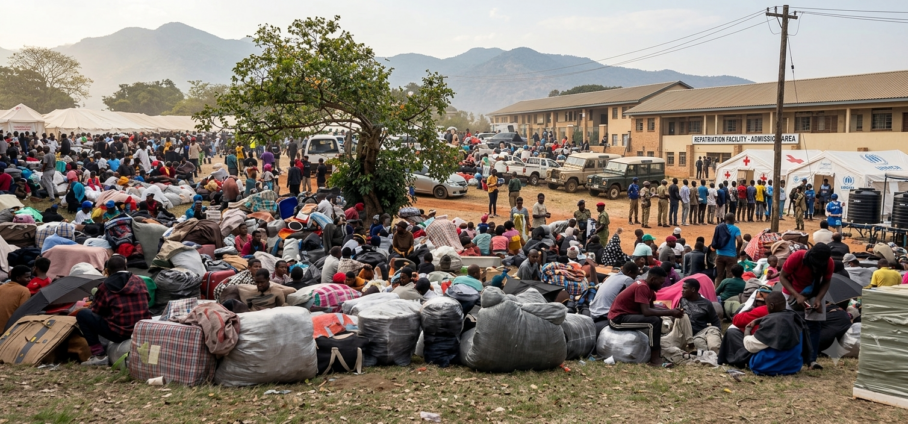
For months, hundreds of asylum seekers and refugees occupied the pavement outside the Durban Refugee Reception Centre on Che Guevara Road. Fleeing violence in nations such as the Democratic Republic of the Congo, Burundi, Uganda, Mozambique, and Tanzania, they sought sanctuary near the Department of Home Affairs. Instead, the street became their home. Men, women, and children spent roughly four months exposed to the elements, relying entirely on volunteers and civil society organisations for necessities. Conditions quickly deteriorated into a desperate struggle for survival. Migrants reported irregular access to food and necessary medication, alongside tragedy when a man suffering from tuberculosis died at the encampment.
"It has been very tough," Bahebwa said. "Never before have I experienced something like this."
The camp offered no immunity from the hostility its residents hoped to escape. On September 3, members of March and March confronted the refugees living outside the centre. Violence erupted, prompting police intervention that left at least four people injured. Subsequent protests saw police officers form physical human barriers between opposing groups. March and March frames its mobilization as a campaign against crime, deteriorating community conditions, and insufficient government enforcement of immigration laws. Leaders repeatedly reject accusations of xenophobia, insisting their sole target is undocumented migration. Yet refugees report that documented status offers no protection. Earlier this year, six refugee salon workers near Warwick Street Market were beaten with sticks, sending two to the hospital. Allegations of police inaction compounded their isolation.
"Police said we can't open cases because we are foreigners. We had nowhere to go," Bahebwa alleged.
Relocation Realities and Historical Echoes
In mid-September, authorities cleared the makeshift Durban camp, presenting residents with stark choices. They could return to neighborhoods they previously fled or accept temporary placement at the Lindela facility in Gauteng. Located hundreds of kilometres away, Lindela is a government-run immigration detention center historically utilized for repatriation. While some feared detention, others felt they could no longer endure life on the pavement. On September 15, authorities transported 274 individuals by bus to Lindela, while roughly 150 others remained in Durban to seek alternative shelter.
Leaving the street failed to resolve underlying safety concerns. Kafuti Muyumba, a Congolese small business owner and community representative, noted that returning to previous neighborhoods remains terrifying.
People are afraid, he said. "Even the police allow March and March violence. They came with sticks and say we are attacking them."
Muyumba noted that many refugees lost their livelihoods during months of upheaval. He linked current tensions to painful historical precedents, recalling deadly xenophobic outbreaks in 2008 and 2015 that displaced thousands. Distrust of local law enforcement runs deep among community members who feel abandoned by authorities.
"We don't trust the police. They are not being fair with us. Some of them are also saying we must go," he said.
While police maintain that normal policing approaches remain unchanged and protesters must obey the law, refugees argue that returning to their countries of origin is impossible. For Congolese refugees, ongoing conflict at home eliminates repatriation as a viable option.
"There is still war there," Muyumba said.
State Enforcement and Looming Anxieties
In response to sustained public pressure, the South African government intensified immigration enforcement operations. Between June 14 and August 20, authorities processed 86,596 foreign nationals for deportation and repatriation through the Inter-Ministerial Committee on Migration. Malawians constituted the largest group, followed by Zimbabweans and Mozambicans. Government figures indicate that 90 percent of those repatriated entered illegally, with 95 percent crossing outside official border ports. Officials stress these actions reflect broader efforts to strengthen border management while repeatedly warning private citizens against taking law enforcement into their own hands. The state maintains that common citizens possess no legal authority to deport anyone, rendering the September 30 deadline legally void.
Despite lacking legal force, deadlines carry psychological weight and generate widespread panic. Bishop Raphael Bahebwa, who has lived in South Africa for 26 years after arriving as a refugee from the DRC, now lives in hiding. Having witnessed anti-foreigner sentiment flare repeatedly over more than a quarter of a century, he believes the current political climate surrounding local government elections makes this year distinct.
"I am in hiding now because they say they are going to kill me for speaking about the rights of foreigners," he noted.
As the September 30 deadline arrives, migrants face deep uncertainty. Some reside hundreds of kilometres away in detention facilities, while others navigate precarious housing in communities they once fled. For Bahebwa and countless others, the core anxiety remains unchanged.
"They are scapegoating us as foreigners," he said. "It is not going to end on September 30. It has to do with the elections."
Balancing structural pressures against fundamental human rights principles, independent observers note that navigating this complex social friction requires sustained institutional accountability and active community dialogue to protect vulnerable populations from political exploitation.
Latest Stories
-
The fight against terrorism requires regional and international cooperation – Mahama
10 minutes -
Refugees in South Africa face mounting tensions as September 30 deadline looms
41 minutes -
At least 12 dead, dozens missing after vessel capsizes in DR Congo
45 minutes -
Two dead, 14 rescued after accident on Kpetoe-Sarakope road
1 hour -
AFCON 2027Q: Moroccan referee Mustapha Kechchaf to officiate Ghana-Gambia match
1 hour -
Our mental health is restored – How Medical Trust Fund is giving doctors hope again
1 hour -
2027 budget to provide for grain silos – Agric Minister
1 hour -
Damongo Communique: Democracy Not For Sale
1 hour -
Yusif Sulemana pushes community benefits, national systems in Global Forest Finance Debate
2 hours -
Todays Front pages: Monday, September 28, 2026
2 hours -
WAFU B U-17 Girls Cup: Black Maidens finish tournament with 4-0 win over Cote d’Ivoire
2 hours -
2026 Women’s Super Cup: FC Savannah to face Epiphany Warriors in final on September 29
2 hours -
Ghana’s second chance: How President Mahama’s return offers historic opportunity for transformation
2 hours -
AFCON 2027Q: Alexander Djiku ruled out of clash against Gambia
2 hours -
RCI Immanuel Temple donates supplies to Motherly Love Orphanage
3 hours