


Audio By Carbonatix
Issued by the Democracy Not for Sale Project (Impact Makers Foundation, in partnership with Joy News/Multimedia Group) Savannah Regional Coordinating Council, Damongo — Friday, September 25, 2026
Preamble
On Friday, September 25, 2026, the Democracy Not for Sale project convened its Joy News-hosted third regional dialogue at the Savannah Regional Coordinating Council in Damongo, the fifth regional dialogue held under the project overall, alongside two further editions separately hosted by Adom. The forum brought together the security services, academia, traditional authority, civic education, and local government, alongside a large and highly engaged public audience, to examine the growing influence of money in Ghana’s democratic processes. It was organised by the Impact Makers Foundation in partnership with Joy News and the Multimedia Group.
The dialogue was grounded in field survey data gathered by a research team across the Damongo area, drawing on more than 90 interactions and 55 structured respondent interviews, well above the region’s calculated ideal sample of 36, derived from the project’s national target of 1,600 respondents across 10 regions at a 95% confidence level and a margin of error of ±2.45%. This communiqué sets out, in full, the findings presented and the recommendations that emerged from the dialogue.
Survey Findings
Respondents were 60% female and 40% male, the first female-majority sample recorded under the project, with the most evenly spread age profile recorded to date: 32.5% were aged 26–35, 25% were 18–25, 22.5% were 36–50, and 20% were 51 and above.
Awareness of Vote Buying
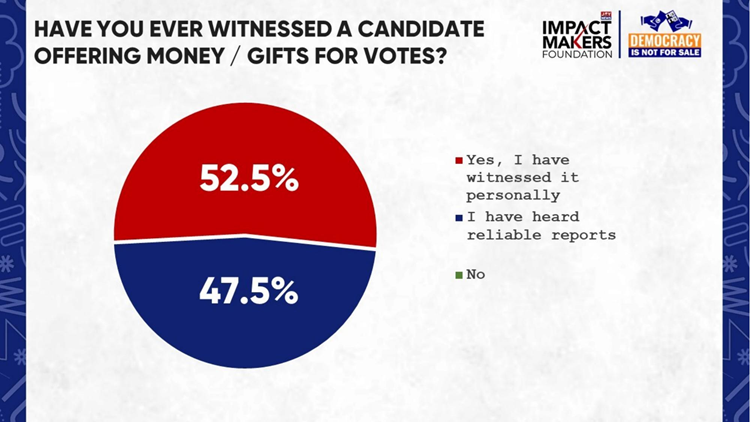
Damongo recorded the first fully saturated awareness result under the Democracy Not for Sale project: every single respondent had either personally witnessed or credibly heard of vote buying, with 0% reporting no awareness at all, a first, as every other region surveyed to date has recorded at least a small share with no awareness. 52.5% of respondents said they had personally witnessed a candidate offering money or gifts for votes, and 47.5% had heard credible reports.
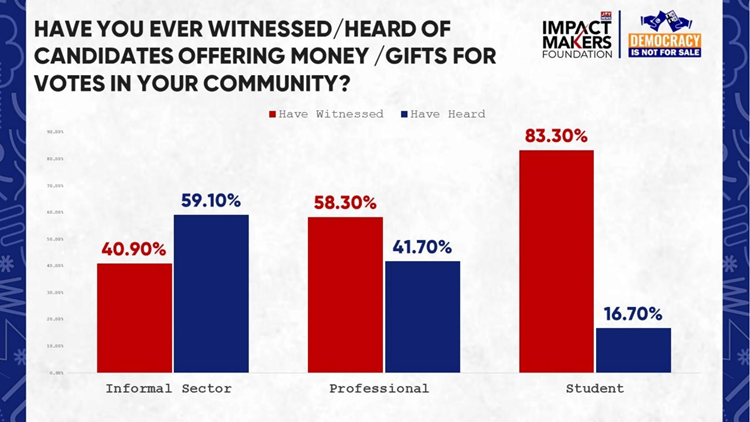
By occupational group, students recorded the highest personal-witness rate of any group in any region surveyed under the project: 83.3%, with the remaining 16.7% having heard reliable reports. Professionals reported 58.3% personal witness and 41.7% reliable reports; the informal sector reported 40.9% and 59.1% respectively. No occupational group reported any respondents with zero awareness.
Money’s Perceived Influence — A Reversed Age Pattern
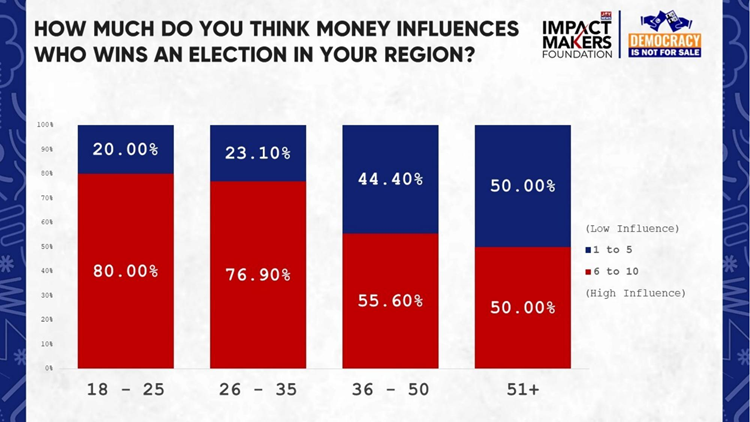
Damongo produced the inverse of the age pattern seen in other regions. 80% of 18–25 year-olds rated money’s influence on election outcomes as high (6–10) — the highest of any age group — followed by 76.9% among 26–35 year-olds, then declining to 55.6% among 36–50 year-olds and 50% among those 51 and above. Elsewhere under the project, older respondents have generally been the most convinced that money determines outcomes; in Damongo, it is the youngest who are most convinced.
Willingness to Vote on Ideas Over Money
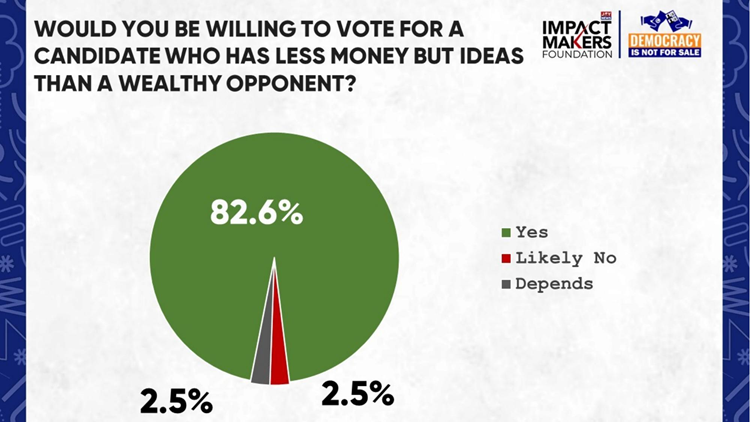
82.6% of respondents said they would vote for a candidate with fewer resources but better ideas over a wealthier opponent. This was most uniform among younger respondents: 100% of both 18–25 and 26–35 year-olds said yes, against 88.9% of 36–50 year-olds and 87.5% of those 51 and above. Damongo’s youngest respondents thus hold two views at once: the strongest belief that money currently decides elections, and, together with 26–35 year-olds, the strongest and most unanimous stated preference for voting on ideas instead.
Sources of Political Financing
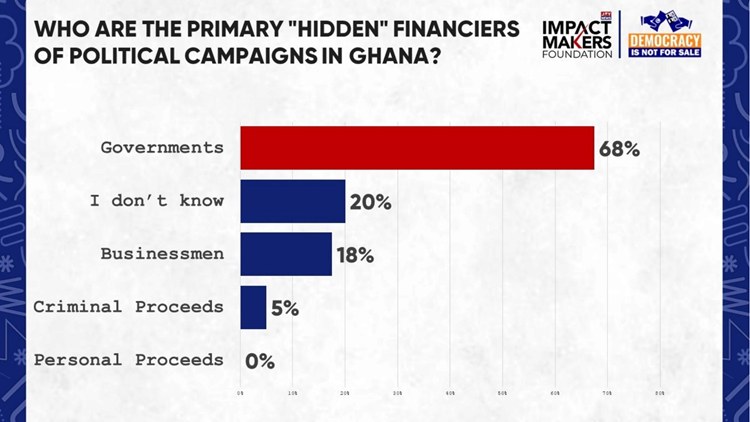
68% of respondents identified government resources in the research team’s framing, taxes citizens themselves pay as the primary hidden financier of political campaigns, ahead of businessmen (18%) and criminal proceeds (5%, explained on air as a money-laundering channel for illicit actors). 20% said they did not know the source but would accept the money regardless. No respondents cited politicians’ personal savings.
Confidence in Existing Laws
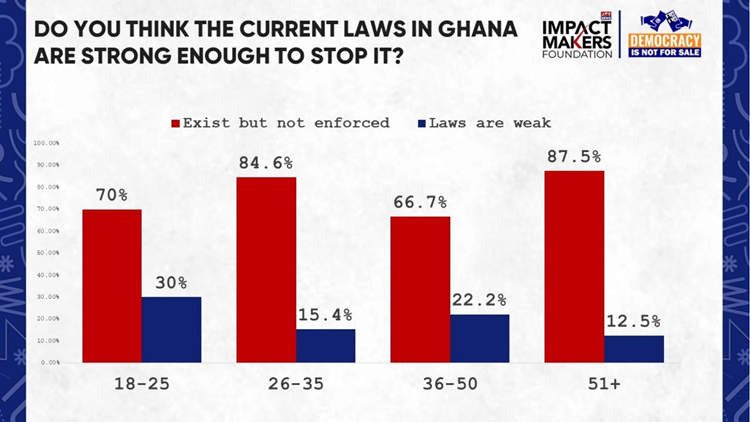
Across every age group, the dominant view was that laws exist but are not enforced, rather than that the laws themselves are weak: 70% among 18–25 year-olds, 84.6% among 26–35 year-olds, 66.7% among 36–50 year-olds, and 87.5% among those 51 and above.
Preferred Remedies — A Different Ranking
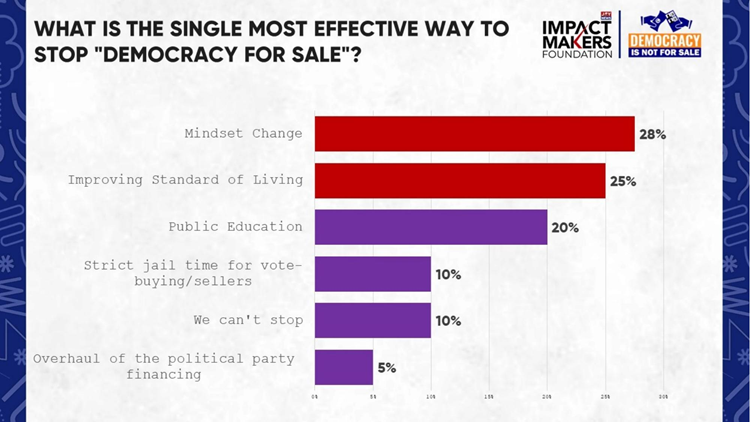
Unlike every other region surveyed, where strict jail time for vote-buyers and vote-sellers has led the ranking of preferred remedies, Damongo respondents ranked mindset change first (28%), followed by improving standard of living (25%) and public education (20%). Strict jail time was cited by only 10% tied with the 10% who said the practice cannot be stopped at all, with a further 5% calling for an overhaul of political party financing.
Taken together, Damongo marks several firsts for the project: full awareness saturation, a female-majority sample, a reversed age pattern on money’s perceived influence, and a public whose preferred remedy is cultural and attitudinal change rather than legal punishment.
The Dialogue
The panel comprised Superintendent Francis Ekoh (District Commander, Damongo, Ghana Police Service); ASP Michael Adjei (Regional Operations Director, Savannah Region, Ghana Police Service); ASP Emmanuel Frimpong (District Crime Officer, Ghana Police Service); Professor Adams Sulemana Achanso (Associate Professor, Department of Development Management and Policy Studies, University for Development Studies, and a three-time parliamentary aspirant); Alijata Haruna (Queen Mother of Damongo Traditional Area); and Issaka Zetor (NCCE Director, Savannah Region). The Savannah Regional Minister, Salisu Be-Awuribe, and Victor Wonder Kutor, a leading NDC party official, also addressed the forum.
A Region That No Longer Sees Vote Buying as Misconduct
The dominant theme of the evening was that many respondents who described receiving money, cloth, sewing machines, or hair dryers from politicians did not classify it as vote buying at all. A widow interviewed at the market described cloth and a sewing machine for her daughter as ordinary help; a woman who travels from Techiman to vote in Damongo described cash, cloth, and a hair dryer as gestures of thanks. Multiple audience members said they had never demanded money from a politician, while separately acknowledging they would accept it if offered.
Professor Achanso, drawing on three of his own parliamentary campaigns, linked this to a long-standing cultural practice of gift-giving tied to courtship and social obligation and to a genuine public ambiguity about where legitimate constituency support ends and vote buying begins, an ambiguity he said leaves citizens unable to recognise the practice even as it happens to them.
Law, Evidence, and the Case No One Reports
Regional Minister Salisu Be-Awuribe cited Section 33 of PNDC Law 284 (as amended), which criminalises inducing a vote through money or gifts regardless of amount, but acknowledged the law’s practical application remains genuinely contested: politicians, police, and the public alike struggle to distinguish inducement from customary courtesy or gratitude.
ASP Michael Adjei and ASP Emmanuel Frimpong said neither had received a single formal vote-buying complaint in the district despite widespread public acknowledgement that the practice is common, explaining that police cannot investigate what is never reported, and that prosecution requires evidence sufficient to prove guilt beyond reasonable doubt, difficult when giver and receiver share an interest in silence. ASP Michael Adjei urged citizens to preserve and report mobile money transfer records from politicians as a concrete, traceable starting point for investigation. An audience member pressed the panel on why no prosecutions have followed widely publicised cases, including a reported GHS 700-per-delegate primary payment and a reported distribution of television sets to delegates by a parliamentary aspirant, surfacing a tension between the panel’s insistence that the law is adequate on paper and the audience’s experience that it is essentially unenforced.
Poverty and the Demand Side
An assembly member representing Canteen electoral area cited 2021 census data showing poverty near 50% and youth unemployment near 30% in parts of the region, both above the national average, arguing the debate must confront these economic realities rather than assign blame solely to givers or receivers. Two audience members said plainly, through a translator, that they would accept money regardless of its source, since declining it while unemployed made little practical sense. A tutor at Damongo College of Education said rural voters in particular feel entitled to accept money immediately, since they do not expect to see a winning candidate’s development promises delivered for another four years.
Youth Disillusionment and a Change of Heart
A young first-time-eligible voter said on air that he did not intend to vote at all, citing both the prevalence of vote buying and his frustration that police cannot act without formal evidence. Panelists argued that abstaining does not remove money’s influence from politics but cedes the decision entirely to those willing to participate on existing terms, and urged him to vote and organise others around advocacy instead. By the end of the exchange, he said he had reconsidered and would register to vote. Separately, a young teacher and regional youth parliament representative asked where exactly the line falls between legitimate campaign support and vote buying, given that a viable campaign is financially out of reach for most young people; Queen Mother Alijata Haruna’s answer was to judge politicians on delivery against their manifesto promises rather than on gifts given at campaign time.
Financing, Transparency, and the Delegate System
Victor Wonder Kutor argued vote buying should not be understood only as cash, comparing it to unpaid academic support in student politics, and contrasted Ghana’s opaque political financing with jurisdictions where campaign donors and amounts are public record, while declining, when asked directly, to unambiguously label two high-profile examples put to him as vote buying. Several panelists welcomed the Supreme Court’s recent ruling opening party primaries to all registered party members rather than a smaller delegate college, reasoning that a much larger electorate raises the practical cost of directly influencing primary outcomes with cash.
Recommendations from Panelists
- Encourage citizens to preserve and report mobile money transfers and other traceable payments from politicians, giving police a concrete evidentiary starting point even without witness testimony.
- Publish clearer, publicly communicated guidance distinguishing legitimate constituency support and customary gift-giving from criminal vote buying, given how many respondents received money or goods without recognising it as vote buying at all.
- Expand civic education, delivered through schools, community outreach, and media, on the specific content and consequences of PNDC Law 284.
- Hold politicians accountable principally against delivery of their manifesto commitments, rather than treating election-time gifts as a substitute for that accountability.
- Address the region's underlying economic conditions poverty and youth unemployment above the national average recognising that moral appeals alone are unlikely to change behaviour among voters who see little else to gain from the political process.
- Introduce greater formal transparency in political campaign financing, including public disclosure of donors and amounts, and a clearer regulatory line between legitimate lobbying and corruption.
- Reduce the financial barriers that keep women from contesting elective office in the region.
Conclusion
The Damongo dialogue surfaced a region whose relationship with vote buying is now nearly universal in its familiarity but genuinely ambiguous in how it is understood a place where citizens overwhelmingly recognise money's role in politics, yet increasingly describe individual transactions as gifts rather than corruption. That ambiguity, more than any gap in the law, appears to be the region's central challenge: respondents themselves point to mindset change, not legal punishment, as the most effective remedy available. Closing the gap between what the law prohibits and what citizens recognise as prohibited will require the concrete steps identified in this dialogue: traceable evidence from mobile money records, clearer public guidance on where gifts end and inducement begins, sustained civic education, and accountability measured against delivery rather than largesse. The Democracy Not for Sale project will continue its engagement across Ghana's remaining regions, building an evidence base to inform national dialogue and policy reform toward strengthening the integrity of the country's democratic processes
Latest Stories
-
Refugees in South Africa face mounting tensions as September 30 deadline looms
3 minutes -
At least 12 dead, dozens missing after vessel capsizes in DR Congo
7 minutes -
Two dead, 14 rescued after accident on Kpetoe-Sarakope road
35 minutes -
AFCON 2027Q: Moroccan referee Mustapha Kechchaf to officiate Ghana-Gambia match
45 minutes -
Our mental health is restored – How Medical Trust Fund is giving doctors hope again
47 minutes -
2027 budget to provide for grain silos – Agric Minister
48 minutes -
Damongo Communique: Democracy Not For Sale
50 minutes -
Yusif Sulemana pushes community benefits, national systems in Global Forest Finance Debate
1 hour -
Todays Front pages: Monday, September 28, 2026
1 hour -
WAFU B U-17 Girls Cup: Black Maidens finish tournament with 4-0 win over Cote d’Ivoire
1 hour -
2026 Women’s Super Cup: FC Savannah to face Epiphany Warriors in final on September 29
2 hours -
Ghana’s second chance: How President Mahama’s return offers historic opportunity for transformation
2 hours -
AFCON 2027Q: Alexander Djiku ruled out of clash against Gambia
2 hours -
RCI Immanuel Temple donates supplies to Motherly Love Orphanage
2 hours -
Ghana calls for predictable, people-centred financing to protect tropical forests
3 hours