

Audio By Carbonatix
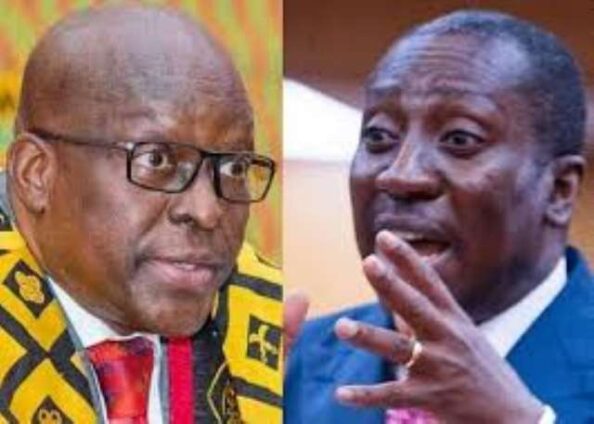
Recent events in Ghana’s political landscape have laid bare a troubling reality: the Speaker of Parliament, a key pillar of our democratic architecture, is under attack for standing firm against the Executive and Judiciary on critical constitutional matters, particularly the issue of parliamentary seat vacations.
At the heart of the controversy lies the Speaker’s principled stance on the interpretation and application of the Constitution. This has ruffled feathers, especially within the Executive, whose dominance over the Judiciary appears to be manifesting in decisions that some argue undermine the independence of Parliament.
The issue came to the fore following disputes over whether certain parliamentary seats should be declared vacant. The Speaker, in exercising his authority, has sought to protect the sanctity of Parliament as a co-equal branch of government. His position reflects a broader understanding that democracy thrives on checks and balances, not subservience. However, this stance has drawn fierce criticism and what seems to be a coordinated attempt to undermine his credibility.
The Broader Implications
This attack on the Speaker is not just a personal affront but a direct challenge to Ghana’s democratic principles. The separation of powers is a cornerstone of any democracy. Parliament, as the representative voice of the people, must operate independently of the Executive and Judiciary. Yet, the recent actions of these branches suggest a troubling attempt to erode this independence.
For instance, the Judiciary’s interpretation of parliamentary procedures has raised concerns about judicial overreach. By interfering in matters traditionally within the purview of Parliament, the Judiciary risks setting a dangerous precedent where parliamentary autonomy is subordinated to external influences.
The Executive, on the other hand, appears to be leveraging its power to discredit the Speaker, possibly because his decisions do not align with its political interests.
Also, the Executive has through its surrogates stifled the passage of the LGBTQ+ Bill which has been held hostage by the combined efforts of the Executive and the Judiciary. This raises fundamental questions: Is the Speaker being targeted because he refuses to toe the line of the Executive? Are these attacks an attempt to centralize power and stifle dissent within the corridors of government?
A Test of Leadership
In the face of these challenges, the Speaker’s resolve has been commendable. By standing firm, he has become a symbol of resistance against the encroachment of executive and judicial overreach. However, the attacks against him also highlight the fragility of our democratic institutions when subjected to undue pressure from those who should be their guardians.
It is not lost on Ghanaians that the Speaker’s health has been weaponized in this political battle. Efforts to tarnish his image through selective scrutiny of his medical expenses, while similar information about other high-ranking officials remains undisclosed, are both unethical and indicative of a deeper agenda. This selective accountability erodes public trust in the very institutions meant to safeguard democracy.
What’s at Stake?
The ongoing attempts to undermine the Speaker are about more than just one individual—they represent a struggle for the soul of Ghana’s democracy. If the Speaker is silenced, Parliament’s ability to act as a check on the other branches of government will be severely compromised. This is not just a political tussle; it is a defining moment for our nation’s commitment to the principles of democracy, accountability, and fairness.
A Call to Action
Ghanaians must not stand idly by as the integrity of our democratic institutions is called into question. Civil society, the media, and ordinary citizens must demand accountability and transparency from all branches of government. The Speaker’s position should not be subjected to partisan attacks but respected as an essential component of our democracy.
In this critical moment, we must remember that democracy is not just about elections—it is about ensuring that power is exercised in a manner that reflects the will and interests of the people. The independence of Parliament, the rule of law, and the balance of power must be safeguarded at all costs.
Ghana’s democracy is being tested. How we respond will determine whether we emerge stronger or allow the foundations of our governance to crumble. The Speaker’s fight is not just his—it is a fight for every Ghanaian who believes in the promise of a fair and just society.
Latest Stories
-
Education Minister inaugurates NDU Governing Council, announces $25m seed funding
6 minutes -
THE LAW 101: La Beach Demolitions – The State’s own documents, the courts’ orders – and the bulldozers
9 minutes -
DVLA contributes GH¢17.7m to Consolidated Fund in 2025
12 minutes -
Why disaster risk reduction must connect early warnings, preparedness and financial protection to household-level resilience
19 minutes -
The AI Gold Rush: Who strikes gold and who gets left behind?
43 minutes -
Pius Hadzide rejects blame for journalists’ visas in 2018 Australia scandal
1 hour -
What Is Wrong With Us: We queue for the Colosseum while our own Castles crumble
1 hour -
Dangote IPO fever could deepen Africa’s capital markets, Citi Bank executive says
2 hours -
US hopes diesel deal can ‘soften’ Moscow on peace talks, sources say
2 hours -
Oil falls as Russia diesel supply prospects counter Gulf supply risks
2 hours -
Moroccan centrist party agrees to form coalition government with three other parties
2 hours -
IMF cites AI slowdown, spiking yields as looming global market risks
2 hours -
Nvidia’s China AI-chip share falls as Huawei closes gap, report finds
2 hours -
Trump says he does not believe China and Russia are helping Iran ‘at all’
3 hours -
One dead and several hurt after rollercoaster incident at Six Flags
4 hours