

Audio By Carbonatix
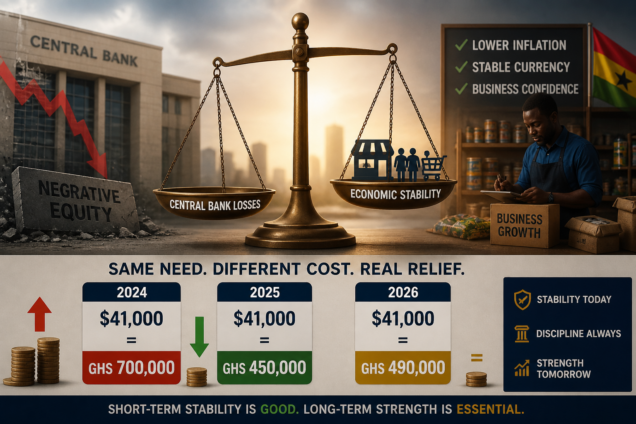
Inflation is easing. The currency is holding. On the surface, things feel better. But beneath that calm, the central bank is carrying negative equity. So the question is simple: should we worry, or should we accept it?
Let’s keep it practical.
Imagine a business that needs $41,000 every year. In 2024, it pays nearly GHS 700,000. In 2025, for the same amount, it pays around GHS 450,000. In 2026, about GHS 490,000. Nothing about the dollar amount has changed. What changed is stability.
That difference is not just numbers on paper. It is cash saved. It is inventory restocked. It is salaries paid on time. It is a business staying alive instead of struggling.
This is why falling inflation and a stable exchange rate matter more than anything else to the real economy. People do not trade in theories. They trade in certainty.
So yes, if stability comes at the cost of central bank losses, many would say it is worth it in the short term. The economy needs breathing room. Businesses need predictability. Households need relief.
But here is the part we must not ignore.
Negative equity means the central bank has taken a financial hit to achieve this calm. It is not free. It is a cost pushed into the system. If not managed carefully, that cost can come back later as inflation, higher taxes, or reduced confidence.
It also raises a deeper issue. A weak central bank balance sheet can limit how much it can respond in the next crisis. It can invite pressure from government. It can quietly weaken trust, which is the most important tool any central bank has.
So the answer is not panic. And it is not a celebration either.
Short-term stability is good. It is necessary. But it must be backed by long-term repair. The central bank must rebuild its strength. Discipline must hold. Independence must be protected.
Because stability that cannot last is just a pause.
And economies cannot afford too many pauses.
Latest Stories
-
Ghana ranked joint 6th in 2026 Absa Africa Financial Markets Index
54 minutes -
Demand and savings deposits decreased in August 2026, but currency outside banks increased by 4%
1 hour -
Fiscal policy implementation poses downside risk to inflation – BoG
2 hours -
Organised Labour should seek fair adjustment, not excessive pay rise – Labour consultant
2 hours -
BoG maintains medium-term inflation target of 8 ± 2%
2 hours -
Sammi Awuku urges NPP Germany to unite ahead of 2028 elections
3 hours -
The Inconvenient Truth: We cannot pray for the cure while protecting the disease
3 hours -
MTN Ghana trains civil society organisations on artificial intelligence
4 hours -
GoldBod FX framework aims to make dollar supply predictable – Acheampong
5 hours -
How does a Ghanaian team make it to the BAL?
5 hours -
Ghana’s investment climate presents opportunities for industrial growth and job creation.
5 hours -
‘I paid thousands to a company for jobs that never came’
5 hours -
SSNIT intensifies informal sector enrolment drive with Techiman float
5 hours -
Ghana seeks long-term mining investments that benefit local communities – Armah-Kofi Buah
5 hours -
GHATOF demands compensation for 85 businesses affected by La Pleasure Beach demolition
6 hours