

Audio By Carbonatix
Across the world, the digital revolution has fully taken over and the pervasive spread of digital technologies continue to create new opportunities for those with access to these new technologies.
As revolutionary as it has been, however, a large chunk of the digital ecosystem across the world are controlled by men, making women hugely underrepresented in shaping the social transformation as a result of global advancements in digital technologies. Addressing this inequity has become a defining challenge, which many societies are grappling with.
In Ghana, more than 88% of students pursuing engineering courses at the tertiary level are male, according to enrolment figures from the Ghana Tertiary Education 2019 Statistical Report, with females making up less than 11% of the undergraduate engineering cohort. Similarly, undergraduate Science enrolment, though better, with 68% males and 32% females enrolled, is, all the same, far from ideal.
The underrepresentation of females in STEM (Science, Technology, Engineering, Mathematics) disciplines is ever-present on a global front. The prevalence of male dominance in these fields of study likely stems from influence in students’ formative and pre-secondary school years. STEM disciplines have a reputation for being rather intimidating. Stereotypical gender biases tend to underestimate and snub young girls’ abilities consequently discouraging them from pursuing such degrees.
These notwithstanding, there is enough evidence that women are equally capable of being at the forefront of technological development and advancement. The example of Estelle Akofio-Sowah, Board Member of Stanbic Bank Ghana, gives credence to this fact. Her understanding, exploits and contribution to the development of Africa’s ICT ecosystem has been par excellence. It is unfortunate, however, that there are very few of such women leading transformational change within the tech space.
The digital and tech space will continue to be a male-dominated sphere as long as not enough female content is developed, as long as technical innovations do not address the needs of women, as long as women remain the more frequent targets of digital violence, cyberbullying and hate speech, as long as codes and algorithms are written only by men, who sometimes automatically discriminate against women and female input ex ante, and as long as some societies forbid women from accessing a computer or enrolling in a computer science course.
The time has come for deliberate measures that ensure that women are empowered with the tool, skills and opportunities that will enable them compete effectively with their male counterparts. It is very refreshing to note that Stanbic Bank Ghana’s digitisation agenda is being spearheaded by four strong women namely Estelle Asare (Head, Digital and Innovation), Jemilatu Abdulai (Head, Digital &eCommerce), Marian Amartey (Head, Business Enablement) and Aya Ayettey (Head, Production Assurance and Customer Care within the Engineering team for the bank, responsible for ensuring the bank’s technology systems are available at all times).
Indeed, there is a recognition that action is needed across diverse areas to ensure all women and girls can fully participate in the online world. Over the years, governments, civil society and corporate organizations have intensified efforts targeted at young women, especially, in a bid to get more women to participate in the digital technology space. Stanbic Bank Ghana has been at the forefront with cutting edge interventions in STEM education for girls.
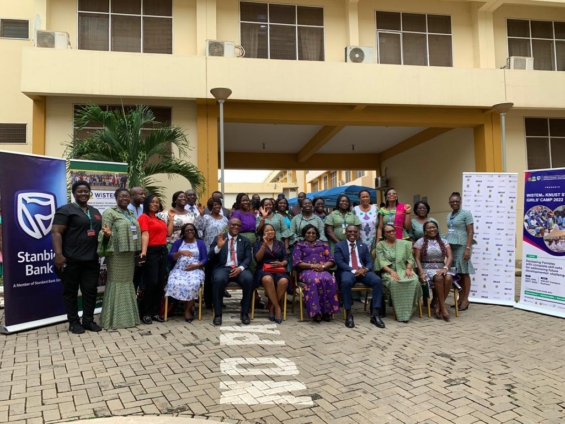
One of such interventions was a collaboration with the Women in STEM Ghana (WiSTEM) to train, equip and inspire 200 girls from various senior high schools in technology. The 5-day camping training programme took the girls through a series of exercises and training to help them sharpen their tech skills. The programme was developed on the back of the fact that the digital gender divide is also fuelled by digital illiteracy, which often translates in lack of comfort in using technology and accessing the Internet. Such “technophobia” is often a result of concurrent factors including education, employment status and income level.
Beyond this, Stanbic Bank Ghana has partnered many academic institutions and FinTechs to deliver a number of STEM related projects which have so far given beneficiaries access to about 300 mentors and advisors across 48 disciplines and technical areas, access to structured training programs and curriculum, internship opportunities with Stanbic Bank, and other partners, and due diligence simulations for student entrepreneurs, most of which are women. The initiative is part of the Stanbic Business Incubator programme launched in 2018 to support start-ups and SMEs through access to structured programs, access to finance and ready markets.
The SBIncubator has to-date, provided support for over 7,288 entrepreneurs, 682 businesses and 1,639 women owned start-ups.
Stanbic Bank Ghana in partnership with Ghana Enterprises Agency (GEA) also launched the Women Entrepreneurship Workshop at the SBIncubator. The two-day workshop was designed to provide female owners of Micro, Small and Medium Enterprises (MSMEs) with the necessary tools and knowledge, including digital technology skills, to grow their businesses. Women from various sectors of the economy including agriculture, textiles and services benefitted from the workshop. The platform also provided a unique platform for aspiring female entrepreneurs in tertiary institutions to meet with female business leaders.
Other episodic initiatives undertaken, particularly over the past 18 months include the Stanbic Incubator programme, the Stanbic Hackaton programmes, the Stanbic Money App Contest, and the annual Kwame Nkrumah University of Science and Technology (KNUST) needy but brilliant STEM students free lap top support programme, together with the Appiatse STEM support donation. There is a mountain to climb in bridging the gender digital gap but with consistent concerted effort from stakeholders across all facets of society, the scale will have some balance.
Latest Stories
-
Power restoration fault suspected in Kumasi Central Market fire
5 hours -
The 7-foot giant of Ngleshie Amanfro: Seven-foot Ghanaian Ephraim Saawa dreams of joining the national basketball team
6 hours -
Government promises support for Kumasi Central Market fire victims
6 hours -
Vibes The Movie: Big Ghun’s Ghanaian film earns five nominations at 2026 REFFA
6 hours -
‘I’m a fulfilled man’—Justice Korbieh on missing out on Supreme Court despite two nominations
6 hours -
MamaCare CEO warns unresolved conflicts among health workers could undermine maternal and neonatal care
7 hours -
Health professionals urged to translate medical knowledge into practice to save mothers
7 hours -
Retired judge Justice Francis Korbieh charges 1,568 new lawyers to uphold integrity
8 hours -
Conflicts among care providers linked to maternal, neonatal deaths – Expert
8 hours -
GIS marks 10th TIME conference, champions improved teaching practices
9 hours -
BRICS Or Balance? What Ghana’s bid really means
9 hours -
GPRTU wants full TRAFFITECH-GH implementation to start in 2027
9 hours -
How 10-mile walks for basic education birthed a 50-year legal career for Justice Korbieh
9 hours -
Mahama announces plans to import electric wheelchairs for PWDs
9 hours -
KGL U17 Colts 2026: Western beat Prempeh Elite Academy to set up final final with Greater Accra Region
10 hours