

Audio By Carbonatix
US Secretary of State Antony Blinken says warring parties in Sudan have agreed to a 72-hour ceasefire from midnight (22:00 GMT) on Monday.
It is at least the third ceasefire to be announced since violence erupted this month but none have held.
Mr Blinken said an agreement had been reached between the army and the paramilitary Rapid Support Forces (RSF) after 48 hours of negotiations.
At least 400 people have been killed since fighting erupted on 15 April.
Both sides independently announced their involvement in the ceasefire.
UN Secretary General António Guterres has warned the violence in Sudan risks causing a "catastrophic conflagration" that could engulf the whole region and beyond.
Since the violence began, residents of the battle-scarred capital Khartoum have been told to stay inside, and food and water supplies have been running low.
The bombing has hit key infrastructure, like water pipes, meaning that some people have been forced to drink from the River Nile.
There will be hopes the ceasefire will allow civilians to leave the city. Foreign governments will also hope it will allow for continued evacuations out of the country.
Countries have scrambled to evacuate their diplomats and civilians as fighting raged in central, densely populated parts of the capital.
Earlier on Monday, Mr Blinken said that some convoys trying to move people out had encountered "robbery and looting".
The US, he added, was looking at potentially resuming its diplomatic presence in Sudan but he described the conditions there as "very challenging".
Sudan is suffering an "internet blackout" with connectivity at 2% of ordinary levels, monitoring group NetBlocks said on Monday. In Khartoum, the internet has been down since Sunday night.
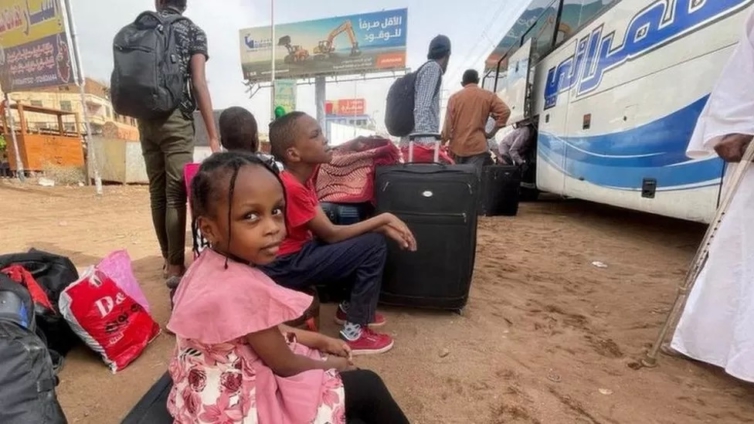
It is estimated that tens of thousands of people, including Sudanese citizens and those from neighbouring countries, have fled because of the unrest.
Hassan Ibrahim, 91, was among them. The retired physician lives near the main airport in Khartoum, where some of the worst fighting has taken place, but has since made the perilous journey into neighbouring Egypt with his family.
He told the BBC World Service's Newshour programme they had escaped being caught up in a firefight between RSF fighters and the army but that a van travelling behind them had got hit. The family then boarded a bus to the border, which took 12 hours, only for them to be met by "crowded and chaotic" scenes as people waited to be given entry.
"There were so many families with elderly passengers, children and babies," said Mr Ibrahim. "The Sudanese are fleeing the country - it is a sad reality."
Eiman ab Garga, a British-Sudanese gynaecologist who works in the UK, was visiting the capital with her children when the fighting began and has just been evacuated to Djibouti on a flight organised by France. Her hurried departure meant that she was not able to say goodbye to her ailing father, nor her mother and sister.
'The country is dirty, there's rubbish all over it," she told BBC Radio 4's World Tonight programme. "There's sewage overflowing it smells so now we're next going to have an outbreak of illness and disease and there won't be a hospital to go to there."
"We're just looking at death and destruction and destitution."
Violence broke out primarily in Khartoum, between rival military factions battling for control of Africa's third largest country.
This came after days of tension as members of the RSF were redeployed around the country in a move that the army saw as a threat.
Since a 2021 coup, Sudan has been run by a council of generals, led by the two military men at the centre of this dispute - Gen Abdel Fattah al-Burhan, the head of the armed forces and in effect the country's president, and his deputy and leader of the RSF, Gen Mohamed Hamdan Dagalo, better known as Hemedti.
They have disagreed on the direction the country is going in and the proposed move towards civilian rule.
The main sticking points are plans to include the 100,000-strong RSF into the army, and who would then lead the new force.
Gen Dagalo has accused Gen Burhan's government of being "radical Islamists" and that he and the RSF were "fighting for the people of Sudan to ensure the democratic progress for which they have so long yearned".
Many find this message hard to believe, given the brutal track record of the RSF.
Gen Burhan has said he supports the idea of returning to civilian rule, but that he will only hand over power to an elected government.
Latest Stories
-
Teachers have lost confidence in government over delayed demands – Abuakwa South MP
2 minutes -
Two months of talks with the government have yielded no progress – GAUA
11 minutes -
COP31 must deliver action, not more promises – African climate negotiators
26 minutes -
What happens when you have too little body fat
27 minutes -
Peki SHS old students to break ground for new entrance gate
45 minutes -
This is an Organised Crime – PAC Ranking Member on 10 million MoH car loan debt
1 hour -
GAUA strike disrupts student registration at University of Ghana
1 hour -
Tema is regaining its industrial glory days as Ghana’s industrial city – Mahama
1 hour -
FBI says more than 130 detained in Ghana over scam operation targeting US victims
1 hour -
BlaKid reflects on Shatta Wale collaboration and TGMA recognition
1 hour -
When vulnerability shows up, run – Rev. Daniel Annan cautions women
1 hour -
FDI rises from $624m to $2.62bn as Tema industrial activity picks up – Mahama
2 hours -
Artificial stability or sustainable equilibrium? Rethinking the Cedi’s performance
2 hours -
GIPA CEO calls for investment to support Ghana’s economic transformation
2 hours -
Banks to suspend lending to public sector workers under Controller and Accountant General’s payroll
2 hours