

Audio By Carbonatix
A Kenyan mother, who has led a long and desperate campaign to save her son from execution in Saudi Arabia, was weak with relief when he was granted a temporary reprieve this week.
Stephen Munyakho, 50, was due to be executed on Wednesday for the murder of a Yemeni man in 2011. It could have been carried out by decapitation - beheading is the most common method in the kingdom - or by hanging, lethal injection or firing squad.
But his stay of execution is only temporary - and Dorothy Kweyu, 73, has told the BBC she has not yet been given any further details about her son’s case by Kenya’s Ministry of Foreign Affairs.
It means her anxiety has not eased. She is still trying to raise the “diyah” or blood money that under the Islamic legal system, known as Sharia, would secure a pardon from the victim’s family.
Saudi Arabia is an Islamic state and its judicial system is based on Sharia for both criminal and civil cases.
A public appeal has so far raised less than 5% of the required $1m (£790,000) needed, says Ms Kweyu, a respected journalist in Kenya.
Getting more time to raise the money may be what Kenyan government officials, negotiating on Ms Kweyu’s behalf, are hoping will be the way forward.
Announcing the execution’s delay on Monday, Korir Sing'Oei, a senior official in the foreign ministry, said negotiators were devising “strategies to bring this matter to a more acceptable conclusion, and thereby giving both families the closure they so urgently need and deserve”.
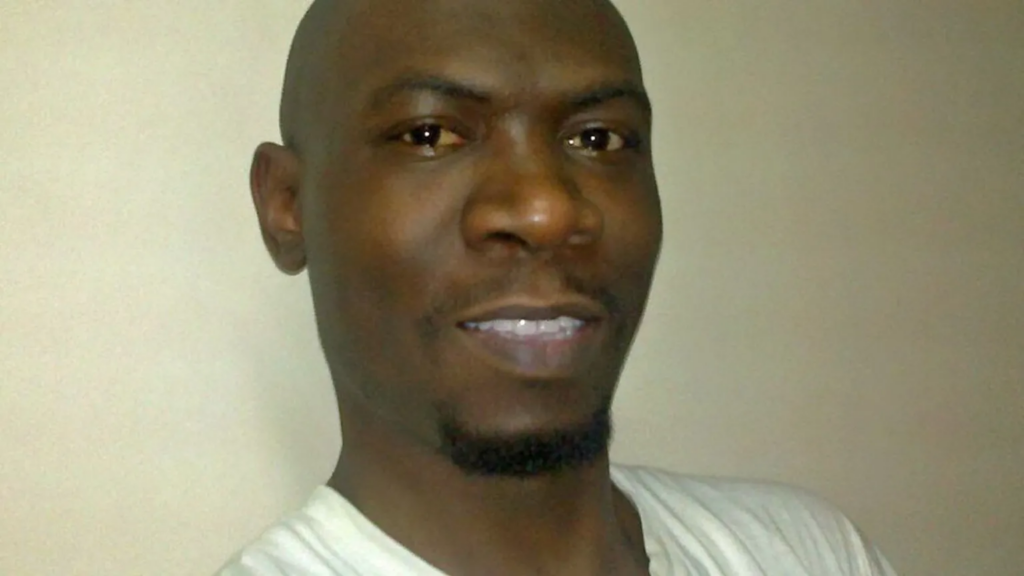
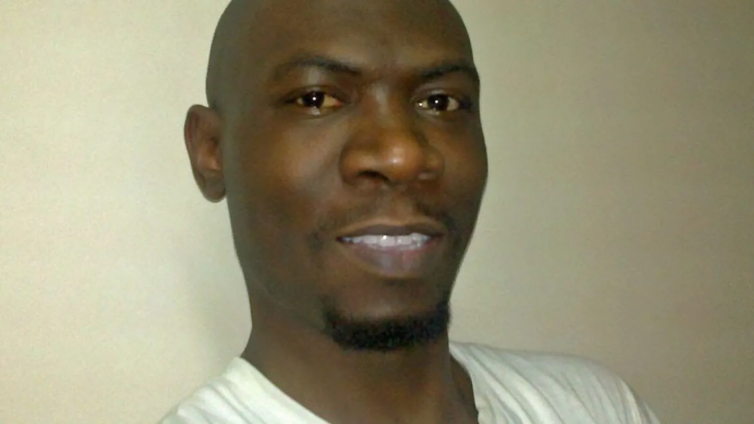
Mr Munyakho, known as Stevo to his friends and family, went to work in Saudi Arabia in his early 20s and 13 years ago was a warehouse manager at a Red Sea tourist resort.
According to Ms Kweyu, her son got into a dispute with a colleague, who she said stabbed Stevo with a letter opener.
Stevo retaliated by grabbing the letter opener and attacked his work mate, leading to his death.
“Initially, my son was found guilty of manslaughter and sentenced to five years in jail,” she told the BBC.
“We expected him to be inside for two-and-a-half years, in accordance with international norms - but it was not to be.”
But an appeal was heard in 2014 that changed the sentence.
“The court ordered that my son face capital punishment, which would have meant the death sentence,” Ms Kweyu said.
“Later on, however, the family of the deceased was convinced by a Kenyan delegation in Saudi to take the diya offer of blood money.”
But the negotiations have proved long and difficult - and raising the money for Stevo, who has three children, has not been easy.
A court had set 15 May as the deadline for the blood money to be paid.
“One day I asked: ‘Is there a way we can exchange so that they execute me instead of Steve my son?’ But I was rebuked and told to stop talking like that,” Ms Kweyu said.
Under Islamic law, diyah compensates a victim or their family. It can be paid for a variety of crimes from murder to injury and damage to property.
It can lead to a reduction in sentence and in certain circumstances a pardon. It is currently applied in about 20 countries in the Middle East and Africa, including Sudan and northern Nigeria.
The Quran, the Muslim holy book, supports the paying of blood money - and this was further clarified by the Prophet Muhammad, who explained in his teachings that the price for murder or manslaughter should be 100 camels.
Modern interpretations mean this amount differs in different countries as diyah is now usually paid in cash.
“In Saudi Arabia one camel is on average 30,000 Saudi riyals [$8,000, £6,300] thus if anybody is going to pay for the life of someone, they have to pay at least $80,000,” Nigerian Islamic scholar Sheikh Husseini Zakaria told the BBC.
Other factors, such as a victim’s gender and religious background, can also determine the amount of blood money demanded. It also needs the agreement of the victim or their family.
Ms Kweyu says she was first asked to pay about $2.6m, but successfully negotiated it down to $950,000.
It is unclear if Stevo has changed his religion while in prison. In Mr Sing'Oei’s statement, posted on X (formerly Twitter), he noted that Stephen Munyakho was now known as “Abdulkareem”.
The name change was news to his family, who are able to occasionally communicate with him when he phones them from prison.
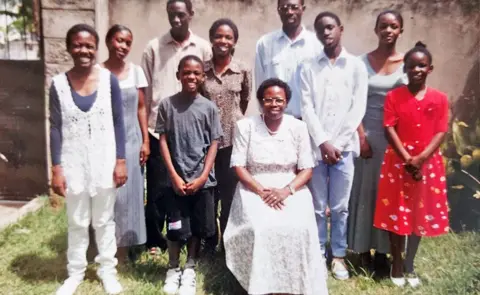
It has been hard for his children. His youngest, 23-year-old Evans Mwanze, has not seen him for more than 20 years.
“There are times I am hopeful that my dad will come home,” he told me.
“Other times I get discouraged and wonder if the worst may happen. I never got to know my dad. He left when I was three and that was the last I saw of him.”
Ms Kweyu says the prospect of beheading is all too real. Last year, there were 172 executions in Saudi Arabia, according to figures released by the authorities.
“There was a day my son called me and told me that one of his friends had been beheaded. That was such a dark moment.”
The Saudi authorities have not responded to BBC requests for comment, but the Kenyan government has been effusive in its thanks for their help in this case.
“We shall continue to lean on the warm and solid friendship that we have with our Saudi partners,” Mr Sing'Oei said, promising further negotiations would happen in the coming days.
“We shall be engaging stakeholders in Nairobi and Riyadh, including representations from our religious leadership, to agree on the next urgent step.”
Latest Stories
-
GPL 2026/27: Asante Kotoko, Coach Boadu and two players charged by GFA
5 minutes -
Hohoe flood: Over 700 residents seek shelter in classrooms, MP appeals for help
5 minutes -
Armah-Kofi Buah has not resigned from GoldBod – Lands Ministry
8 minutes -
Attacks on Lordina Mahama, Samira Bawumia reinforce unequal power – Victoria Hamah
23 minutes -
Ghana’s Starlets step up training ahead of second friendly with Morocco
1 hour -
COCOBOD says $1.4bn domestic funding is a strategic shift, not market exclusion
2 hours -
Richmond Quarcoo appointed Ghana’s Chef de Mission for 2028 Olympics
2 hours -
‘Our missing players are more important’ – Gambia coach fires shot at Ghana
4 hours -
Today’s front pages: Tuesday, September 29, 2026
4 hours -
Ghana ‘showing up differently’ on global stage – Joyce Bawah Mogtari
4 hours -
Ghana’s tuna industry in crisis as 20 hook-and-line vessels collapse
5 hours -
South Tongu MP launches apprenticeship programme for 159 young people
5 hours -
The Pusiga connection behind Gertrude Atongi’s work in New York
5 hours -
Teachers took promotion exams in December to beat government clearance deadline – GNAT
5 hours -
NPA launches 2026 staff welfare week with focus on teamwork and employee wellbeing
5 hours