

Audio By Carbonatix
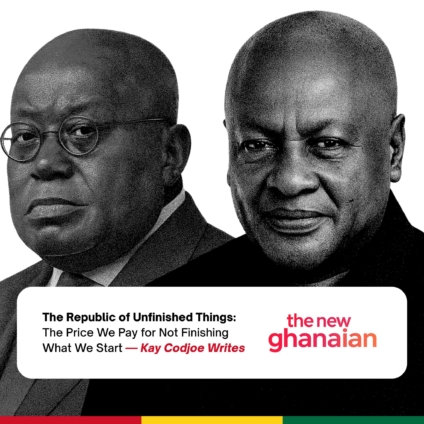
Somewhere in Ghana, there is a signboard that has been standing for years. The paint has faded. The foundation is there. The building never came. When people fall seriously ill, they still travel far before they can be treated. The signboard remains, quietly doing the work the building was supposed to do.
This is not an unusual story. It is a familiar one.
A country does not develop by announcing. It develops by finishing. Yet in Ghana, we have mastered the art of starting. We lay foundations. We cut sod. We mount signboards. We hold ceremonies. Then we move on. The buildings remain. The promises remain.
Across the country, concrete skeletons stand as evidence. A classroom without a roof. A clinic without doors. A water system that never carried water. These are not accidents. They are signatures. Research based on more than 14,000 local government projects from 2011–2013 found that approximately one-third of projects that start are never completed, consuming nearly 20 per cent of all local government capital expenditure. The “one-third of projects” fact gives scale without drowning the piece. It tells us this is not a marginal problem. It is a systemic one.
Every abandoned project has a human cost. A woman is still walking for water. A patient is still travelling for care. A child is still squeezed into an overcrowded classroom. A farmer, still cut off from the road that was announced and never arrived. This is how waste becomes normal.
At the national level, policies are announced before systems exist. Promises are made before financing is secured. Spending is committed before consequences are counted. And when the bill comes, it is not paid by those who spoke. It is paid by the market woman whose basket buys less, the worker whose salary shrinks in real value, and the family that removes one more item from the shopping list. Inflation is not a number. It is subtraction. Debt is not a ratio. It is postponed pain.
We are often told to be patient. But patience is not a development strategy. Every election resets the story. Old failures are buried under new slogans. Nobody stands beside the abandoned building to explain. Nobody is truly punished for wasting years and millions. In this country, failure is rarely punished. It is often recycled.
We must also be honest about ourselves. We have learned how to look away. We pass these buildings and stop seeing them. We hear these promises and stop remembering them. We vote, we move on, and we allow the unfinished to become part of the landscape.
This is why trust is thin. This is why enthusiasm is cautious. This is why politics sometimes feels like theatre. because nothing works. Some things do. But too many good ideas are rushed, overstretched, and poorly grounded. Temporary fixes become permanent arrangements. Improvisation becomes a system. And when it breaks, responsibility disappears.
This is the concern The New Ghanaian respectfully brings before those who lead us. We believe in a simple standard: what is started must be finished. Not announced. Not rebranded. Not re-launched. Finished. We believe public money is not stage property. It is household money multiplied by millions and must be treated with the same care. We believe promises are not poetry. They are contracts. We believe abandoned projects are not just eyesores. They are stolen time. We believe elections are not resets. They are audits.
A serious democracy is not one that produces many speeches. It is one that produces results and keeps records. And so, in the spirit of citizenship and respect for authority, and because our leaders have promised to grant us their ears, we make these demands.
No major project should begin without secured financing and a public completion plan. No policy should be launched without clear capacity, timelines, and measurable benchmarks. No abandonment should occur without automatic investigation and consequences. Failure should not be recycled as experience. And governance should no longer be conducted by explanation.
But this is also a promise The New Ghanaian must make to ourselves.
We will no longer celebrate beginnings and ignore endings. We will no longer clap for announcements and forget outcomes. We will no longer vote without asking what has been finished.
We will look for buildings, not billboards. We will reward delivery, not performance. We will support journalists who follow documents, not microphones, auditors who count money, not excuses, and civic groups who keep memory alive in a country that sometimes prefers forgetting.
The New Ghanaian does not treat waste as normal. The New Ghanaian does not lower expectations until they fit disappointments. A country does not rise by hoping. It rises by insisting.
Somewhere in this country, someone is still waiting for a building that was promised. They are not asking for a speech. They are waiting for a door, a roof, a tap, a road.
This argument is for them.
Latest Stories
-
Communities affected by construction of Akosombo Dam urge government to speed up compensation process
10 minutes -
World Cup visa scandal: Sports Ministry not shielding anyone – Sports Minister’s special aide
31 minutes -
World Cup visa scandal: Over 30 people misrepresented as GTA board members to US Embassy – Vincent Assafuah alleges
33 minutes -
Fire destroys wooden structure near Yesu Mo Villa at Bush Road
34 minutes -
NDC threatens sanctions over oversized campaign posters, gives aspirants 5 days to comply
1 hour -
Star Oil paid GH¢2.7bn in taxes, levies in nine months of 2026
2 hours -
Samson’s Take: The rule of law is cheaper before the bulldozer
2 hours -
GRA blames system failure for delay in issuing receipt over passenger’s customs duty
2 hours -
Livestream: Newsfile discusses World Cup visa scandal, beach demolitions, education strikes, BRICS bid
2 hours -
NC-PTAs welcomes end of teachers’ strike, urges parents to prepare children for Monday
2 hours -
Government procures over 2,000 transformers as Ghana’s electricity access hits 89.13% – Energy Minister
3 hours -
UTAG-UG threatens strike on October 19 over unpaid allowance
3 hours -
Let The Constitution direct Chieftaincy to deliver “All Development Is Local”
4 hours -
John Jinapor outlines renewable energy, nuclear power priorities for 2027
4 hours -
Ghana explores centre of excellence for hearing, communication and cochlear implant care
5 hours