

Audio By Carbonatix
An endangered plant known as the "corpse flower" for its putrid stink is about to bloom in Australia - and captivated the internet in the process, with thousands already tuned in to a livestream ahead of its grand debut.
The titan arum plant, housed in the Royal Botanic Gardens of Sydney, blooms only once every few years for just 24 hours.
Affectionately dubbed Putricia, it will release a smell described as "wet socks, hot cat food, or rotting possum flesh".
The long wait and uncertainty as to when Putricia will bloom - have spawned jokes and even a unique lingo in the livestream's chat, with thousands commenting "WWTF", or "We Watch the Flower".
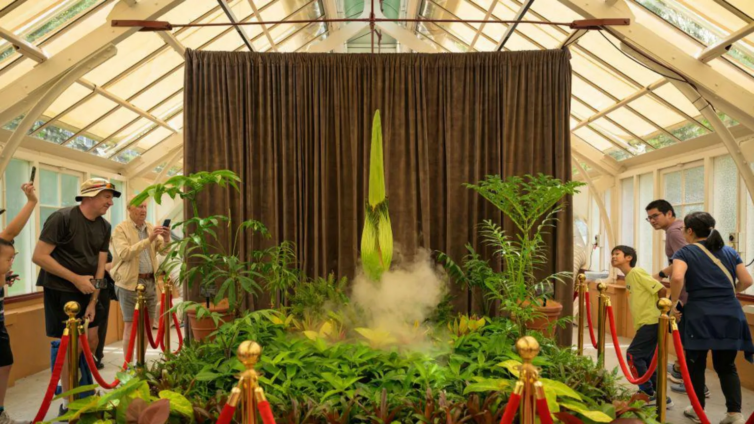
The current view is not much: Putricia stands silent and tall in front of a brown curtain, comfortably ensconced behind a red velvet rope. Occasionally, a visitor pops into the frame as they snap a selfie with the plant.
But once she blooms, viewers can expect to see Putricia unfold a vibrant maroon or crimson skirt, known as a spathe, around her spadix which is the large spike in the middle of the plant.
The Gardens have said it is "hard to predict exactly when" Putricia will bloom, but that has not stopped the thousands gathered online.
"I'm back again to see how Putricia is going and I can see she's still taking her time like the queen she is, fair play," wrote one commenter. "This is the slowest burlesque ever," said another.
Yet another person wrote: "Overnight I watched, fell asleep, awoke, watched, fell asleep. I am weak, but Putricia is strong. WWTF."
Other popular acronyms among viewers are WDNRP (We Do Not Rush Putricia) and BBTB (Blessed Be The Bloom).
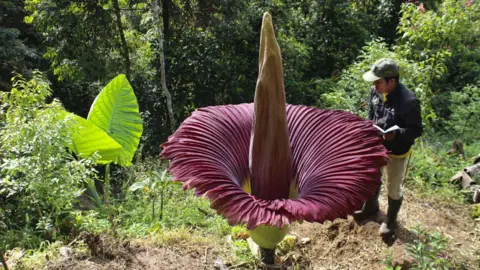
The plant can only be found in the rainforests of Sumatra, Indonesia, where it is known as bunga bangkai - or "corpse flower" in Indonesian. Its scientific name is Amorphophallus titanum, which is derived from Ancient Greek and means "giant misshapen penis",
It has the world's largest flowering structure, as it can grow up to 3m (10 feet) tall and weigh up to 150kg. The plant contains several hundred flowers in the base of its spadix.
It is endangered in the wild due to deforestation and land degradation.
Putricia is one of several titan arums in Sydney's Royal Botanic Gardens, which last saw one bloom 15 years ago.
But there have been other corpse flower blooms across Australia in recent years, including Melbourne and Adelaide's botanic gardens, each time attracting thousands of curious visitors keen on having a whiff.
There are also a few housed in Kew Gardens in London, where one bloomed in June last year. The titan arum first flowered outside of Sumatra in 1889 in Kew.
Latest Stories
-
Diaspora Nasara Caucus congratulates Mohammed Ali Suraj, new NPP executives
1 hour -
Dr Antwi-Boasiako’s cybersecurity book showcased at UN crime prevention congress
1 hour -
We will empower the grassroots and protect every vote – NPP’s 1st Vice Chair Kojo Bamba
1 hour -
I do not see myself as better than anyone – NPP’s 1st Vice Chair Kojo Bamba
2 hours -
Police blur the line between invitations and arrests – Reindorf Twumasi Ankrah
3 hours -
Turning invitations into arrests is making citizens reluctant to assist police – Twumasi Ankrah
3 hours -
The Traffitech-GH SMS spot-fine system: The good, the sad, and the funny – Bright Simons writes
3 hours -
Hawa Koomson pledges experienced and mature leadership of NPP women’s wing
4 hours -
Young woman found dead at Kasoa Peace Town
5 hours -
Playback: The Law examined lawful arrest in Ghana
5 hours -
Mahama urges African governments to treat healthcare as an investment, not budget cost
6 hours -
Bawumia congratulates John Boadu and new NPP executives, pledges support ahead of 2028
6 hours -
Aksa Energy delegation pays courtesy call on GRA Commissioner-General
6 hours -
‘No talent should be left out’ – Bawumia pledges inclusive NPP campaign for 2028
6 hours -
Prof. Mike Oquaye recounts how he blocked the Special Prosecutor’s attempt to arrest Bawku Central MP
6 hours