

Audio By Carbonatix
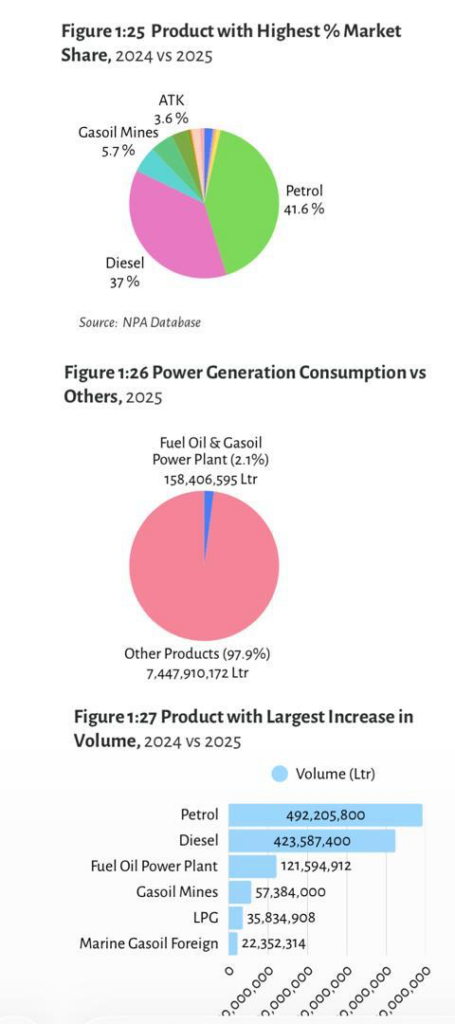
Total petroleum product consumption in Ghana reached 7.45 billion litres in 2025. This represents a 15.29% increase over the 6.46 billion litres recorded in 2024.
Details of Consumption
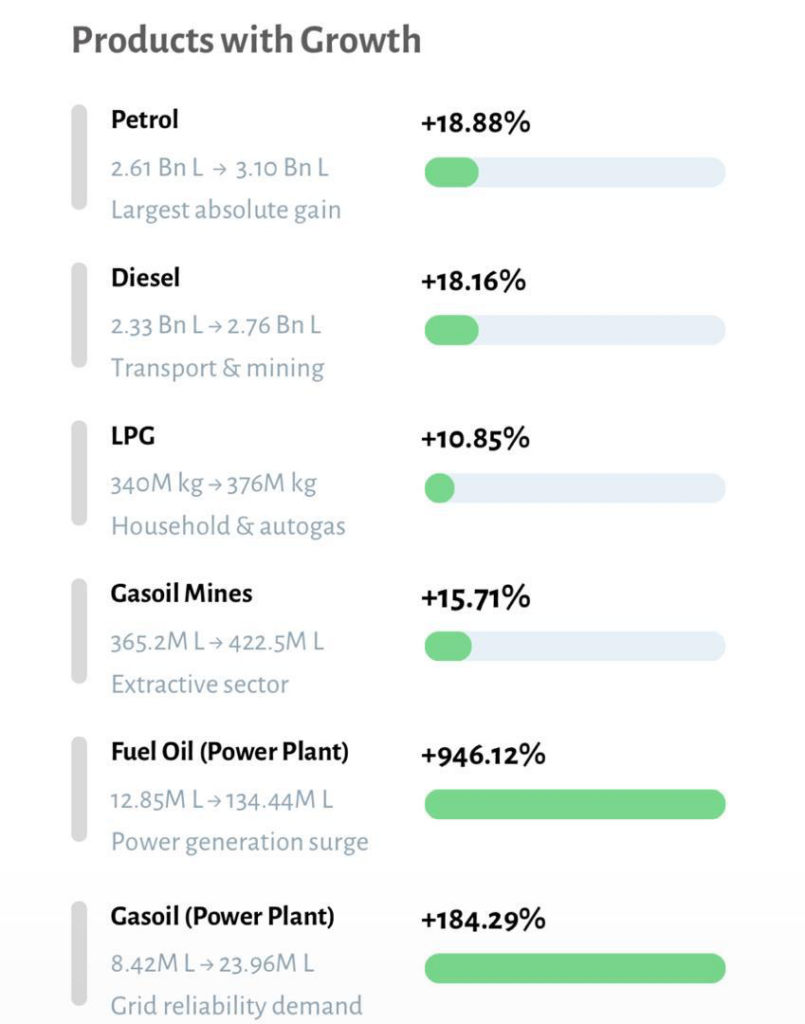
Fuel allocation for power generation recorded the strongest growth. Fuel oil for power plants increased by 946.12%, while gas oil for power plants rose by 184.29%.
This was followed by Marine Gas Oil (Foreign), which grew by 143.75%. The two dominant fuels, petrol and diesel, both increased by more than 18% last year.
These details are contained in the 2025 Petroleum Analysis Report seen by JoyBusiness.
The report provides a detailed examination of Ghana’s petroleum product supply and consumption trends from January to December 2025, with a comparative analysis of 2024.
It also offers key insights into national and regional petroleum product volumes, highlighting trends relevant for market penetration and policy formulation.
Analysis of Other Petroleum Products
Petrol rose to 3.10 billion litres, while diesel increased to 2.76 billion litres, recording the largest absolute volume gains.
LPG grew by 10.52% to reach 376 million kilograms, while gasoil for mines rose by 15.71% to 422.5 million litres.
However, Marine Gas Oil (Local) declined sharply by 61.70%. Gasoil for cell sites fell by 37.88%, while kerosene dropped by 12.24%.
Monthly Dynamics
The 2025 report shows that aggregate monthly consumption across all product categories followed a demand cycle, ranging from 556 million litres in February, the lowest month, to 712 million litres in December, the highest.
The year began strongly in January at 615 million litres, dipped in February, and recovered in March and April to around 588 million litres. This reflects a typical post-holiday slowdown after the festive season.
The middle months, from May to August, recorded relatively stable figures around the 649 million litre range, with June and July posting the strongest numbers, driven largely by higher Marine Gas Oil and gasoil consumption for mines.
The final quarter recorded a steady upward trend, with volumes rising from 628 million litres in September to 712 million litres in December, the highest monthly total for the year.
The December surge was driven by peak demand for petrol, LPG, aviation turbine kerosene (ATK), gasoil for mines, and premix fuel, consistent with heightened economic and social activities during the festive period.
Regional Breakdown of Petroleum Consumption
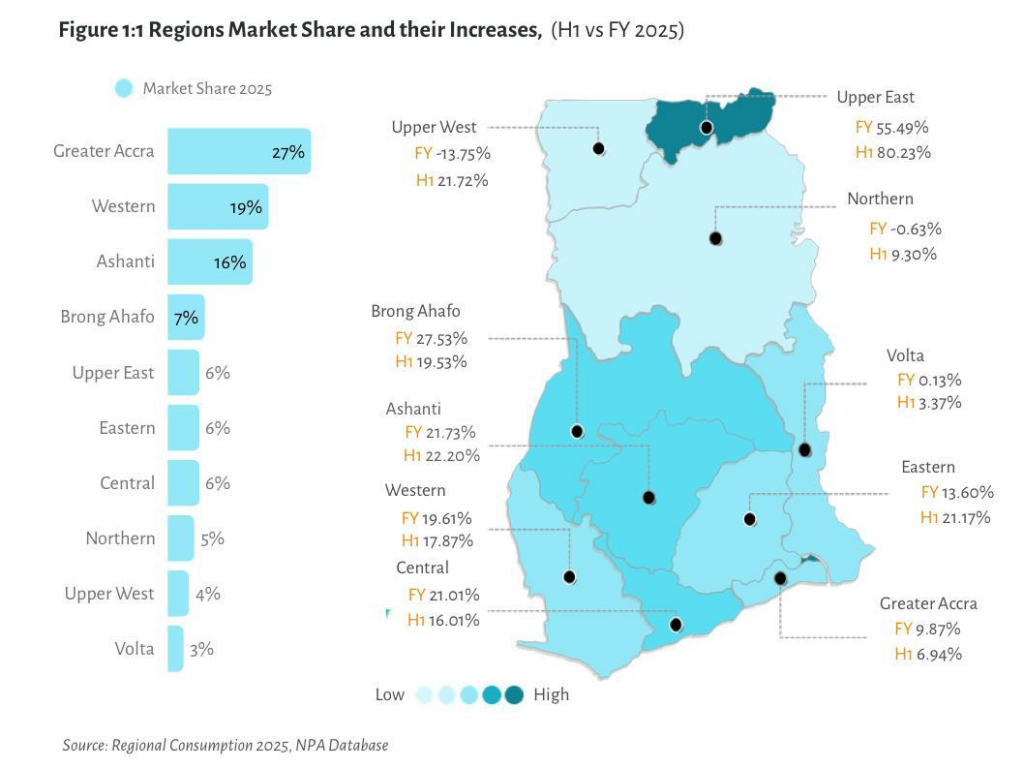
In terms of growth, the Upper East Region recorded the highest increase at 55.5%. This reflects growth, not total volumes consumed.
Consumption in the region rose from 306 million litres in 2024 to 476 million litres in 2025.
It was followed by the Bono Ahafo area, where consumption reached 491 million litres, representing a growth of more than 27%.
In the Greater Accra Region, consumption rose from 1.8 billion litres in 2024 to 2 billion litres in 2025, a 9.87% increase.
In terms of market share, Greater Accra accounted for 27%, followed by the Western Region with 19%.
State of Ghana’s Refinery
Domestic refining capacity remains underutilised due to operational disruptions, technical and financial constraints.
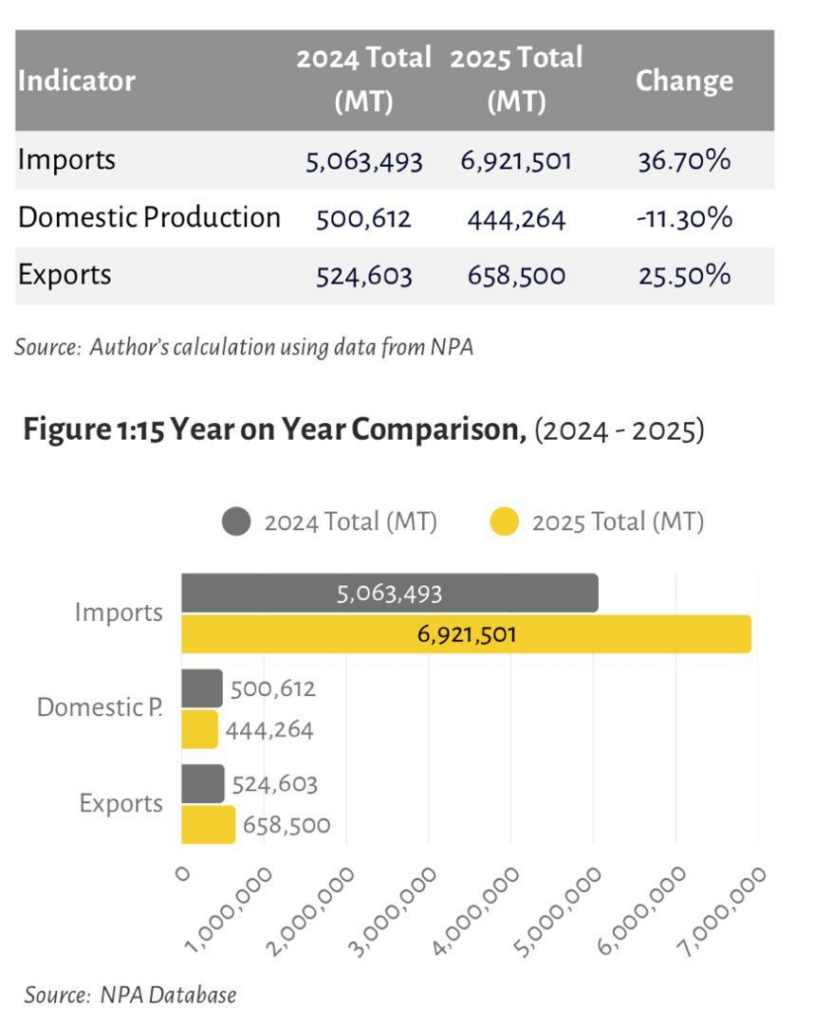
While petroleum product exports increased moderately due to expanding regional re-export activities, Ghana continues to maintain a significant net import position, exposing the economy to foreign exchange pressures and international price volatility.
In 2025, total local refinery production from four refineries accounted for about 18% of national consumption.
Sentuo Oil Refinery contributed roughly 30% of petrol, diesel, and LPG supply in the last quarter, providing a critical buffer against import dependence.
As of January 2026, Sentuo is supplying about 18% of Ghana’s overall local fuel consumption.
Meanwhile, Tema Oil Refinery has reaffirmed its technical capability to refine domestic crude and is undertaking integration works to increase throughput from 28,000 to 45,000 barrels per stream day.
With these developments, local refining could meet between 18% and 25% of national fuel consumption in the coming year, provided operations remain stable and are supported by reliable crude supply and adequate financial investment.
Latest Stories
-
The Cyrus Lesson: Why Ghana must look beyond religion in choosing its next leader
5 minutes -
I have no problem with public tribunals; they’re constitutional – Anthony Forson
16 minutes -
GRA boss supports mothers’ hostel, donates pickup to Upper Denkyira East Police
22 minutes -
NSMQ 2026: St. John’s School beat Benkum SHS, Nandom SHS to secure quarter-finals spot
29 minutes -
Minifootball Association of Ghana unveils women’s national team ahead of inaugural AFCON
31 minutes -
Appointments Committee recommends approval of three Supreme Court nominees
31 minutes -
NSMQ 2026: St. Hubert Minor Sem. reclaims lost seed, sends Mawuli School packing to book quarter-final spot
31 minutes -
Beyond “what do you bring to the table?”: Rethinking what partners bring to relationships
33 minutes -
NSMQ 2026: Mfantsiman Girls’ back in the quarter-finals after 10 years, snatches spot from St. James
36 minutes -
Education Ministry to amend law to restore faith-based representation on GES Council
39 minutes -
Teacher unions demand automatic salary placement for newly promoted teachers
40 minutes -
Asawase fire: NADMO stops victims from rebuilding burnt homes
42 minutes -
SYPALA 2026: ‘Anti-corruption without enforcement is meaningless’ — Senanu
1 hour -
ICT, afternoon court sittings can help clear case backlog – Supreme Court nominee
1 hour -
Beyond the GH¢500bn Target: The silent workforce blind spots in Ghana’s AI strategy (Part I)
1 hour