

Audio By Carbonatix
Geophysicists at the Kwame Nkrumah University of Science and Technology have commenced investigations into one of Ghana’s oldest slave centres in the south eastern part of Ghana.
It aims to advance the fields of geophysics and geoarcheology and train a new generation of geoscientists.
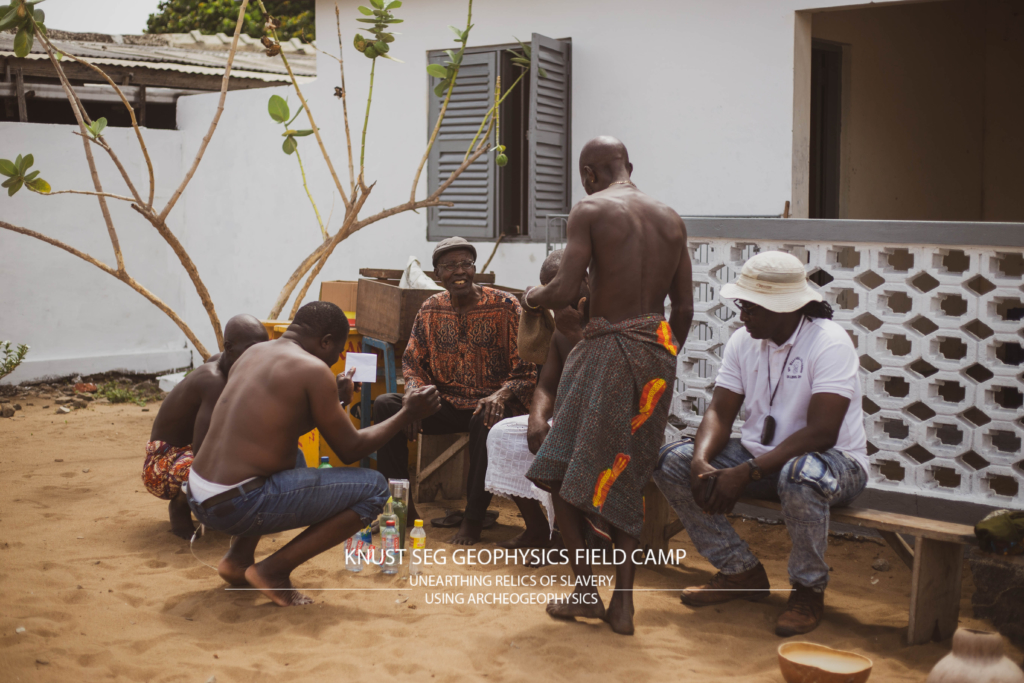
The countless footprints in the approximately 100 x 80 sandy compound evoke a place traversed by a 100-person household. Well, they are about 30 and representatives of an 18th century royal family located in a community known as Hedzranawo in the Ketu South Municipality of the Volta region.
This is the compound of Koku Mensah, the great warrior of Hedzranawo one of the five issues of Sape Agbo, the founder of Hedzranawo.
“Kokumensah was gifted the royalty being the last born among the 4 male children. After the death of Sape Agbo, Kokumensah was installed the chief of Hedzranawo,” Prince Paul Senyoh Kokumensah the great-great-great-grandson of Kokumensah and father of the late Sape Agbo IV summarized.
The Sape Agbo lineage at Denu in the Volta region of Ghana played a significant role in the slave trade in the South Eastern part of the country. They initially served as protectors of slave merchants and then later as slave merchants themselves.
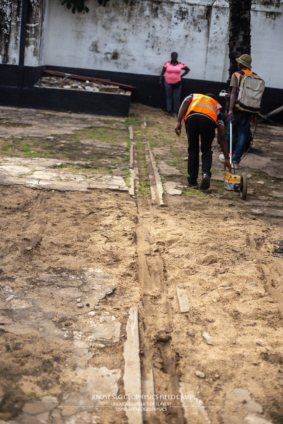
After the British abolished slavery, head of the family tells us the tools of the slave trade such as shackles and chains were buried by the family in one of the six courtyards of the household. Unfortunately, no one can actually tell where the items were buried.
“I was happy when I was informed about the research of using geophysics to find things hidden underground,” he said.
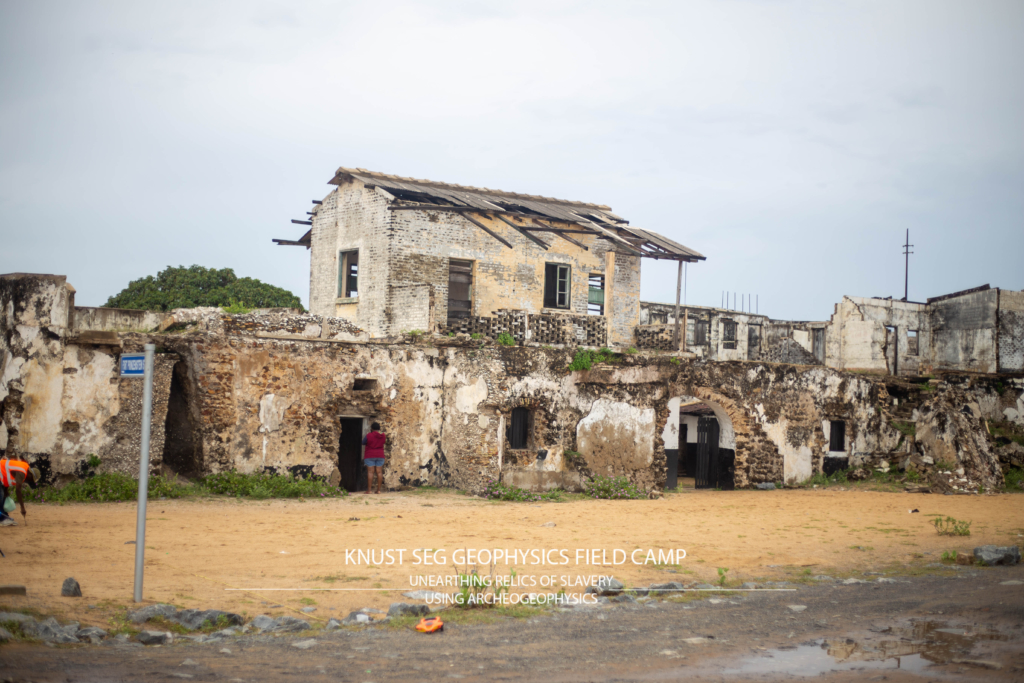
At some 20 kilometers away, the elements haven’t been charitable. They have walloped the walls of Fort Prinzenstein, the only fort in the Volta Region, revealing its skeletal burnt bricks and sea shells.
Built by the Danes in 1784, the fort was used as a dungeon for slaves awaiting transportation to the Caribbean. However, in 1850, the British bought the Fort and used it as a prison. The tidal waves have destroyed part of the Fort.
A group of scientists from Ghana is embarking on a field camp to train geoscience students from universities in Ghana and Nigeria and to acquire geophysical data to discover relics of slavery such as shackles, rifles, unearthed remains, pottery, beads, and evidence of cultural practices.
This will help unravel the mode of living of slaves.
“The project was very important not only because of the scientific value, but the impact in terms of the practical training for students, outreach to senior high schools and historical records that will be built based on research output,” lead researcher, Dr. Cyril D. Boateng said.
The project is a collaboration between the Department of Physics, Kwame Nkrumah University of Science and Technology and the Department of Archeology and Heritage Studies, University of Ghana. It was funded by the Society of Exploration Geophysicists (SEG) Foundation.
Identifying the relics
The geophysical work done at the Fort is divided into two parts: inside and outside the Fort. Inside the Fort, they’re interested in evidence of slavery relics.
To identify these relics in the subsurface, the scientists are conducting geophysical surveys using the Ground Penetrating Radar and magnetic susceptibility surveys in all the rooms, courtyards and dungeons in the Fort.
“We primarily focused on understanding the spatial and vertical extent of the anchors used to hold the slave chains,” Dr. Boateng said.
Ground Penetrating Radar (GPR) is a widely used technique in geoarchaeology, which allows the detection of features in the subsurface.
Electromagnetic waves with a fixed frequency are sent into the subsurface and a portion is reflected by variations in material properties of the subsurface.
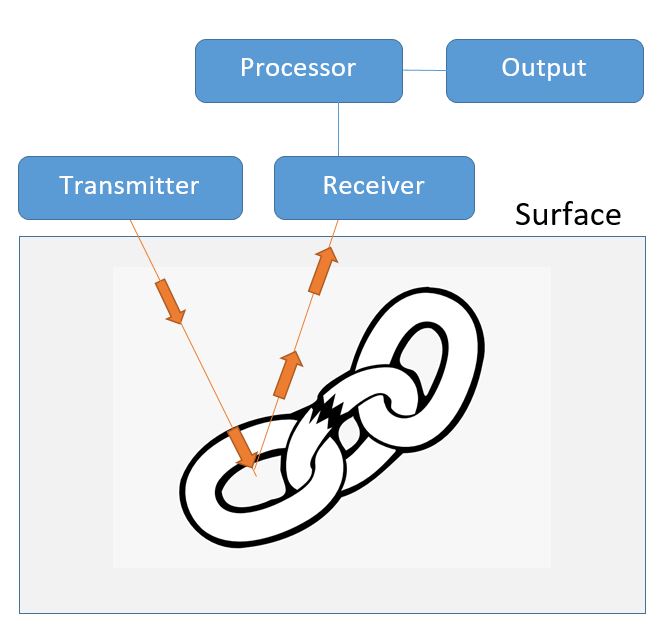
The electromagnetic waves in this case, can determine the depth at which the object is found and how it is shaped.
The magnetic method is based on the spatial variation in the earth’s magnetic field. It is particularly well suited to identifying archeological remains.
This measures the effects buried materials have upon the geomagnetic field. This helps archeologists to identify what lies beneath without having to excavate.
Outside the walls of the Fort, the scientists are interested in identifying the original extent of the Fort before being destroyed by tidal waves.
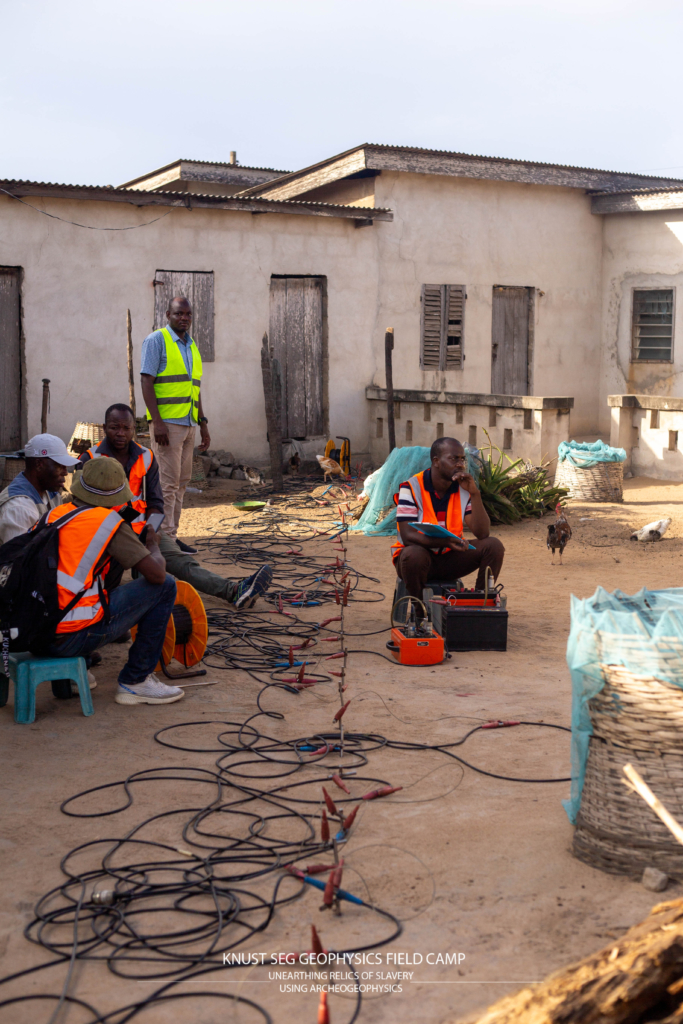
Geophysical methods can therefore be employed to locate the original foundations in the ground. The resistivity method comes in handy.
The resistivity method depends on a material in the ground’s opposition to the movement of current.
In the resistivity method, a resistivity meter records localised variations in current flow and therefore resistance between metal probes inserted into the ground surface.
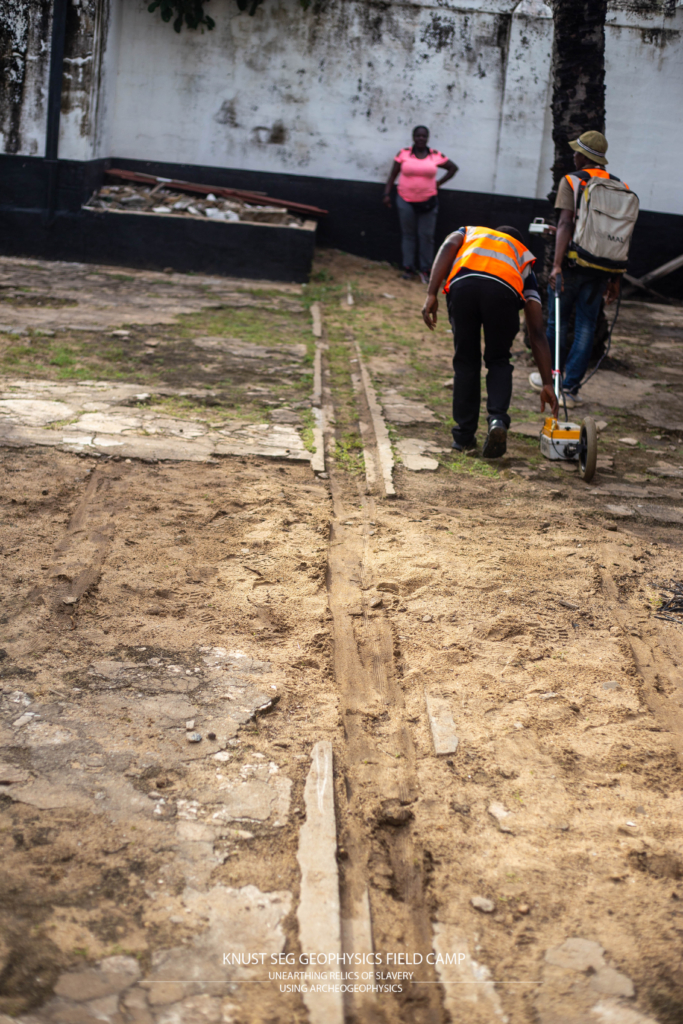
Prof. Wazi Apoh, a co-researcher on the project and Dean of the School of Arts, University of Ghana reiterated the need for this kind of research because the archeology of slavery is important to strengthen our understanding of the history and impact of slavery and its aftermath.
Latest Stories
-
Imprisonment should be rehabilitative, not punitive – Ghana Prisons boss at UNGA
58 seconds -
Ga Adangbe traditional priests petition Mahama over McDan aviation licence revocation
12 minutes -
Anti-LGBTQ Bill: NDC’s arrogance is worrying – Hassan Tampuli
23 minutes -
Let’s give OSP time to mature, not to scrap it – Hassan Tampuli
26 minutes -
Nigeria convicts 386 Islamist militants in mass trials
32 minutes -
Djibouti president wins election with 97.8% of vote, state media says
36 minutes -
We don’t have mandate to deduct tax from rent allowance of security services personnel – Interior Ministry clarifies
50 minutes -
Ablakwa receives Presidential Special Envoy on Reparations to advance global agenda
1 hour -
Christina Koch becomes first woman to travel around the moon on Artemis II
1 hour -
Epstein survivors’ calls to meet King Charles and Queen harder to ignore as US visit approaches
1 hour -
UN Secretary-General names Ghana’s Anita Kiki Gbeho as South Sudan envoy
1 hour -
Mali withdraws recognition of Sahrawi Republic, backs Morocco’s autonomy plan
2 hours -
Gov’t distributes over 8,500 laptops to One Million Coders project
2 hours -
Julius Debrah, ‘man to beat’ as NDC’s James Agbey dismisses Musah Dankwah’s polls
2 hours -
GPRTU in Savannah Region to protest alleged eviction in Damongo
2 hours