

Audio By Carbonatix
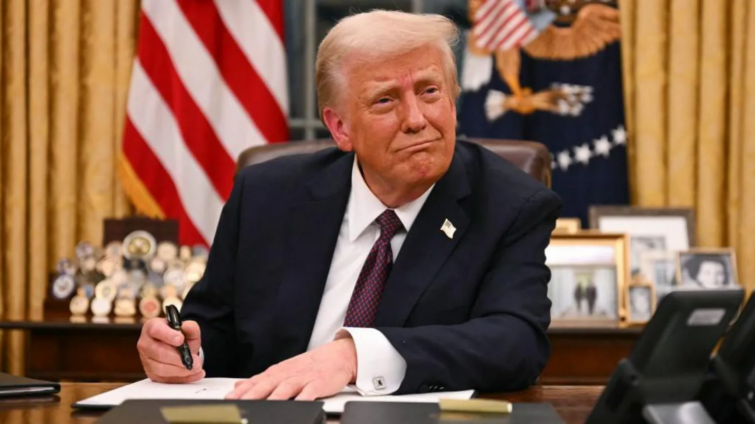
It's been three days since President Donald Trump took office. And he has come out swinging.
On the 2024 campaign trail, he promised to bring rapid and sweeping change to American government and society if he were re-elected.
Some of his policies and reforms will take time – and congressional legislation – to enact. Other moves might be blocked by the courts.
In the first days of his presidency, however, Trump has already made waves with dozens of unilateral orders and actions that represent a substantial expansion of White House power.
For many of his supporters - so far - it looks like he has delivered on his promises.
"He signed all the executive orders that he told us he was going to do," said 68-year-old Rick Frazier, a loyal Trump supporter from Ohio who has attended more than 80 of his rallies. "I'm satisfied with all that."
That has been cause for concern among some. Mariann Budde, the Episcopal bishop of Washington, publicly asked Trump during a prayer service on Tuesday at the National Cathedral, to "have mercy upon people in our country who are scared now".
Nowhere has this display of presidential authority been more prominent than on the topic of immigration, which polls suggest was a significant concern for many voters.
Just hours after taking office, Trump declared an emergency at the US-Mexico border, allowing him to deploy more US military personnel to the area.
He effectively closed the country to all new asylum-seekers and suspended already approved resettlement flights for refugees.
Mr Frazier's daughter died of a heroin overdose last year. He told the BBC that the southern border was his top issue in the 2024 election.
"In my opinion had the border been closed, my daughter would not have had access to the compound that killed her," he said.
Trump has also ordered authorities to stop granting automatic citizenship to the children of undocumented migrants born on American soil – setting up a lengthy legal battle over what had previously been viewed by courts as a constitutional guarantee.
One step that Trump repeatedly promised – but has yet to show signs of implementing – is mass deportations of migrants who crossed illegally into the US, something he said would start on day one of his presidency.
While some Trump officials have said the deportation process has begun, there have been no signs yet of the kind of law-enforcement raids or other expansive actions that would be necessary to detain and remove the millions of undocumented migrants who currently reside in the US.
Bryan Lanza, who previously served as a senior adviser to Trump, told the BBC's Americast podcast that the total number of deportations is less important than the message it sends.
"It's never about a number," he said. "It's more about the PR."
If you deport a million undocumented migrants, he said, than the rest will start wondering if they're next – and take steps to return to their home countries.
"Illegals aren't welcomed here," he said. "Every other country is allowed to say that. Why shouldn't we?"
Immigration was a major issue that helped propel Trump to the White House, but in terms of voter concerns, it was still dwarfed by worries about the economy and inflation.
So far the president has focused on energy policy - tying it directly to the high prices that millions of Americans have struggled with.
"When energy comes down, the prices of food and the prices of everything else come down," Trump said on Tuesday evening. "Energy is the big baby."
To that end, Trump declared a "national energy emergency" and rescinded Biden-era protections for fossil fuel extraction in Alaska and in American coastal waters. He also started the process of withdrawing the US from the Paris climate agreement, which commits nations to slashing emissions to try to avoid the most extreme effects of climate change.
Even optimistic estimates suggest these moves will take time to show any results, but Aziz Wehbey, a Syrian-American Republican voter in Allentown, Pennsylvania, said he was pleased by what he had seen so far.
"That's a good sign for the economy, and for those of us who run businesses," he said. "The economy is starting to move and not be frozen. Everyone will notice that."
One topic that Trump has mentioned, but hasn't acted on yet, is tariffs. He had pledged to slap them on some of America's biggest trade partners on day one to protect American industries and generate new revenue to fund his favoured government programmes.
Economists, including some in the Trump administration, have cautioned that tariffs could drive up consumer costs and hurt American businesses that rely on imports in their supply chain. It could be a reason why Trump, with his eye on the stock market and economic growth, is treading more carefully when it comes to trade.
Many of President Trump's other early executive actions focused on reshaping the vast federal workforce.
He has reinstated rules that allow him to fire senior-level civil servants, suspended new regulations and hiring, and ordered all federal employees involved in DEI - diversity, equity and inclusion - programmes to be put on paid leave.
He also renamed the Gulf of Mexico as the Gulf of America and instructed the US government to only recognise two sexes, male and female, in all official documents and forms. The changes, while controversial, have also been extremely popular with Trump's base – a sign that the president will continue to lean in to contentious cultural issues.
Trump's second term is just getting started. He promises more significant presidential actions in the days ahead – moves that will almost certainly test the limits of presidential power.
But the big splash, the noise, the drama, says former adviser Lanza, isn't a problem for the president. It's his strength.
"Where we are in modern politics today, which people haven't figured out, is that from our standpoint, to communicate to voters are supportive of our issues, controversy enhances the message," he said.
How do you get your message heard amid the overwhelming din of modern politics?
"It's the controversy."
Understand that, and the strategy behind Trump's frenetic first days in office begins to come into focus.
Latest Stories
-
Wealth Over Water: How Galamsey Is Threatening Ghana’s Water Security
35 minutes -
LA 2028: Black Queens pumped up for second leg of Mauritius tie
42 minutes -
LA 2028: Black Queens hold final training session ahead of second leg against Mauritius
1 hour -
Standards are not Seasonal: What the EC appointments teach both sides
1 hour -
King Mohammed VI urges private sector to create youth jobs and spread benefits of growth
2 hours -
KGL U17 Colts 2026: Greater Accra win title after penalties win over Western Region
2 hours -
UK Investment Roadshow opens in London to advance UK-Ghana growth partnership
2 hours -
Assemblies of God requires pastors to resign before entering partisan politics – Rev. Wengam
2 hours -
Ghana targets 20% annual reduction in maternal deaths – Health Minister
2 hours -
Cyber attacks in Africa grow faster than global rate, report finds
2 hours -
Ghana signs UAE deal to create 5,000 overseas jobs
2 hours -
One Million Coders Programme targets 100,000 digital jobs in two years – Sam George
2 hours -
John Jinapor, Italian Ambassador explore opportunities for energy sector investment
2 hours -
NHIA seeks legal reforms to support Free Primary Healthcare
2 hours -
Beatrice Annan defends Afi Agbenyo’s EC appointment, cites record of gender advocacy
2 hours