

Audio By Carbonatix
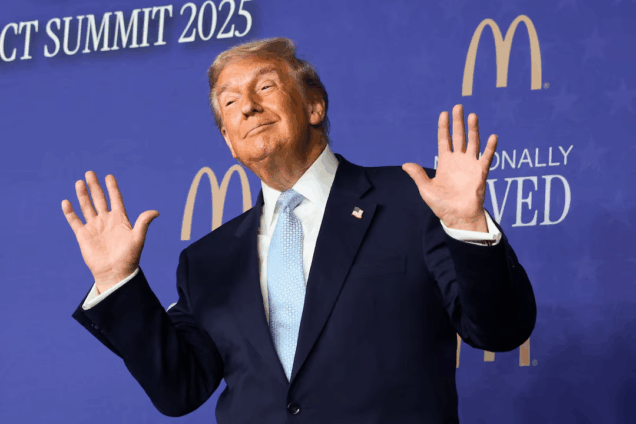
Feeling the heat from Americans worried about inflation, U.S. President Donald Trump told owners, operators and suppliers of fast-food chain McDonald's on Monday that his administration was making progress in combating inflation, but more work needed to be done.
Trump, who promised during the 2024 election campaign to bring down costs, insists that his administration's tax cuts and steps to re-shore domestic manufacturing will help boost Americans' real income and spur growth. Still, he has conceded of late that it could take time for those measures to kick in.
"As president, I'm fighting every day to support small businesses like yours," Trump told the group. "There's still a lot of work to do, and we're making tremendous progress.
Costs have continued to rise in the U.S., not least because of sweeping tariffs Trump has imposed against nearly every country. Inflation worries fueled Democratic victories in state and local elections this month. Trump's approval ratings have continued to languish amid Americans' frustration over persistently high prices.
On Monday, Trump appealed directly to the nation's largest fast-food chain in a speech that offered no new initiatives but touched on military attacks on Iranian nuclear facilities to his personal devotion to McDonald's products and his renaming of the Gulf of Mexico.
He peppered his remarks with false and misleading claims about the economy's performance under his stewardship.
TRUMP SAYS WORKING TO LOWER INFLATION
McDonald's CEO Chris Kempczinski this month warned that low-income consumers were having to absorb "some significant inflation."
The company, keenly aware of how resistant low-income earners are to higher prices, has been offering a $5 value meal for more than a year now.
Trump reminisced about serving french fries during a campaign stop at a Philadelphia-area McDonald's in 2024, telling the chain's bipartisan "Impact Summit" in Washington on Monday his administration was working to reduce inflation.
"We're going to get it a little bit lower," he said, without providing any details.
Trump, who has long argued that his tariffs are not fueling price increases, reversed course on Friday when he announced the elimination of duties on more than 200 imported food items, including coffee and bananas, later conceding to reporters that tariffs could raise costs "in some cases."
Trump has already floated the idea of a $2,000 tariff-funded check for lower- and middle-income Americans, although such a measure would require congressional approval.
He also suggested 50-year mortgages as a way to make houses more affordable, although homeowners would pay more in interest.
TRUMP PLANS RALLIES FOCUSED ON ECONOMY IN COMING MONTHS
Trump plans to hold rallies around the United States in the coming months in battleground states to tout his economic agenda, two administration officials said, ahead of midterm elections next November.
Trump insists that inflation is far lower now than during former Democratic President Joe Biden's term, when consumer prices spiked up to around 9%. But Americans remain sceptical.
The Economist's longtime "Big Mac" index, which measures the cost of the famous double-decker hamburger across numerous countries, shows that a Big Mac costs on average $6.01 as of July, up from $5.69 a year ago and $5.15 three years ago.
Meat costs have remained a sore point. A pound of ground chuck beef costs consumers about $6.33 in September, up 13.5% from a year earlier, according to U.S. government data.
The most commonly cited measure of U.S. inflation, the Consumer Price Index, was 3% higher year over year in September, its highest since January, with more than half of line items tracked showing gains that topped the 3% overall rate.
The annual cost increase overall for food consumed at home, while seemingly more modest at 2.7% in September, is the largest in more than two years.
Consumers remain frustrated with high prices, a fact corporate executives frequently noted during third-quarter earnings calls. They said lower- and middle-income earners were bearing the brunt of higher costs on food, rent and other costs.
Companies like Procter & Gamble, Coca-Cola and Colgate-Palmolive all cited concerns about rising costs and a widening gap between low- and higher-income consumers.
McDonald's, keenly aware of how resistant low-income earners are to higher prices, has been offering a $5 value meal for more than a year now.
Latest Stories
-
Epstein survivors’ calls to meet King Charles and Queen harder to ignore as US visit approaches
3 minutes -
UN Secretary-General names Ghana’s Anita Kiki Gbeho as South Sudan envoy
5 minutes -
Mali withdraws recognition of Sahrawi Republic, backs Morocco’s autonomy plan
9 minutes -
Gov’t distributes over 8,500 laptops to One Million Coders project
10 minutes -
Julius Debrah, ‘man to beat’ as NDC’s James Agbey dismisses Musah Dankwah’s polls
16 minutes -
GPRTU in Savannah Region to protest alleged eviction in Damongo
46 minutes -
Re: Reinsurance does not replace process — A response to the SIGA–SIC defence
1 hour -
Gender Ministry supports Harriet Amuzu in ongoing abuse case
1 hour -
AG joins plaintiff to scrap OSP ?: We should be mindful of the mischief in this – Bobby Banson
1 hour -
Samson Lardy Anyenini questions willingness of Attorneys-General to prosecute political colleagues
1 hour -
It is only fair the OSP is heard in Supreme Court case – Bobby Banson
1 hour -
Asiedu Nketia resumes Ashanti tour, second leg kicks off on Sunday
2 hours -
NLA denies salary cut claims, threatens legal action over reports
2 hours -
BoG Governor honoured for stabilising cedi, improve inflation
2 hours -
Kyebi Easter Homecoming 2026: A resounding success!
2 hours