


Audio By Carbonatix
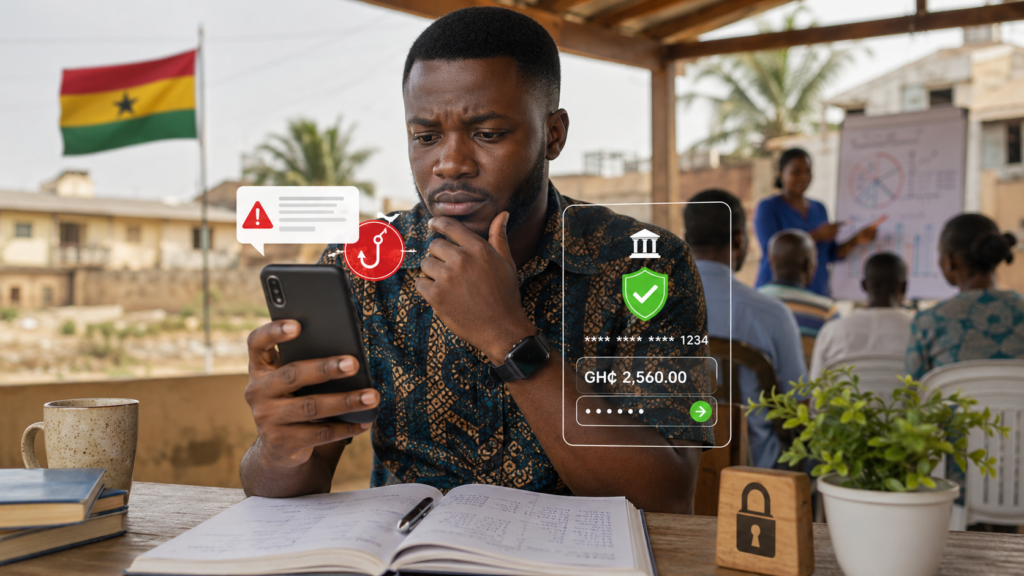
The Head of Fintech and Innovation at the Bank of Ghana (BoG), Elhanan Owureku Asare, has warned that rising digital fraud could weaken public confidence in Ghana's push towards a cash-lite economy.
He says trust is the foundation of digital financial services, and any loss of confidence could push consumers back to cash.
“Trust is a currency. Trust in itself is a currency. The moment we lose that trust, the trajectory that we are on towards a cash-lite economy is at risk,” Mr Asare said.

He said Ghana’s digital payment system has grown because people increasingly trust mobile money, bank apps and other electronic channels to move funds quickly.
But he warned that repeated instances of fraud could reverse those gains.
“The moment we lose trust, we will default back. People will say, 'Look, I am better off holding the cash than relying on digital channels,'" he said.
Mr Asare said banks, fintech companies, mobile money operators and the central bank must work together to protect public confidence in digital finance.
“I think everybody - banks, fintechs, the central bank - we want to make sure that we safeguard that trust related to digital financial services,” he added.
His comments come as reported fraud cases across Ghana’s financial sector continue to rise.
The Bank of Ghana's 2024 fraud report shows that banks, specialised deposit-taking institutions and payment service providers recorded 16,733 fraud cases in 2024, up from 15,865 in 2023.
The total value at risk increased by 13 per cent, from GH¢88 million in 2023 to approximately GH¢99 million in 2024.
Payment service providers, which include electronic payment platforms, accounted for most of the reported incidents.
They recorded 15,673 electronic fraud cases in 2024, compared with 14,655 in 2023.
The value at risk in that sector also rose by 18 per cent, from GH¢16 million to GH¢19 million.
The increase is happening at a time when Ghana’s digital payment ecosystem is expanding rapidly.
Payment service providers processed about 8.1 billion transactions valued at GH¢3 trillion in 2024.
This represented a 19 per cent increase in transaction volume from 6.8 billion in 2023, and a 58 per cent rise in value from GH¢1.9 trillion.
The BoG’s Head of Fintech and Innovation said digital payments have become central to economic activity because speed now determines access to services and trade.
“Payments in general facilitate economic activities. Services require payments. The sale of goods requires payments. So, we have gotten to the point where speed becomes a critical part of the payment system,” he said.
He explained that if one person can make payment faster, that person is more likely to secure the goods or services ahead of another person relying on slower payment methods.
“If you request something to be done for you and you do not pay on time, the one that pays on time will have that service, and you will be left behind. So, the agility and speed related to payments is critical,” he said.
But the same speed that makes digital payments useful also creates new risks. Mr Asare said financial crime is shifting from physical cash theft to digital fraud as more money moves through electronic channels.
“Anytime you move from a particular way of doing things to a new area, the risks shift towards that end. We used to have physical fraud, burglary and major robberies because people kept cash in different places. Now, it is becoming digital fraud or digital burglary, or digital armed robbery,” he indicated.
He said fraud has become harder to contain because digital channels allow criminals to operate at greater scale.
“Having a manual approach towards everything limits its scale. But the moment you digitise it, the scale becomes much easier to handle, and it cuts across. So, the scale at which we are dealing with fraud is much larger than when it was more manual or cash-based,” he said.
The Bank of Ghana has warned that fraudsters are exploiting vulnerabilities in digital payment channels, particularly through mobile money and social-engineering schemes.
Mr Asare said consumer protection must therefore remain central to the regulation of digital financial services. He said protecting customers is not only a consumer-rights issue, but also a financial-stability concern.
The central bank’s 2024 fraud report directed payment service providers to strengthen authentication, introduce customer-behaviour monitoring technologies, educate customers and improve the monitoring and training of mobile money agents.
Banks and specialised deposit-taking institutions were also directed to work with law-enforcement agencies and other stakeholders to ensure that suspected fraudsters are apprehended and prosecuted.
For Mr Asare, the stakes go beyond individual fraud cases.

He said Ghana’s goal of building a cash-lite economy depends on whether people feel safe using digital financial channels.
He also noted that reducing reliance on cash could save the country money because printing and managing physical currency is expensive.
“If we can get into a situation where maybe funds in circulation, only maybe five per cent or less than two per cent is cash, we will be able to save some value. But the moment you do that, we need to make sure that we protect that level of trust,” the BoG Head of Fintech and Innovation said.
The issue will form part of discussions at the maiden Digital Economy Forum under the theme, “The Trust Crisis: Why Fraud Is Holding Back Ghana’s Digital Economy.”
The thought-leadership platform, an initiative of Hubtel, will air on JoyNews and Joy FM on Wednesday, July 22, 2026, at 8 p.m.
The forum will bring together regulators, banks, fintech companies, telecommunications firms, security agencies and consumers to examine how Ghana can protect trust in its fast-growing digital economy.

The Head of Fintech and Innovation at the Bank of Ghana, Elhanan Owureku Asare, will be joined by other industry players at the maiden Digital Economy Forum to examine why fraud is undermining trust in Ghana’s digital economy.

They include economist Professor Godfred Bokpin; Chief Executive Officer of the Ghana Association of Banks, John Awuah; Executive Chairman of e-Crime Bureau, Dr. Albert Antwi-Boasiako; Chief Risk and Compliance Officer of MobileMoney Fintech Limited, Godwin Tamakloe; Deputy Director-General in charge of Technical Operations at the Cyber Security Authority, Stephen Cudjoe-Seshie; and Head of Internal Affairs at Hubtel, Ebenezer Boffour.
Latest Stories
-
‘No talent should be left out’ – Bawumia pledges inclusive NPP campaign for 2028
5 minutes -
Prof. Mike Oquaye recounts how he blocked Special Prosecutor’s attempt to arrest Bawku Central MP
21 minutes -
Make health sovereignty a priority for Africa – Mahama
32 minutes -
Dorimon Naa, Wa West DCE lead massive clean-up exercise; threaten sanctions against recalcitrant residents
50 minutes -
Photos From Adom FM Y2K Jam
52 minutes -
Praye Tiatia steals the show at Adom FM Y2K Jam [Watch]
1 hour -
Boakye Agyarko congratulates John Boadu, pledges support for NPP leadership
1 hour -
Antwi HiMight thrills fans with Antwi ne Antwi hits at Adom FM’s Y2K Jam [Video]
1 hour -
Amb. Edward Boateng congratulates Boadu, Kodua on election wins
2 hours -
John Boadu pledges to rebuild NPP from grassroots and restore ‘winning machinery’
2 hours -
Ashaiman Assembly deploys monitoring system to curb dumping in storm drain
2 hours -
John Boadu must rebuild, unite NPP for 2028 – Edward Boateng
2 hours -
Executive intimidation of opposition undermines separation of powers – Prof Oquaye
2 hours -
I have no issue with John Boadu; we’ll work together – Justin Kodua
3 hours -
Adom FM Y2K Jam delivers a night of music, fashion and nostalgia
4 hours