


Audio By Carbonatix
The new president of the Democratic Republic of Congo, Félix Tshisekedi, has been sworn into office.
Kenya's President Uhuru Kenyatta was the only African head of state, out of 17 invited, to watch the ceremony at the presidential palace in Kinshasa.
President Tshisekedi is taking over from Joseph Kabila in the first peaceful transfer of power in the country in nearly 60 years.
But many still dispute his victory in last month's presidential election.
Numerous sources say his opponent Martin Faylulu won a landslide victory and has been denied office by a backroom deal between Mr Kabila and Mr Tshisekedi.
The influential Catholic Church, which deployed election observers on voting day, said the official data did not match its own numbers.
Mr Fayulu's appeal to the Constitutional Court for a vote re-count was rejected, and critics say the body is too close to outgoing President Kabila and lacks independence.
Addressing the nation on Wednesday, Mr Kabila said he had no regrets and called on Congolese citizens to support his successor, who he said could call on him for advice at any time.
Yet many people there believe the handover demonstrates that DR Congo is becoming more democratic, the BBC's Gaïus Kowene in Kinshasa reports.
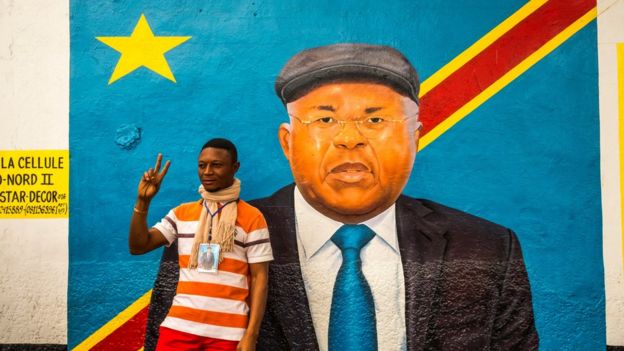
Félix Tshisekedi's father Etienne - featured in the mural - was a veteran opposition politician
The new president is mostly known for being the son of the late veteran opposition leader Etienne Tshisekedi, who was regarded as one of DR Congo's most important pro-democracy advocates.
The UDPS party President Tshisekedi leads was founded in 1982 by his father, who turned it into the largest opposition party. But President Tshisekedi, 55, insists he is not trying to rival his father.
A presidency without power?
Analysis - Fergal Keane, BBC Africa editor
Félix Tshisekedi comes to the presidency with little weight of expectation from beyond his own support base.
What was supposed to be the first democratic transfer of power since independence in 1960 looks tainted with strong suspicions that the outgoing president, Joseph Kabila, intends to exert control from behind the scenes.
Mr Tshisekedi's challenges are immense. His Union for Democracy and Social Progress (UDPS) party did poorly in the elections, so he lacks the firm parliamentary base which might give him the means to assert his independence as president.
The senior echelons of the army and police are all appointees of the old regime. Removing them would be a significant sign that the new president means to be independent.
But would he risk challenging Joseph Kabila? It is highly unlikely. Félix Tshisekedi may find he has been handed the responsibility of the presidency but with little of the power.
Latest Stories
-
Labour Minister wants SOEs to help shape new public pay system
3 hours -
IPEC will ensure Equity and Sustainability in SOEs Compensation
4 hours -
White House bars CNN from travelling with Trump on Air Force One
5 hours -
Fennis wins second consecutive ITF J60 title in Accra
5 hours -
Spain beat England in thriller after Kane penalty miss
5 hours -
GPL 2026/27: Zaidan’s late goal ends Hearts of Oak unbeaten start
5 hours -
CEOs demand clarity on pay harmonisation, board autonomy as FWSC engages SOEs bosses over IPEC transition
5 hours -
2026 Women’s Super Cup: FC Savannah, Epiphany Warriors maintain top spots ahead of final group games
5 hours -
‘Is EOCO responsible for determining lawyers’ fees?’ – Baffour Awuah
5 hours -
David Beckles claims second J60 Accra title
5 hours -
No France cocaine suspect linked to Mahama, Vice President’s security details – NACOC
6 hours -
Anwelle Foundation launched in Jirapa to tackle poverty, youth unemployment
6 hours -
Joy Sports Editor Fentuo Tahiru Fentuo to moderate inaugural Music Meets Football Summit in Zambia
6 hours -
Court premises too volatile for Baffour Awuah’s attempted arrest by EOCO – Inusah Fuseini
6 hours -
Drug bust: Under no circumstances will NACOC leadership be compromised – Twum-Barimah
6 hours