

Audio By Carbonatix
Tunisia's president has sacked the prime minister and suspended parliament, after violent mass protests nationwide on Sunday.
Anger over the government's handling of a massive recent spike in Covid cases has added to general unrest over the nation's economic and social turmoil.
President Kais Saied, who was elected in 2019, announced he was taking over.
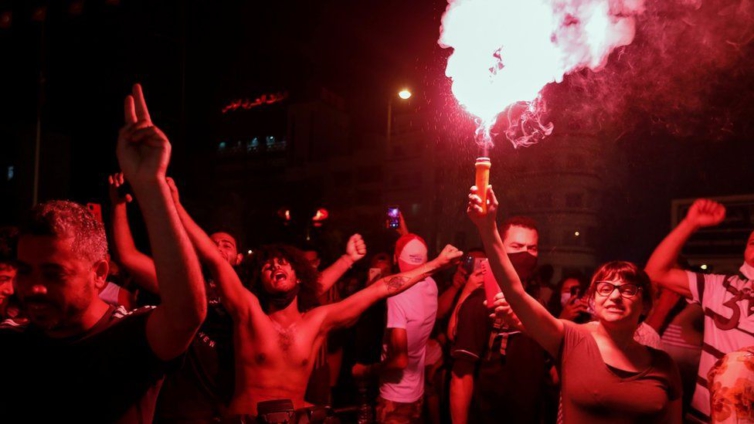
His supporters erupted in celebration, but opponents in parliament immediately accused him of staging a coup.
Tunisia's revolution in 2011 is often held up as the sole success of the Arab Spring revolts across the region, but it has not led to stability economically or politically.
The recent coronavirus surge - which saw the health minister sacked last week after a bungled vaccination operation - has fuelled long-standing frustration.
Sunday saw thousands of people demonstrating against Prime Minister Hichem Mechichi and the moderate Islamist ruling party, Ennahda, shouting "Get out!".
One protester, Lamia Meftahi, told Reuters news agency that this was "the happiest moment since the revolution".
Security forces in the capital, Tunis, blocked off parliament and streets around the central Avenue Bourguiba.
Protesters also stormed Ennahda offices, smashing computers and setting fire to its local headquarters in Touzeur.
In a televised address, Mr Saied said: "We have taken these decisions... until social peace returns to Tunisia and until we save the state."
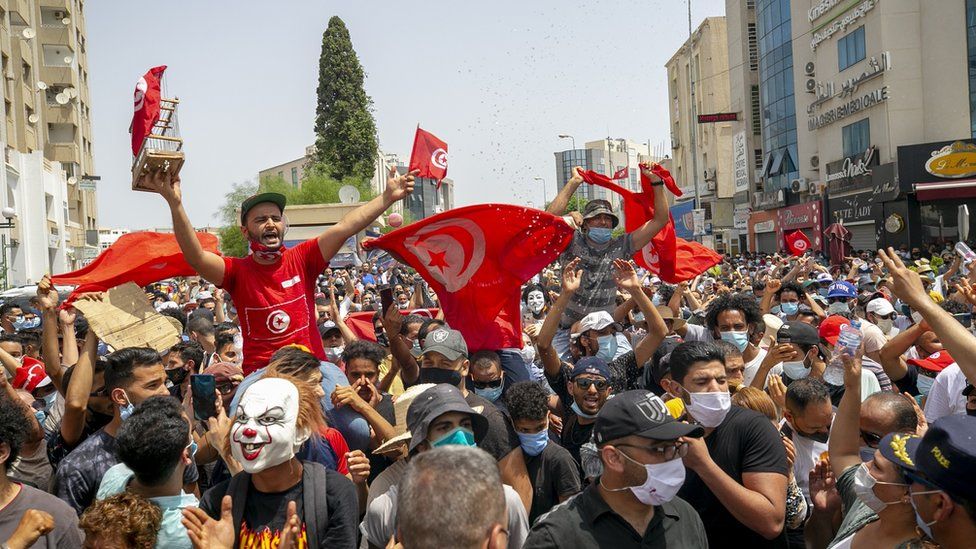
He later joined the celebrating crowds in Tunis.
President Saied also vowed to respond to further violence with military force.
"I warn any who think of resorting to weapons… and whoever shoots a bullet, the armed forces will respond with bullets," he said.
Coup accusations
In Tunisia, both the president and parliament are elected in popular votes.
Under the constitution, the president oversees only the military and foreign affairs, but Mr Saied, an independent, has long been in conflict with Mr Mechichi.
Mr Saied has said he will now govern alongside a new PM, with parliament suspended for 30 days.
The president cited Article 80 of the constitution for his actions, saying it allowed him to suspend parliament if it was in "imminent danger".
But Tunisia's legal and political framework is unclear. The 2014 constitution calls for a special court to be set up to decide disputes like this, but it has not been established.
Tunisian Parliament Speaker Rached Ghannouchi accused the president of mounting "a coup against the revolution and constitution".
"We consider the institutions to be still standing and supporters of Ennahda and the Tunisian people will defend the revolution," Mr Ghannouchi, Ennahda's leader, said.
Two other parties, Heart of Tunisia and Karama, echoed the coup accusations.
Ennahda denounced attacks on its offices, blaming "criminal gangs" who were trying to "seed chaos and destruction".
Latest Stories
-
Turning invitations into arrests is making citizens reluctant to assist police – Twumasi Ankrah
11 minutes -
The Traffitech-GH SMS spot-fine system: The good, the sad, and the funny – Bright Simons writes
23 minutes -
Hawa Koomson pledges experienced and mature leadership of NPP women’s wing
2 hours -
Young woman found dead at Kasoa Peace Town
2 hours -
Playback: The Law examined lawful arrest in Ghana
2 hours -
Mahama urges African governments to treat healthcare as an investment, not budget cost
3 hours -
Bawumia congratulates John Boadu and new NPP executives, pledges support ahead of 2028
3 hours -
Aksa Energy delegation pays courtesy call on GRA Commissioner-General
3 hours -
‘No talent should be left out’ – Bawumia pledges inclusive NPP campaign for 2028
3 hours -
Prof. Mike Oquaye recounts how he blocked the Special Prosecutor’s attempt to arrest Bawku Central MP
3 hours -
Make health sovereignty a priority for Africa – Mahama
4 hours -
Dorimon Naa, Wa West DCE lead massive clean-up exercise; threaten sanctions against recalcitrant residents
4 hours -
Photos from Adom FM Y2K Jam
4 hours -
Praye Tiatia steals the show at Adom FM Y2K Jam [Watch]
4 hours -
Boakye Agyarko congratulates John Boadu, pledges support for NPP leadership
4 hours