

Audio By Carbonatix
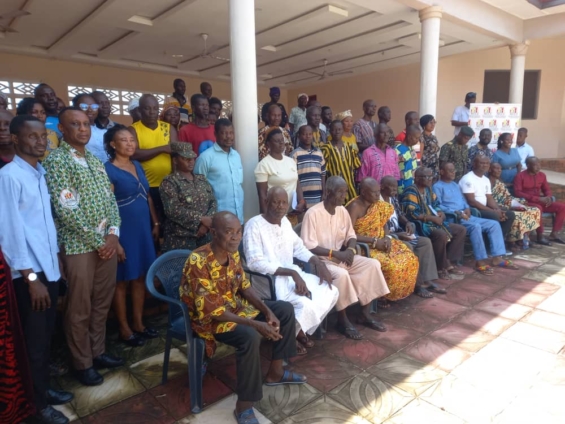
The Department of Sociology and Anthropology at the University of Cape Coast (UCC) has held its maiden public lecture with a call on Africans to prioritise internal unity as a foundation for the success of the Pan-Africanism agenda.
Dr. Joseph Ocran, Head of the Department of Social Sciences at Central University, who delivered the keynote address, stressed that efforts to reconnect with the African diaspora would be futile without strong internal cohesion among Africans on the continent.
“If we cannot mend our ties within our African space, we have no business looking at connecting with those on the outside. Pan-Africanism must start from home,” he declared.
Dr. Ocran questioned the lack of strong academic and institutional connections among African countries: “We are happy to be affiliated with universities in the West, but what are the connections between us here in Ghana and those in Nigeria, Cameroon, Congo, Angola, Senegal, and beyond?”
Lecture Series to Influence Policy
The annual lecture series, initiated by the Department, seeks to create a platform for sociologists and anthropologists to address Ghana’s socio-economic challenges and contribute to national policy dialogue. It also aims to raise awareness of the importance of Sociology and Anthropology across sectors.
The maiden edition was organised in partnership with the Du Bois Museum Foundation in Accra and celebrated the legacy of W.E.B. Du Bois. Themed “Reclaiming the Narrative: W.E.B. Du Bois – Race, Slavery, Pan-Africanism and Our Heritage,” the lecture also saw the launch of the Du Bois Club of Pan-Africanism.
Expanding the Pan-African Vision
Dr. Ocran emphasised that Pan-Africanism must extend beyond the US and the Caribbean to all parts of the world where people of African descent live, including India, Pakistan, and Sri Lanka, where many Africans face hardship and marginalisation.
“We often focus on the US and the Caribbean when we speak of the diaspora, but it’s much broader than that,” he noted. “If we are to reclaim the narrative, we must define our diaspora expansively.”
He also urged Africans to overcome linguistic barriers that limit unity and collaboration. “We must look beyond our linguistic comfort zones to reach those places we have traditionally ignored,” he said.
Relevance of Sociology and Anthropology
Professor Georgina Yaa Oduro, Head of the Department of Sociology and Anthropology, explained the purpose of the lecture series, underscoring the relevance of Sociology and Anthropology to modern society.
She noted that the disciplines were often misunderstood or underappreciated but are deeply connected to all facets of life, including agriculture, health, environment, gender, politics, education, media, culture, and even the study of witchcraft.
Prof. Oduro said the focus on Du Bois was deliberate, to honour his enduring legacy in shaping African identity. “Du Bois’ intellectual contributions offer a framework for current conversations on slavery, Pan-Africanism, and our collective heritage,” she stated.
Du Bois’ Intellectual Activism
Prof. Valera N.Y.M. Botchway of UCC’s Department of History and Diplomacy praised Du Bois for using intellectual activism to fight racial injustice in America, despite not having personally experienced slavery.
He highlighted Du Bois’ efforts to educate people of African descent and influence global discourse on their conditions, urging the youth to follow his example.
Dr. Edgar Takyi Akonor of UCC’s Department of Sociology and Anthropology condemned attempts to downplay the atrocities of slavery. He stressed the importance of preserving this historical memory to guide future development.
“We live in an age where we are not dreaming. We speak of Nkrumah and other great leaders, but who are the new torchbearers?” he asked. “It is our responsibility as a Department to help shape the next generation of African visionaries.”
Du Bois Museum Vision
Madam Ophelia Morgan Mensah, a representative of the Du Bois Museum Foundation, reiterated the organisation’s commitment to preserving Du Bois’ legacy.
“Our vision is to transform the Du Bois Centre into a world-class museum complex—a space for research, inspiration, and innovation,” she said. “We want it to be a place where history meets the future, where Du Bois’ fire is carried across borders and generations.”
Latest Stories
-
Power restoration fault suspected in Kumasi Central Market fire
1 hour -
The 7-foot giant of Ngleshie Amanfro: Seven-foot Ghanaian Ephraim Saawa dreams of joining the national basketball team
2 hours -
Government promises support for Kumasi Central Market fire victims
2 hours -
Vibes The Movie: Big Ghun’s Ghanaian film earns five nominations at 2026 REFFA
3 hours -
MamaCare CEO warns unresolved conflicts among health workers could undermine maternal and neonatal care
3 hours -
Health professionals urged to translate medical knowledge into practice to save mothers
3 hours -
Conflicts among care providers linked to maternal, neonatal deaths – Expert
5 hours -
GIS marks 10th TIME conference, champions improved teaching practices
5 hours -
BRICS Or Balance? What Ghana’s bid really means
5 hours -
GPRTU wants full TRAFFITECH-GH implementation to start in 2027
6 hours -
Mahama announces plans to import electric wheelchairs for PWDs
6 hours -
KGL U17 Colts 2026: Western beat Prempeh Elite Academy to set up final final with Greater Accra Region
6 hours -
Late Solanke strike salvages 10-man Spurs draw at Man United
6 hours -
Gender Ministry to monitor welfare of Nana Akua Addo’s children amid domestic violence case
6 hours -
Benedict Okyere Yeboah: Ghana’s football problem goes beyond sacking a coach
6 hours