

Audio By Carbonatix
The US Supreme Court has cleared the way for the first executions of federal prisoners in 17 years.
Several executions were delayed after a judge ruled on Monday that there were still unresolved legal challenges against the justice department.
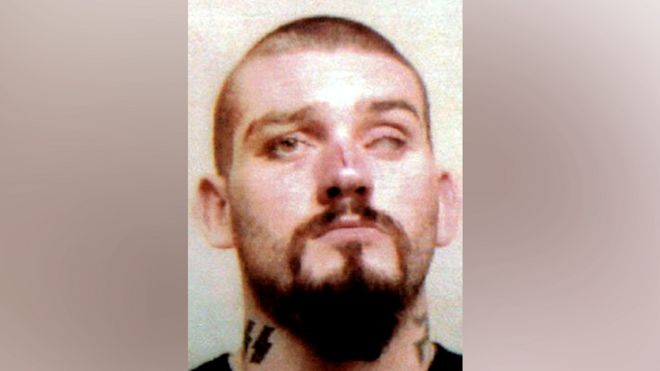
Among those facing the death penalty is triple murderer Daniel Lewis Lee, who was due to be executed on Monday.
The condemned prisoners have argued that lethal injections constitute "cruel and unusual punishments".
The Supreme Court voted 5-4 that "executions may proceed as planned".
Last year, the Trump administration said it would resume federal executions.
In a statement at the time, Attorney General William Barr said: "The justice department upholds the rule of law - and we owe it to the victims and their families to carry forward the sentence imposed by our justice system."
Some of the relatives of Lee's victims oppose his execution in Indiana and had sought to have it delayed, arguing that attending it could expose them to coronavirus.
Earlene Peterson, 81, whose daughter, granddaughter and son-in-law were killed by Lee, has said she wants the 47-year-old to be given life in jail, the same sentence as his accomplice.
The Trump administration's move has been criticised as a political decision, with campaigners expressing concern about cases being rushed.
The last inmate executed by federal death penalty was Louis Jones Jr, a 53-year-old Gulf War veteran who murdered 19-year-old soldier Tracie Joy McBride.
Federal and state executions - what's the difference?
The women who write to death row inmates
Certain crimes, such as counterfeiting currency or mail theft, are automatically tried at a federal level, as are cases in which the US is a party or those which involve constitutional violations. Others can be tried in federal courts based on the severity of the crimes.
The death penalty was outlawed at state and federal level by a 1972 Supreme Court decision that cancelled all existing death penalty statutes.
A 1976 Supreme Court decision allowed states to reinstate the death penalty and in 1988 the government passed legislation that made it available again at federal level.
According to data collected by the Death Penalty Information Center, 78 people were sentenced to death in federal cases between 1988 and 2018 but only three were executed. There are 62 inmates currently on federal death row.
Latest Stories
-
NPP national elections: 4,000 police to handle security, traffic in Kumasi – Karbo
2 minutes -
Atta Akyea fumes as Manhyia MP is to spend another night in EOCO custody
32 minutes -
SSNIT says La Beach clearance was to protect hotel investments, beaches to remain public
1 hour -
APSU congratulates St Augustine’s College after back-to-back National Investment Quiz wins
1 hour -
Renewed flood intervention at Mallam Junction raises hopes among residents, businesses
2 hours -
St Augustine’s College retain National Investment Quiz title after nail-biting grand finale
2 hours -
Education infrastructure investment will drive Banda’s development – Ahmed Ibrahim
2 hours -
Teacher unions strike: Gov’t presents fresh proposals as talks end inconclusively
3 hours -
51,000 teachers’ promotion arrears to be validated for October payment – Education Minister
4 hours -
Kwabena Boamah appointed Board Chair for Impact Investing Ghana
4 hours -
Striking teacher unions to meet Fair Wages and Salaries Commission on October 6
4 hours -
EOCO working with AG to arraign Nana Baffour Awuah before weekend court
4 hours -
Duraplast reassures customers after fire, announces October 5 reopening
4 hours -
Call off strike, gov’t will not renege on promotion arrears pledge – Haruna Iddrisu to teacher unions
4 hours -
Committee set up to validate teachers eligible for 20% deprived-area allowance – Education Minister
4 hours