

Audio By Carbonatix
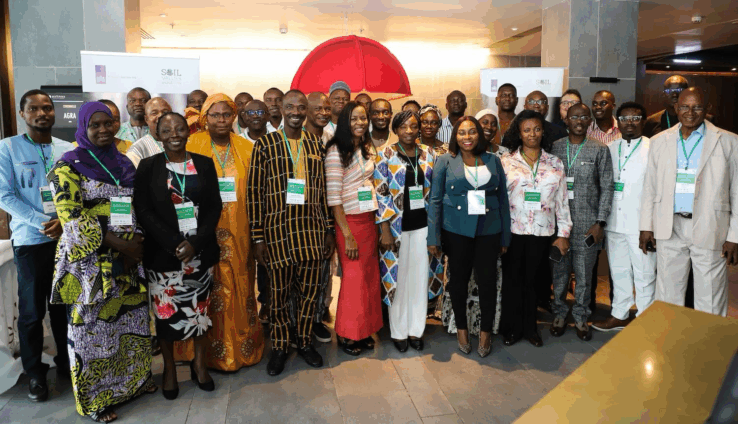
Agricultural stakeholders from across West Africa have affirmed their commitment to prioritising soil health as a central pillar of agricultural transformation after a two-day “Soil Values Convening Strategy Validation Meeting” in Abidjan, Côte d'Ivoire.
The meeting was co-led by AGRA and the International Fertiliser Development Centre (IFDC) with support from the Kingdom of the Netherlands, as part of the Soil Values Program (SVP).
A statement at the end of the meeting, signed by Jessie Lafourcade, West Africa Regional Communications Officer for AGRA and Diro Bénoit Wilfried Toe of the IFDC/SVP explained that the program is a ten-year initiative designed to restore degraded land, improve soil fertility, and support climate-resilient agriculture in West Africa and the Sahel Region.
The program seeks to address soil fertility challenges and promote sustainable land management. It integrates policy dialogue, scientific innovation, and stakeholder engagement to enhance resilience, productivity, and environmental sustainability.
Dr. Asseta Diallo, Senior Specialist – Soil Health and Integrated Management at AGRA, said: "Soil health is at the heart of the resilience of our food systems. It is where it all starts. This event marks an essential step in bringing together stakeholders, strengthening advocacy and mobilising the necessary resources.”
“Together, with our partners and governments, we must transform this momentum into concrete action, in line with the Nairobi Declaration's action program and regional and continental priorities,” she added.
Dr. Diallo said AGRA is committed to helping ensure the objective of making soil health a real lever of transformation for food systems in Africa is realised.
“We will continue working with our partners and the consultants to ensure that our theory of change delivers tangible impact,” she said.
Dr. Oumou Camara, Vice President for Programs at IFDC Global, added: “We must always keep in mind our objectives: reaching 1.5 million smallholder farmers and covering two million hectares of farmland.
"Achieving this will require building strong, collective efforts — no single actor can do it alone. Together, we can deliver on this ambition.”
Dr. Alain Sy Traoré, Director of Agriculture and Rural Development at ECOWAS, noted: “Restoring and protecting our soils is a strategic opportunity to strengthen food security, resilience, and sustainable development in West Africa.
"ECOWAS is committed to ensuring that the momentum generated here translates into practical action aligned with the regional roadmap and the Africa Fertiliser and Soil Health Action Plan. Alone we may go fast, but together we will go far.”
Yemisrach Getachew Aseffa, Senior Partnership Officer, African Union Commission and Coordinator, African Fertiliser & Soil Health Action Plan Implementation, noted the importance of building inclusive and transparent partnerships.
"The African Fertiliser and Soil Health Action Plan is more than a roadmap — it is a call to action. Through sustainable soil management, smarter fertiliser use, and strengthened local systems, it aims to drive resilience, productivity, and food security across Africa,” Aseffa noted.
Eric Smaling, Acting Director of the Soil Values Program, noted the importance of self-reflection and positioning within the regional ecosystem.
“So many things are happening in the region. We need to ask ourselves: Who are we? Where are we going? What are we offering? How do we fit — and with which tools?”
Over 40 government representatives, farmer leaders, scientists, private sector stakeholders and development partners from Burkina Faso, Côte d’Ivoire, Ghana, Mali, Niger, and Nigeria participated in the meeting.
Participants from the Permanent Interstate Committee for Drought Control in the Sahel (CILSS), the Economic Community of West African States (ECOWAS), and the World Bank's Food Systems Resilience Program (FSRP) were also present.
The meeting was held under the theme “Catalysing Stakeholder Collaboration for Sustainable Soil Health in the Sahel.”
The strategy, validated in Abidjan, provides a roadmap for multi-level stakeholder dialogue, policy engagement, and on-the-ground action to reverse soil degradation, boost crop yields, and improve farmers’ livelihoods.
The meeting validated and helped improve the convening strategy for coordinated stakeholder engagement across the six countries.
There was a commitment to policy advocacy, incentives, and integration of soil health into national planning.
There was also strengthened collaboration across stakeholders, including ministries, farmer organisations, the private sector, development partners and research on improving soil health.
Latest Stories
-
‘Our missing players are more important’ – Gambia coach fires shot at Ghana
56 minutes -
Today’s front pages: Tuesday, September 29, 2026
58 minutes -
Ghana ‘showing up differently’ on global stage – Joyce Bawah Mogtari
1 hour -
Ghana’s tuna industry in crisis as 20 hook-and-line vessels collapse
2 hours -
South Tongu MP launches apprenticeship programme for 159 young people
2 hours -
The Pusiga connection behind Gertrude Atongi’s work in New York
3 hours -
Teachers took promotion exams in December to beat government clearance deadline – GNAT
3 hours -
NPA launches 2026 staff welfare week with focus on teamwork and employee wellbeing
3 hours -
Ghana, Saint Kitts and Nevis sign labour deal to strengthen protections for Ghanaian nurses
3 hours -
Delayed promotions put teachers’ retirement benefits at risk – GNAT
3 hours -
No ‘Bawumia candidates’ in NPP executive elections – Anthony Karbo
3 hours -
Over 3,000 displaced as flooding overwhelms Hohoe communities
3 hours -
Sunyani East NPP executives begin reconciliation drive ahead of 2028 polls
3 hours -
Agric Minister engages Ga Mantse on agriculture transformation agenda
3 hours -
Aayalolo expansion targets private car users, not trotro operators – Mahama Ayariga
3 hours