

Audio By Carbonatix
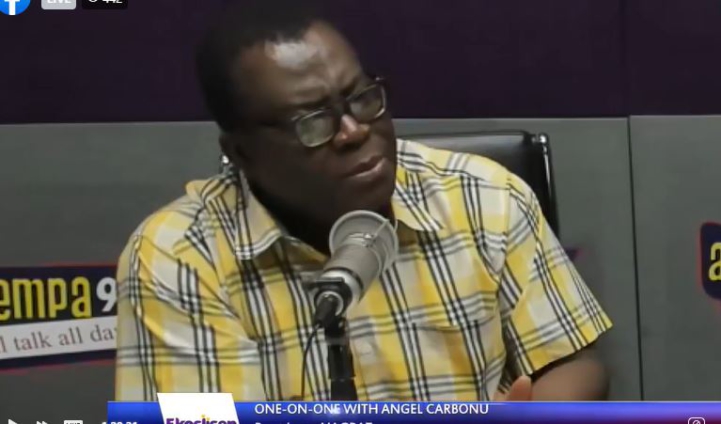
The President of the National Association of Graduate Teachers (NAGRAT), Angel Carbonu, has expressed deep concern over Ghana’s lack of robust democratic systems that can function independently of human emotions, particularly during political transitions.
Mr. Carbonu noted that while Ghana is often celebrated as a beacon of democracy, the country has failed to establish institutional systems that transcend individual sentiments and ensure smooth governance transitions.
In an interview on Joy FM Top Story on Tuesday, December 17, he said: “As a Ghanaian and a public sector worker, I am very disturbed and worried. Over the years, we’ve been touting ourselves as a beacon of democracy, yet we have failed to put in place democratic systems that can transcend individual human sentiments."
His comments come at a time of heightened debate over the delayed mini-budget, with public sector salaries and government operations for early 2025 hanging in the balance.
Mr. Carbonou emphasized the need for automatic systems to manage critical state functions, especially during the period between elections and the swearing-in of a new government.
“If systems were in place, whenever elections are over and a government becomes a lame duck, and the newly elected party prepares to assume office, we would know how to transition seamlessly. We currently rely too much on human emotions and last-minute decisions.”
He cited the importance of operational budgets to sustain the nation during the transition period. “For example, the operational budget—funds necessary to manage this country for the next three months, covering salaries, emoluments, and financial obligations of various agencies—should have been managed by a system that automatically kicks in after December 7 until January 7 when power is handed over.”
Mr. Carbonou stressed that the absence of such systems exposes the country to unnecessary risks.
He also referenced past instances where laws were hurriedly passed during the final days of a government, only to have negative repercussions later.
Calling for urgent reforms, Mr. Carbonu urged stakeholders to develop clear frameworks that define what an outgoing government can and cannot do in its final month in office.
“…We should put in place measures to know what the government can do and cannot do in the last month.”
Latest Stories
-
Elevate Africa confirms presidents, vice presidents and ministers for 2026 Annual Convening in Accra
15 minutes -
Keta MP commissions 60-seater kindergarten facility to replace unsafe structure
20 minutes -
Salomey Awiti-Baffoe’s lawyers welcome GH¢100,000 bail after earlier rejection
21 minutes -
Domestic tourism and its impact on the local economy
29 minutes -
Top-Up Pharmacy wins Community Pharmacy Chain of the Year at 2026 PSGH Pharma Excellence Awards
30 minutes -
Nigeria military aircraft with 32 on board crashes
32 minutes -
Black Stars need a coach who can inspire players to perform – Ignatius Osei Fosu
33 minutes -
Revenue collector crushed to death on Kasoa-Winneba highway
38 minutes -
GPL Week 5: Stephen Amankona, 8 other outstanding players win NASCO awards
39 minutes -
NPP’s new leadership team has experience to deliver – Dr Asah-Asante
40 minutes -
Mahama committed to developing Volta Region – Chief of Staff
41 minutes -
NPP’s new leadership offers no renewal after ‘micro minority’ defeat – NDC’s Abeiku Hayford
42 minutes -
Blackstar Experience to hold fashion show and summit in November
43 minutes -
Prof Mike Oquaye backs Kojo Bamba’s call for stronger ballot protection
52 minutes -
If police won’t protect you, you’ll protect yourself – Prof Mike Oquaye backs Kojo Bamba’s election
53 minutes