

Audio By Carbonatix
A global team of researchers arrived Thursday in the Chinese city where the coronavirus pandemic was first detected to conduct a politically sensitive investigation into its origins amid uncertainty about whether Beijing might try to prevent embarrassing discoveries.
The group sent to Wuhan by the World Health Organization was approved by President Xi Jinping’s government after months of diplomatic wrangling that prompted an unusual public complaint by the head of WHO.
Scientists suspect the virus that has killed more than 1.9 million people since late 2019 jumped to humans from bats or other animals, most likely in China’s southwest. The ruling Communist Party, stung by complaints it allowed the disease to spread, has suggested the virus came from abroad, possibly on imported seafood, but international scientists reject that.
Fifteen team members were to arrive in Wuhan on Thursday, but two tested positive for coronavirus antibodies before leaving Singapore and were being retested there, WHO said in a statement on Twitter.
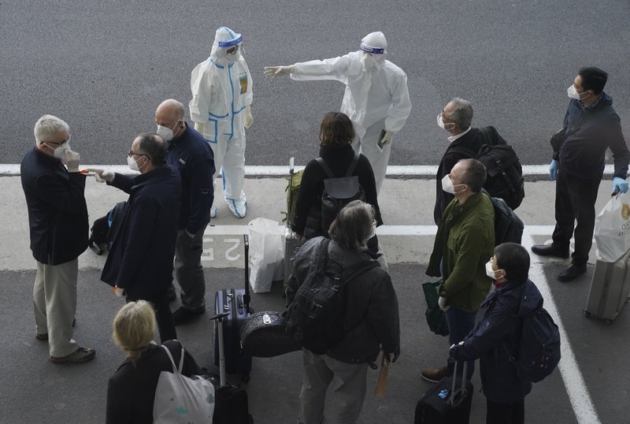
The rest of the team arrived at the Wuhan airport and walked through a makeshift clear plastic tunnel into the airport. The researchers, who wore face masks, were greeted by airport staff in full protective gear, including masks, goggles and full body suits.
They will undergo a two-week quarantine as well as a throat swab test and an antibody test for COVID-19, according to CGTN, the English-language channel of state broadcaster CCTV. They are to start working with Chinese experts via video conference while in quarantine.
The team includes virus and other experts from the United States, Australia, Germany, Japan, Britain, Russia, the Netherlands, Qatar and Vietnam.
A government spokesman said this week they will “exchange views” with Chinese scientists but gave no indication whether they would be allowed to gather evidence.
China rejected demands for an international investigation after the Trump administration blamed Beijing for the virus’s spread, which plunged the global economy into its deepest slump since the 1930s.
After Australia called in April for an independent inquiry, Beijing retaliated by blocking imports of Australian beef, wine and other goods.
One possibility is that a wildlife poacher might have passed the virus to traders who carried it to Wuhan, one of the WHO team members, zoologist Peter Daszak of the U.S. group EcoHealth Alliance, told The Associated Press in November.
A single visit by scientists is unlikely to confirm the virus’s origins; pinning down an outbreak’s animal reservoir is typically an exhaustive endeavor that takes years of research including taking animal samples, genetic analysis and epidemiological studies.
“The government should be very transparent and collaborative,” said Shin-Ru Shih, director at the Research Center for Emerging Viral Infections at Taiwan’s Chang Gung University.
The Chinese government has tried to stir confusion about the virus’s origin. It has promoted theories, with little evidence, that the outbreak might have started with imports of tainted seafood, a notion rejected by international scientists and agencies.
“The WHO will need to conduct similar investigations in other places,” an official of the National Health Commission, Mi Feng, said Wednesday.Full Coverage: Coronavirus pandemic
Some members of the WHO team were en route to China a week ago but had to turn back after Beijing announced they hadn’t received valid visas.
That might have been a “bureaucratic bungle,” but the incident “raises the question if the Chinese authorities were trying to interfere,” said Adam Kamradt-Scott, a health expert at the University of Sydney.
A possible focus for investigators is the Wuhan Institute of Virology in the city where the outbreak first emerged. One of China’s top virus research labs, it built an archive of genetic information about bat coronaviruses after the 2003 outbreak of Severe Acute Respiratory Syndrome.
According to WHO’s published agenda for the research of its origins, there are no plans to assess whether there might have been an accidental release of the coronavirus at the Wuhan lab, as some American politicians, including President Donald Trump, have claimed.
A “scientific audit” of Institute records and safety measures would be a “routine activity,” said Mark Woolhouse, an epidemiologist at the University of Edinburgh. He said that depends on how willing Chinese authorities are to share information.
“There’s a big element of trust here,” Woolhouse said.
An AP investigation found the government imposed controls on research into the outbreak and bars scientists from speaking to reporters.
The coronavirus’s exact origin may never be traced because viruses change quickly, Woolhouse said.
A year after the virus was first detected in Wuhan, the city is now bustling, with few signs that it was once the epicenter of the outbreak in China. But some residents say they’re still eager to learn about its origin.
“We locals care about this very much. We are curious where the pandemic came from and what the situation was. We live here so we are keen to know,” said Qin Qiong, owner of a chain of restaurants serving hot and sour noodles. She said she trusts in science to solve the question.
Although it may be challenging to find precisely the same COVID-19 virus in animals as in humans, discovering closely related viruses might help explain how the disease first jumped from animals and clarify what preventive measures are needed to avoid future epidemics.
Scientists should focus instead on making a “comprehensive picture” of the virus to help respond to future outbreaks, Woolhouse said.
“Now is not the time to blame anyone,” Shih said. “We shouldn’t say, it’s your fault.”
Wu reported from Taipei, Taiwan.
Corrects that the Communist Party has “suggested” the virus came from abroad. It has not definitively said this.
Latest Stories
-
Philanthropist Alhaji FuZak donates Da’wah bus to Ambariya Sunni community
3 minutes -
GUTA calls for suspension of Publican AI system over trade disruptions, demands temporary halt in import activities
5 minutes -
TTAG raises alarm over proposed recruitment of 7,000 teachers, demands national posting roadmap
39 minutes -
Civilians feared killed after reports of air strike on Nigerian market
48 minutes -
Bishop Simon Kofi Appiah installed as new Jasikan Diocese Bishop
49 minutes -
Trump’s Strait of Hormuz blockade threat raises risks and leaves predicaments unchanged
52 minutes -
US Court backs extradiction of former MASLOC CEO Sedina Tamakloe-Attionu’s to Ghana
1 hour -
Seven arrested as NAIMOS dismantles illegal mining camp, seizes firearms at Boin River
1 hour -
Fire erupts at Madina Ritz Junction, destroys multiple wooden structures and containers
1 hour -
Daniel-Kofi Kyereh returns from long-term injury, registers assist for Freiburg U23
2 hours -
Knifeman calling himself ‘Lucifer’ slashes three at NYC’s Grand Central
2 hours -
Brands are built from within to without
2 hours -
Matriculants urged to pursue excellence as gov’t reaffirms support for Maritime education
2 hours -
See the areas that will be affected by ECG’s planned maintenance on Monday, April 13, 2026
2 hours -
GPL 2025/26: Salim Adams double fires Medeama back to summit after Kotoko rout
2 hours