

Audio By Carbonatix
Technology is dismantling longstanding barriers for women in Africa's mining industry and enabling greater participation without the physical and logistical challenges that once deterred female involvement.
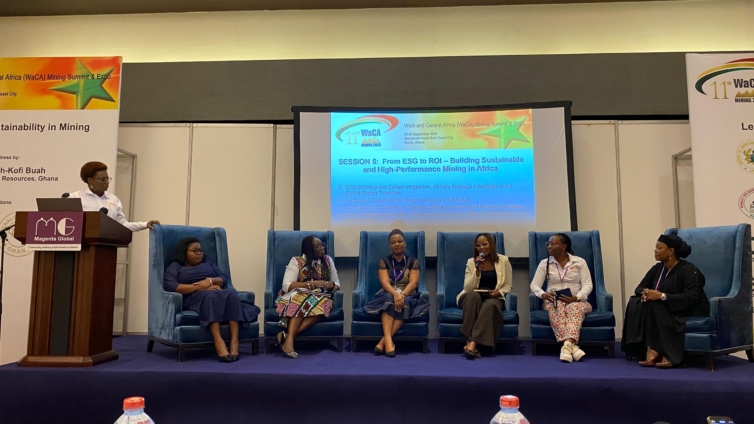
This is according to industry leaders who gathered at the West and Central Africa (WaCa) Mining Summit & Expo at the Kempinski Gold Coast Hotel in Accra for a conversation themed around innovations making technical roles in geoscience, engineering, metallurgy, mining operations, and plant management more accessible to women.
The discussion, led by members of Women In Mining, Ghana (WIM), layed strong emphasis on how mining technology is shifting the nature of work from manual and physically intensive to digital and analytical.
Hajia Amina Tahiru, a seasoned industry player, highlighted how technology has revolutionised gold purchasing, testing, and concession applications, directly empowering women. "In the past, applying for a mining concession meant days of travel, including crossing rivers and remote areas, which families often wouldn't allow for women," she recounted. "Now, I can send someone to take coordinates with a phone, input them into a search engine from my office, and apply online. Technology is wonderful; it's helping us break those little things that held women back."
She added that real-time pricing apps and advanced testing equipment, which project gold purity on screens in real time, have further levelled the playing field. "Even local miners who can't read have learned to check prices on their phones; no more relying on distant sources.”
The speakers also stressed the importance of environmentally responsible innovation. Ghana, a signatory to the Minamata Convention, is phasing out mercury in small-scale mining. New mercury-free gold recovery technologies, gravity concentrators, and centralised processing facilities are being deployed, and women are taking on research, advocacy, and operations leadership roles in the area, according to geologist and environmental scientist, Justine Seyire.
On her part, Dr. Yvonne Loh, an academic, addressed the reluctance among female students to engage in fieldwork, a key entry point to the industry. "Getting females into the field is difficult; they worry about dressing or long nails. But we teach them that technology like machine learning and Python programming complements hands-on skills," she said. "It's not just about software; it's understanding data collection. We urge industry women to mentor them, showing that tech makes the 'real deal' more manageable."
Globally, women account for just 8–17% of the mining workforce, with only 12–14% holding senior leadership roles. Ghana’s numbers are improving, with women now making up roughly 10% of the large-scale mining workforce, but industry experts say technology can accelerate inclusion further.
The panel, therefore, called for more mentorship programs, policy incentives, and industry-academia partnerships to ensure that women are not only participating but also leading technological change.
The WaCA Summit focused on disruptive technologies, capital raising, and green metals amid the global energy transition. It attracted stakeholders from Ghana, Mali, Ivory Coast, Democratic Republic of Congo, Nigeria, and Sierra Leone, among others.
Latest Stories
-
Libya’s military seizes narcotics after firefight with smugglers
2 hours -
At least 139 migrants dead, including some children, after boat from Djibouti to Yemen capsizes, UN agency says
2 hours -
“US Embassy introduced TRIBE Culture Fest to NSA, GTA” – Kofi Adams
2 hours -
“NSA did not tell us of any embassy arrangement” – Kofi Adams
3 hours -
Kumasi records third commercial fire in three days
4 hours -
Trump faces growing backlash over plans to import diesel from Russia
4 hours -
AI is less regulated than milk, says Microsoft president
4 hours -
Boots sold in £7bn deal to Canadian billionaire family
4 hours -
Glasner suffers loss on Selhurst return as Palace beat Forest
4 hours -
WAFU B U17: ‘We won but I expected more from my boys’ – Kassim Ocansey
4 hours -
Royal Mail plans to cut 2,500 jobs
4 hours -
Man City cruise to statement win over 10-man Liverpool
4 hours -
Citroen revives the 2CV for an electric age
4 hours -
Blind guide dog owner says quiet EVs put lives at risk
5 hours -
Hamilton apologises to Ferrari as Antonelli moves to brink of title
5 hours