

Audio By Carbonatix
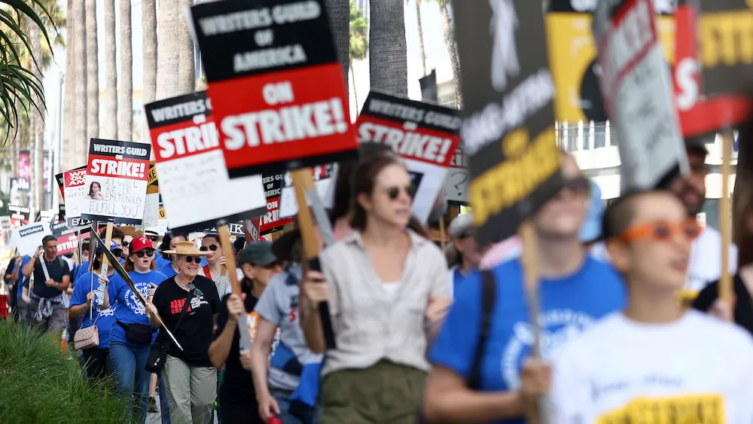
The Writers Guild of America has voted overwhelmingly to ratify its new contract, formally ending one of the longest labour disputes in Hollywood history.
The membership voted 99% in favour of ratification, with 8,435 voting yes and 90 members opposed.
In a statement, WGA West president Meredith Stiehm thanked leadership, strike captains, and WGA staff for working to deliver the contract.
“Through solidarity and determination, we have ratified a contract with meaningful gains and protections for writers in every sector of our combined membership,” she said. “Together we were able to accomplish what many said was impossible only six months ago.”
The Alliance of Motion Picture and Television Producers, which represents the studios in bargaining, congratulated the WGA on ratifying the contract, “which represents meaningful gains and protections for writers.”
“It is important progress for our industry that writers are back to work,” the studio group said.
The WGA ended its strike on Sept. 27, after the boards of the WGA West and East voted to submit the tentative agreement to the membership for ratification. The voting period opened on Oct. 2 and closed at 1 p.m. Pacific Time on Monday.
Ratification is a necessary step to get the industry back up and running. But production cannot resume until the AMPTP reaches an agreement with SAG-AFTRA, whose 160,000 members have been on strike since July 14. Negotiations with the actors’ union resumed last week, and are continuing this week. The two sides remain at odds on increases in minimum rates, a proposed revenue share in streaming, and other items.
Lisa Takeuchi Cullen, the president of WGA East, urged the AMPTP to make a fair deal with SAG-AFTRA.
“Until the studios make a deal that addresses the needs of performers, WGA members will be on the picket lines, walking side-by-side with SAG-AFTRA in solidarity,” she said in the statement.
The new WGA contract provides that for the first time ever, writers will get a bonus for top-performing shows on streaming platforms. Also for the first time, the contract establishes staffing minimums for writers rooms. The studios had resisted both of those items, describing each of them in the early going as “non-starters.”
The agreement also provides a new minimum wage tier for writer-producers, which will be 9.5% higher than the rates for story editors. The contract also provides increases of 5%, 4% and 3.5% for most minimums over the three-year contract.
The agreement establishes a framework for the use of artificial intelligence, which will allow writers to make use of AI without undermining their credit or compensation. The writers did not get one of their key demands on AI, a provision forbidding the studios from training AI systems on screenwriters’ work. The two sides agreed to disagree on that issue, which may have to be resolved by arbitration or court decisions.
The 148-day strike ranks among the longest strikes in guild history, matching the duration of the 1960 film strike. The TV strike that year went on for an additional week, ending after 156 days. And the 1988 film and TV strike lasted 154 days.
The new contract runs from Sept. 25, 2023 through May 1, 2026.
Latest Stories
-
GAEC must retain nuclear scientists for Ghana’s nuclear ambitions – Minister
25 minutes -
Man reportedly mistaken for game and shot by hunter dead in forest
28 minutes -
19-year-old mason jailed 15 years for defiling seven-year-old pupil
32 minutes -
Ghana’s banking sector assets rise 20.47% to GH¢500.2bn – BoG Governor
36 minutes -
22 injured as Sprinter bus overturns at Sege after tyre burst
38 minutes -
UN housing expert urges Ghana to strengthen Rent Control Department amid housing affordability concerns
46 minutes -
Delta-BCI partnership reaches 166,000 people with breast cancer education
55 minutes -
Power restoration fault suspected in Kumasi Central Market fire
6 hours -
The 7-foot giant of Ngleshie Amanfro: Seven-foot Ghanaian Ephraim Saawa dreams of joining the national basketball team
7 hours -
Government promises support for Kumasi Central Market fire victims
7 hours -
Vibes The Movie: Big Ghun’s Ghanaian film earns five nominations at 2026 REFFA
7 hours -
‘I’m a fulfilled man’—Justice Korbieh on missing out on Supreme Court despite two nominations
8 hours -
MamaCare CEO warns unresolved conflicts among health workers could undermine maternal and neonatal care
8 hours -
Health professionals urged to translate medical knowledge into practice to save mothers
8 hours -
Retired judge Justice Francis Korbieh charges 1,568 new lawyers to uphold integrity
9 hours