

Audio By Carbonatix
Students of the University of Environment and Sustainable Development (UESD) have been urged to take a frontline role in driving Ghana’s climate adaptation agenda, with youth advocates stressing that the country’s National Adaptation Plan (NAP) cannot succeed without active student involvement.
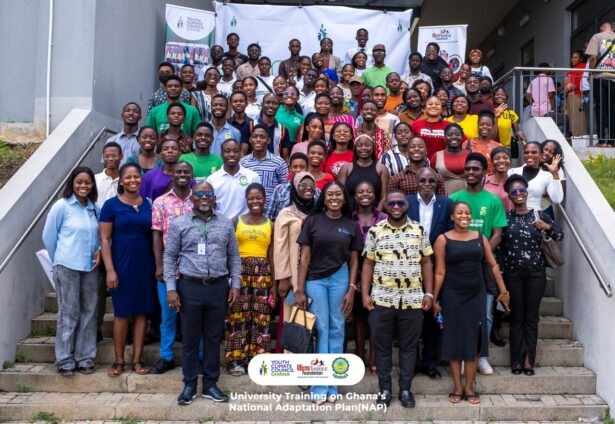
The call was made by the Research and Policy Officer of the Youth Climate Council Ghana (YCCG), Emmanuella Manchaya Kalari, during a training session on Ghana’s NAP held on April 1, 2026, at the UESD campus. The programme, organised by YCCG in partnership with the Youth Bridge Foundation (YBF), aimed to empower university students to translate national climate policies into tangible community action.
Ms Kalari said the NAP is not a technical document reserved for policymakers, but a framework that depends on youth leadership to take shape at the local level.
“Young people are key drivers of climate policies, and the NAP creates real opportunities for us to engage, influence decisions, and lead action in our communities,” she said. “The responsibility now is for us to step forward and take up that space.”
She noted that universities are among the most strategic platforms for nurturing climate action, adding that students must move beyond general awareness and engage directly with adaptation priorities such as water resources, health, food systems and biodiversity.
Dean of Students at UESD, Prof. Daniella Delali Sedega, described the training as timely, given the rising climate risks facing the country. She encouraged students to position themselves as essential partners in implementing the NAP across communities and sectors.
According to her, the plan presents several avenues for youth participation, especially in agriculture, ecosystem protection, health resilience and climate-smart infrastructure. She emphasised that the country’s ability to build long-term resilience will depend partly on the commitment and innovation of young people.
The session offered students an in-depth understanding of Ghana’s NAP — a national framework designed to strengthen resilience across districts and guide long-term planning for climate impacts. Discussions explored practical solutions for key priority areas, including food security, water management and ecosystem conservation.
Organisers said bridging the gap between policy and impact requires an informed and empowered youth base, adding that sustained engagement on university campuses will be essential as Ghana works toward a climate-resilient future.
Latest Stories
-
BDCs lobby NPA for regional fuel depots amid concerns over BOST’s role
4 minutes -
Green means Business: How Ghana’s garden revolution is growing jobs, wealth and hope
5 minutes -
Ahafo Regional Minister cuts sod for 24-hour market project in Tano North
11 minutes -
PURC resolves over 97 per cent of complaints lodged during first half of 2026
17 minutes -
New DVLA office opens in Asuogyaman to improve access, fight licensing fraud
23 minutes -
Ga-Dangmes urged to preserve lands, culture for future generations
28 minutes -
Organised Labour pledges support for IPEC establishment
40 minutes -
South Africa returnees form ‘Evacuation Boys’ to support sanitation in Ghana
43 minutes -
Tema Traditional Council calls for cleaner environment, responsible parenting
49 minutes -
Ghana–Namibia relations must be people-centred – Gunu
55 minutes -
Dialogue is key in the establishment of IPEC – Labour Minister
55 minutes -
Cedi appreciates against US dollar from GH¢11.75 – 10.94 in one week
1 hour -
GBA’s legal vacation argument is ‘bizarre’ and ‘not workable’ – Srem-Sai
1 hour -
FWSC consults Organised Labour on transition to IPEC
1 hour -
Why Afrobeats artistes shouldn’t stick to what fans like – Rema
1 hour