

Audio By Carbonatix
The Minority in Parliament has rejected suggestions that the recent fire incident at the Akosombo substation is responsible for the ongoing power outages affecting parts of the country, insisting that the crisis predates the event.
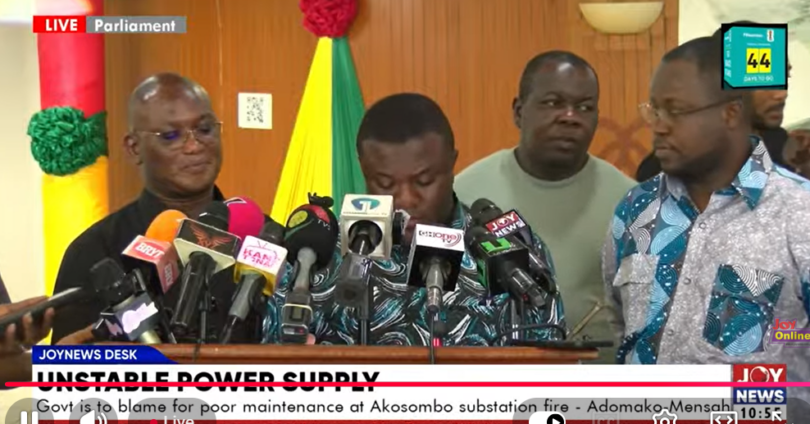
At a press conference on Tuesday, April 28, the Deputy Ranking Member on Parliament’s Energy Committee, Collins Adomako-Mensah, argued that the current electricity challenges, commonly referred to as "dumsor," began long before the 23 April incident.
He stated that Ghana’s power crisis, which millions of citizens have reportedly been experiencing since 25 January, cannot be attributed to any isolated fault or accident at Akosombo.
"Ghana's power crisis, the dumsor that millions of Ghanaians have been enduring since January 25, was not caused by any accident at Akosombo. It was caused by this government,” he said.
Mr. Adomako-Mensah further described the April 23 incident as “the latest and most dramatic symptom” of what he called a deteriorating power sector.
“The events of 23rd April are the latest and most dramatic symptom of a power sector left to decay under the NDC's incompetent stewardship,” he said.
He cautioned against attributing the crisis to the Akosombo incident, arguing that doing so would misrepresent the origins of the problem.
“The Mahama government must not be permitted to use this incident as a convenient alibi for a crisis that predates it by more than a year, and the Minority will not allow that cynical rewriting of history to pass unchallenged,” he added.
The Minority also outlined a timeline of power disruptions, stating that Ghanaians had been experiencing persistent outages well before the substation fire.
“Long before the event of 23rd April 2026, Ghanaians across every region of this country had been enduring persistent, unannounced, and devastating power outages,” he said.
He further noted that the Electricity Company of Ghana (ECG) had issued multiple emergency and maintenance notices in April, alongside public apologies from its leadership over unstable power supply and damage to electrical appliances.
According to him, the situation had already placed significant strain on households, businesses, and essential services.
“Communities were living in darkness, not for hours, but for days. Industries were hemorrhaging losses. Cold stores were warm. Hospitals were straining on generators,” he stated, adding that "that was the reality of Ghana's power sector before any incident at Akosombo.
He maintained that these conditions existed before the Akosombo incident and should not be overlooked in assessing the broader energy situation.
Latest Stories
-
Joyce Bawah Mogtari urges women leaders to build strong support networks
14 seconds -
Bawumia engages GUTA over import duties, VAT and rising business costs
55 seconds -
Fuel prices begin to fall as Star Oil cuts petrol to GH¢16.45
2 minutes -
GoldBod supplies banks with US$282m in weekly forex sales
3 minutes -
Joyce Bawah Mogtari says Obaasima Conference should help women connect and learn
5 minutes -
Nzema East launches Responsible Cooperative Mining Programme to tackle environmental destruction
33 minutes -
Ghana included in WHO lead-testing programme as questions remain over local exposure risks
42 minutes -
2026 Amputee World Cup: We will win the trophy – Samson Deen
50 minutes -
Controller and Accountant-General pays promotion arrears to 56,003 GES teachers ahead of deadline
50 minutes -
2026 Amputee World Cup: We want to make the continent proud – Black Challenge coach
55 minutes -
International Day of the Girl: Central Region Education Directorate calls for action to tackle child marriage, teenage pregnancy
1 hour -
The Eyes of Ghana: iShowSpeed joins Obamas as producers of Chris Hesse documentary
1 hour -
FirstBank Ghana pledges action on customer feedback at service week forum
2 hours -
Sahara Group urges journalists to look beyond fuel prices in energy reporting
2 hours -
Today’s front pages: Friday, October 16, 2026
2 hours