

Audio By Carbonatix
Monitoring water quality is pivotal in ensuring safe water consumption.
However, a study revealed that about 23 million people in Ghana use water that may not follow standard treatment processes.
While some African countries suffer from a lack of water, Ghana is battling with polluted water.
To address this issue, the Aquaya Institute, a non-governmental organisation in collaboration with the Department of Civil Engineering, Kwame Nkrumah University of Science and Technology, has identified 30 pipe systems in 12 districts in both the Bono and Ahafo regions to undergo water quality testing under the Rural Evidence and Learning for water (REAL-Water) project. The REAL-Water project is an initiative of the United States Agency for International Development (USAID).
In 2020, the Aquaya Institute collaborated with Ghana Water Company Limited to pilot an approach to address poor water quality in Asutifi North district of the Bono region.
This led to the formation of the Water Quality Assurance Fund.
The fund is a promising mechanism to promote regular water quality testing in rural areas, which can improve water safety management.
The system now serves over 26,000 people in the district.
The Water Quality Assurance Fund project is meant to ensure that payment is made to laboratories for testing activities and reduce the risk of non-payment by the small water systems.
The purpose of the water quality assurance fund is to support rural small-town water systems to conduct regular water monitoring at Ghana water company limited (GWCL) laboratories to guarantee the quality of drinking water.
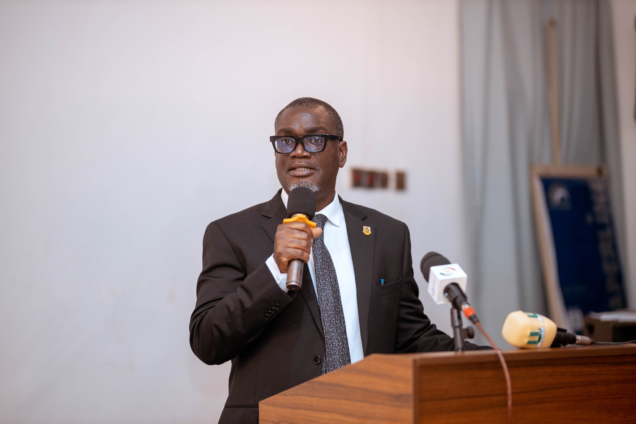
Speaking at the launch of the fund, Professor Kwabena Biritwum Nyarko, Provost of the College of Engineering at the Kwame Nkrumah University of Science and Technology, emphasized the importance of water quality testing.
"For the quality assurance fund, safe water is important and to make sure that you are delivering safe water, it is important to test water. The system should be managed professionally.
“Providing safe water means monitoring it and to be convinced you are delivering safe water, it is important to test water.
"The Assurance fund is providing a guarantee to ensure that even in an unlikely situation when payments required are not made, the assurance fund will set in so GWCL will provide a monthly testing, and the systems will make the payment," he said.
Justina Owusu Banahene, the regional minister for the Bono region, cautioned the locals to refrain from disciplinary acts which lead to the destruction of the ecosystem.
"We must endeavour to desist from practices such as pollution of water bodies, indiscriminate littering of the environment, deliberate indulgence in open defecation and lack of maintenance culture which are bane to our socio-economic development," she said.
She urged stakeholders and participants to help make the project become a success.
“I wish to crave the indulgence of all participants and parties in the water quality assurance chain to commit yourselves to ensure that this programme becomes a success for the benefit of our people."
Jeffery Albert, the Deputy Director for REAL-Water at Aquaya encouraged stakeholders not just to know the rules of water quality testing but to practice it as well.
"Follow the rules on water quality testing, that is, collecting the water samples and running the test, not just knowing about the rules and talking about them but actually doing it.
"As you know, when the water providers test the water carefully and frequently, they do two essential things, one is to identify problems quickly and act on it, secondly, when customers believe in your service, they know that you care and the water you are delivering is safe, and they will understand why they pay tariffs,” he said.
The facilitators of the regional launch, Dr. Eugene Appiah-Effah (KNUST) and Mr. Bashiru Yachori (Aquaya), were optimistic that the assurance programme will professionalise rural water, improve sustainable water safety management practices in rural water systems and contribute toward achieving Sustainable Development Goals (SDG) 6.1 by 2030.
The project is funded by the United States Agency for International Development (USAID) and the Conrad N. Hilton Foundation (CNHF).
Latest Stories
-
Let The Constitution direct Chieftaincy to deliver “All Development Is Local”
14 minutes -
Ghana explores centre of excellence for hearing, communication and cochlear implant care
2 hours -
Schizophrenia-related disorders lead mental health cases recorded in Ghana
2 hours -
Dutch authorities enlist Ghana in hunt for fugitive drug lord Bolle Jos
2 hours -
Ghana housing finance conference adopts communiqué to improve affordable housing access
7 hours -
Special Initiatives Minister urges Wa Technical Institute to enrol more girls as EU-backed solar training lab opens
7 hours -
In the matter of my first year at the Bar
7 hours -
ActionAid Ghana calls for an end to child marriage, greater investment in girls’ rights
8 hours -
Newsfile to tackle World Cup visa scandal, beach demolitions, education strikes, BRICS bid
8 hours -
UK-Ghana Trade & Investment Summit: Trade Resource Centre to help businesses maximise UK-Ghana trade opportunities
8 hours -
Embassy of Denmark celebrates World Maritime Day
8 hours -
Linking LEAP to productive inclusion could cut extreme poverty by 2030 – UNICEF
9 hours -
Trade Ministry backs use of creative arts to rehabilitate prison inmates
9 hours -
Negotiations with government to continue despite strike suspension – GNAT
10 hours -
‘Ghana cannot afford to waste public resources; every cedi has a job’ – Ato Forson
10 hours