

Audio By Carbonatix
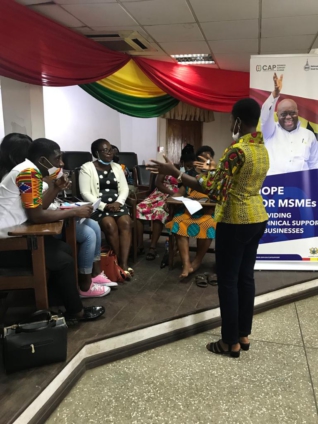
The National Board for Small Scale Industries (NBSSI) as part of its mandate to support private businesses to recover from the effects of Covid-19 has organised an Entrepreneurship, Business Management and Financial Literacy training for Micro, Small and Medium Scale Enterprises (MSMEs).
The event which has been running since Monday, September 28, targets about 8,100 beneficiaries that received financial support under the Coronavirus Alleviation Programme Business Support Scheme (CAP BuSS) across the country.
The training exercise is expected to end on Saturday, October 31, 2020.
The ongoing training programme includes financial management, bookkeeping, basic accounting and formalization of businesses. It is hoped that these topics will contribute positively to the agenda of NBSSI to push for the formalization of MSMEs in Ghana.
The training programmes are being facilitated by representatives of NBSSI and professionals with experience in financial literacy and business formalization.
The initiative forms part of the technical support aspect of the Scheme being implemented by the NBSSI to assist beneficiaries of the CAP BuSS initiative to equip them with additional skills and knowledge to grow and sustain their business.
Since the inception of the Scheme, NBSSI made it known that the Scheme will not only focus on providing financial support to these beneficiaries but will be equally dedicated to ensuring that beneficiaries utilise the funds in order to grow and sustain their businesses which will motivate repayment.
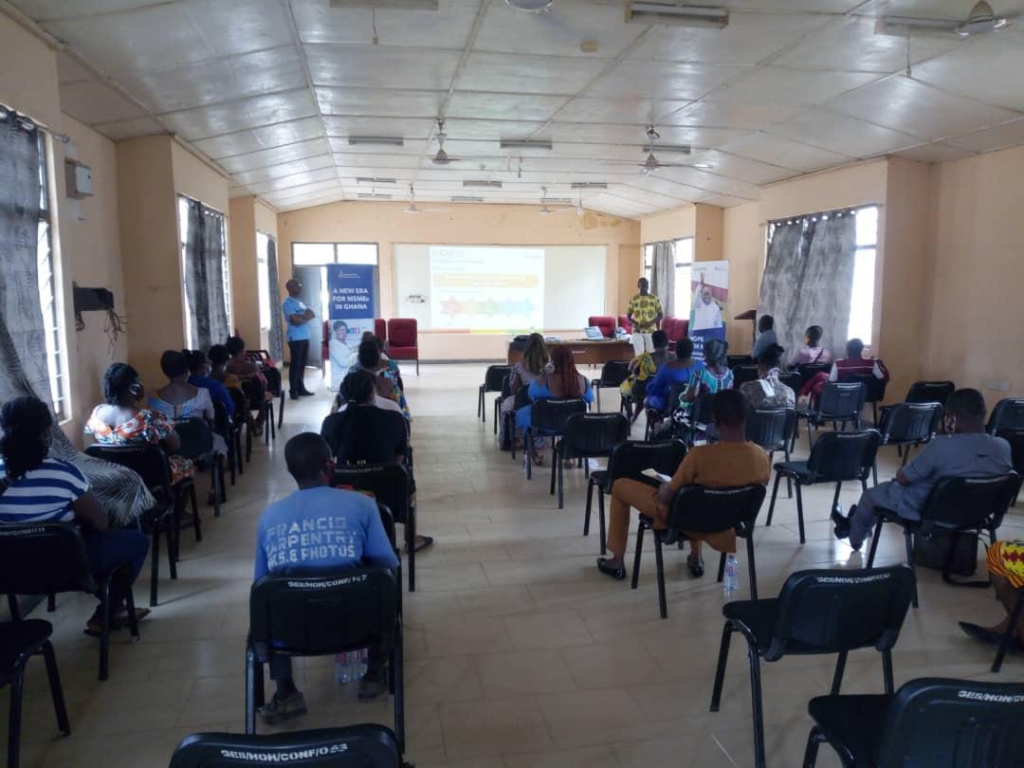
The NBSSI has also indicated that its 185 offices are opened to assist MSMEs all year round.
While at it, the NBSSI has taken into consideration the necessary Covid-19 health protocols to ensure that participants are safe.
Provision has been made for Personal Protective Equipment (PPEs) including hand sanitizers, soaps, nose masks, water and veronica buckets. Social distancing is also being observed.
Why the CAP BuSS was set up
The CAP BuSS was instituted by the President, His Excellency Nana Addo Dankwa Akufo-Addo to provide support to MSMEs negatively impacted by the Coronavirus Pandemic.
In Ghana, MSMEs account for 92% of businesses and contribute to about 70% of Gross Domestic Product (ISSER, University of Ghana, 2015). Undoubtedly, MSMEs are the pulse of the Ghanaian economy. It is these businesses that keep the lights on in Ghana.
Currently, about 237,518 MSMEs have received disbursements from the Scheme. Beneficiaries include businesses in the manufacturing, health care and pharmaceutical, water and sanitation, textiles and garments, education and hospitality sectors.
Latest Stories
-
How healthy is Ghana’s health sector?
3 minutes -
HACSA Tech4Girls graduates 80 young women with digital and technology skills
4 minutes -
Arrest of Manhyia South MP should involve Parliament, not police station – Kpebu
36 minutes -
Two Nigerians sentenced to 189 months in US prison over $2.4m cyber fraud
59 minutes -
Cristiano Ronaldo leaves Portugal’s training camp after rift with Head Coach
1 hour -
Ghana Energy Awards opens nominations for landmark 10th anniversary edition
1 hour -
Aayalolo contra-flow: Are we treating the symptom instead of the disease?
1 hour -
GTEC orders Colleges of Education to begin 2026/2027 admissions despite fees approval delay
1 hour -
Legal reforms must solve real problems, improve justice – Bagbin
1 hour -
Ofori-Sarpong named Alumni President of the Year, honoured for PRESEC dormitory project
2 hours -
Germany commits $132m to Ghana for skills development and training university – Pelpuo
2 hours -
‘Influence should go beyond visibility’ – Taadi Banyinba GH launches The TB Impact
2 hours -
Videos: Government announces emergency LEAP package for Hohoe flood victims
2 hours -
Salomey Baffoe’s children are crying for their mother – Family appeals for her release
2 hours -
Shortage of trained investigators and prosecutors hampers Ghana’s fight against money laundering – Report
2 hours