


Audio By Carbonatix
Ballots are being counted in Nigeria's closely fought general election, although voting has been extended to a second day in a handful of places.
Due to logistical problems and some cases of violence, polls have been put back to a later date in a few areas.
President Muhammadu Buhari, 76, is seeking a second term. His main challenger is former Vice-President Atiku Abubakar, 72.
The election had been due last week but was delayed at the last minute.
Whoever wins in Africa's most populous nation and largest economy will have to address power shortages, corruption, security threats, and an economic slowdown.
President Buhari cast his ballot in his hometown of Daura in the northern state of Katsina. Asked if he would congratulate his rival if he lost, he said: "I will congratulate myself."
Mr Abubakar, a business tycoon, also said he was confident of victory.
The main results centre is expected to open at 18:00 local time (17:00 GMT) in the capital, Abuja, but final results are not expected until Monday at the earliest.
Was the election peaceful?
Most of the country was calm but there were reports of attacks by the Boko Haram Islamist militant group in the north, and voter intimidation and attempts to steal ballot boxes from some polling stations, especially in the southern states of Rivers, Lagos and Anambra.
Two people were arrested in the Surulere district of the commercial capital, Lagos, after voters were attacked by a group of young men "brandishing weapons: cutlasses, axes and stakes", one witness told the BBC.
"What they were saying was that if you were not [voting for the ruling party] APC, you'll be attacked," Ralph Onodike, who sustained an arm injury, told the BBC.
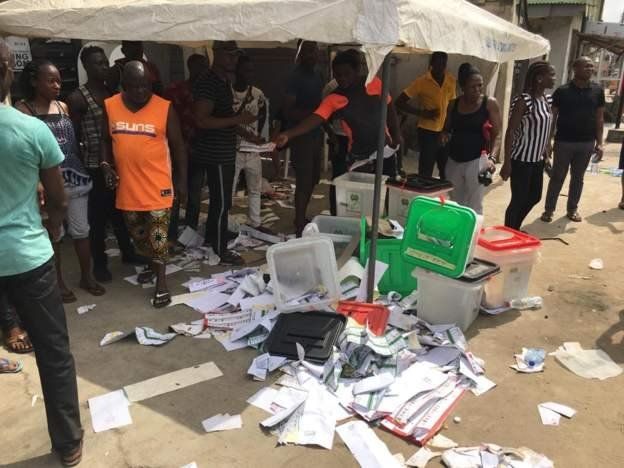
Photo: These ballot boxes were destroyed in the Isolo district of Lagos
The Independent National Electoral Commission (Inec) said that voting had not been possible in about 8,500 of the 120,000 polling stations around the country, reports the AFP news agency.
But Inec official Festus Okoye said the commission was "generally satisfied with the process and the procedures for the conduct of these present elections". He said 68% of polling units had opened by 10:00, according to Reuters news agency.
The initial vote was rescheduled in a dramatic press conference in the early hours of Saturday 16 February, just five hours before polls were due to have opened.
Voters were also choosing members of the House of Representatives and Senate.
How does the election work?
The candidate with the most votes is declared the winner in the first round, as long as that person gains at least 25% of the votes in two-thirds of Nigeria's 36 states.
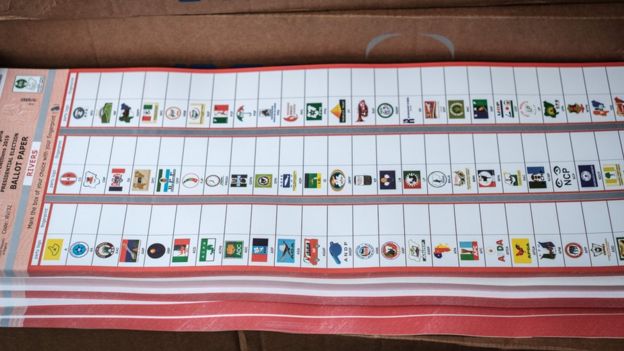
There are 73 registered candidates in the presidential election, but campaigning has been dominated by the two political giants and the established party machines behind them.
The president's All Progressives Congress (APC) has promised to take the country to the "next level", arguing that in his first four-year term Mr Buhari has done a lot of "foundational work" that may not be immediately obvious.
Mr Abubakar and his People's Democratic Party have pledged "to get Nigeria working again", saying that the president has wasted the last four years.
Both men are from the mainly Muslim north of the country. While they are in their 70s, more than half of Nigeria's 84 million registered voters are under 35.
What are the main issues?
Nigeria is Africa's largest oil producer but corruption and a failure to invest the proceeds from the industry have hampered development in the country.
It slipped into a recession in 2016 and a slow recovery has meant that not enough jobs have been created to cope with the large number of young people coming into the employment market. Currently, nearly a quarter of the working age population is unemployed.

Election in numbers
- 73 million have voters' cards
- 51% of the electorate under the age of 35
- 73 registered presidential candidates
- 120,000 polling stations
Mr Buhari has quelled a militant Islamist rebellion in the north-east of the country, but Boko Haram remains active. There has also been an upsurge in violence in the country's Middle Belt as traditional herders and more settled farmers have clashed.
Until 1999 Nigeria was governed by either short-lived civilian administrations or military rulers. But this year marks 20 years since the return of democracy.
Mr Buhari was elected in 2015 - the first time an opposition candidate had defeated an incumbent to become president.
Latest Stories
-
Mission schools have the right to remain 100% Christian – Christian Apologetic Alliance
17 seconds -
UG reopens portal for applicants to review entries after WASSCE results
42 minutes -
Ampem Darkoa Ladies miss out on CAF Champions League qualification after penalty shootout loss
2 hours -
Herbal Medicine: Less than 15% practitioners registered
5 hours -
Road inspections not a witch-hunt against contractors — Agbodza
5 hours -
HTU clinic upgraded to primary hospital after HeFRA inspection
5 hours -
“When I am gone, just like Kwame Nkrumah people will appreciate me” – Kurt Okraku
6 hours -
“I love people who are not only critical but constructive” – Kurt Okraku
6 hours -
TECNO’s Modular Phone and TAURUS win gold at IFA 2026, recognising breakthroughs in mobile and gaming technology
6 hours -
Youth Forum in Accra calls for debt cancellation, reparations and African economic independence
6 hours -
Dr Abu Sakara urges African youth to seize global upheaval for economic emancipation
6 hours -
Fulham booed off after third defeat in a row
6 hours -
Joy FM Back-to-School Fair 2026 ends in massive success after two days of discounts and one-stop shopping
6 hours -
Man City maintain 100% start with win over Coventry
7 hours -
Kwesi Pratt urges African youth to reject ‘Gen Z revolution’, reclaim Africa’s resources
7 hours