

Audio By Carbonatix
The Traditional Medicine Practice Council (TMPC) has disclosed that less than 15 per cent of more than 100,000 traditional medicine practitioners in the country are currently registered in its database.
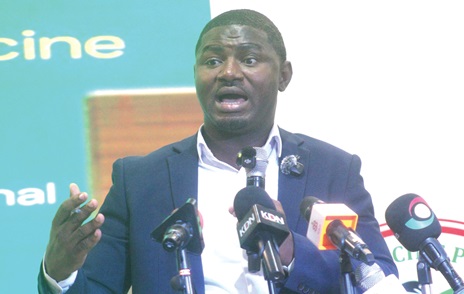
The Registrar of the council, Dr (MH) Yakubu Tobor Yusuf, said the registration gap made it difficult for the council to bring practitioners under proper regulatory oversight.
He said the council had, over the past six months, been engaging practitioner associations at the district level to register more practitioners, and had opened new regional and district offices to bring its services closer to them.
Dr Yusuf disclosed this at a media launch to commemorate the 2026 African Traditional Medicine Day in Accra last Thursday.
He said TMPC had also inspected more than 500 traditional medicine practice premises across the country, with some facilities closed because they posed risks to public health.
“We found out that the numbers are mind-boggling. Over 100,000. Now the ones that we've worked with, I said we've visited over 500 premises,” he said.
Dr Yusuf urged members of the public to ensure that they patronised only licensed traditional medicine practitioners and products that had gone through the required regulatory processes.
He said every licensed practice premise was required by law to display its licence, which had a QR code that could be scanned to verify the status of the practitioner.
“To the Ghanaian public: before you are treated, ask to see the licence. It must be displayed on the wall,” he said.

He also cautioned the public against practitioners who used social media platforms to market unregistered medicines.
He said the council had tracked more than 500 practitioners operating in unregulated areas on social media and would take action against them.
“Tell the public to stay away from some of these people unless they are licensed practitioners and have been licensed to do so,” he said.
Dr Yusuf said the council was also working closely with the Food and Drugs Authority (FDA) to ensure that products requiring certification and registration were referred to the authority.
He explained that while licensed practitioners could prepare fresh, unlabelled and unbranded herbal preparations for patients, products that were stored, labelled or branded had to be submitted to the FDA for certification and registration.
The Registrar warned that practitioners who operated without licences risked prosecution and imprisonment.
He said the law provided for a summary conviction of up to 500 penalty units (or GH¢6,000), two years’ imprisonment or both for practising without a licence.
Dr Yusuf disclosed that a traditional medicine practitioner in the Volta Region had been arrested and was expected to be put before court for allegedly practising without a licence.
“Practising without a licence, you could go to jail for two years,” he said.
He added that licences were not issued once and for all, explaining that practitioners were required to renew them annually.
The TPMC Registrar said renewal was subject to continuous professional development (CPD), payment of the prescribed fees and re-inspection of the practitioner’s premises.
Dr Yusuf said the council was also working to improve the training of indigenous practitioners as part of efforts to raise standards in the sector.
He said the Governing Board was reviewing a six-month competency-based curriculum for indigenous practitioners, including herbalists, bone setters, birth attendants and spiritual healers.
He said the programme would abe taught in local languages and would take into account the years of experience of practitioners.
The Registrar also called for greater investment in research into traditional medicine, saying traditional knowledge needed to be subjected to research to establish its safety, quality and effectiveness.
He said KNUST and Central University were leading research into standardised herbal products for the management of hypertension and the relief of pain, with support from German
Technical Cooperation, GIZ, and PharmaVax.
Dr Yusuf said that about 70 per cent of the Ghanaian population relied on herbal and traditional medicine as part of their primary health care, making research and regulation necessary to ensure that such medicines were safe for public use.
Latest Stories
-
Committee set up to validate teachers eligible for 20% deprived-area allowance – Education Minister
1 minute -
Five-member committee to search for new Black Stars coach after Sports Ministry-GFA meeting
36 minutes -
Pinktober: Breast cancer survival exceeds 90% when detected early – Breast Society of Ghana
43 minutes -
TCDA to adopt Upper West’s MATCO mango farm as northern prototype, issues warning against felling shea trees
53 minutes -
‘Fear delegates’ tag: Afoko touts genuineness among delegates ahead of NPP delegates conference
56 minutes -
John Boadu: The leader our party needs at this time – Amb. Edward Akwasi Boateng
1 hour -
Baffour Awuah: EOCO effected an arrest, detained MP after hours of waiting, questioning – Afenyo-Markin
1 hour -
EOCO court warrant authorised search of Baffour Awuah’s law firm, not residence – Afenyo-Markin
2 hours -
NPP delegates conference: 3,000 to 4,000 police personnel deployed for security in Kumasi – Anthony Karbo
2 hours -
KGL Foundation commits $200,000 to support juvenile football for the next two years
2 hours -
UNDP invites Mahama Ayariga to Northern Peace Conference in Tamale
2 hours -
Afoko can give NPP ‘new identity’ ahead of 2028 to overcome NDC – Political scientist, Dr Amakye-Boateng
2 hours -
2 injured amid gunshots during raid at Nawara Mining office at Nsuapemso
2 hours -
St Augustine’s College retains 2026 National Investment Quiz title
2 hours -
KNUST Nursing and Midwifery School staff recognised at 2026 Health Ministry Excellence Awards
2 hours