


Audio By Carbonatix
Algeria's President Abdelaziz Bouteflika is resigning after weeks of mass protests, state media report.
Mr Bouteflika, who had been in power for 20 years, had already dropped plans to seek a fifth term as opposition to his rule grew.
The powerful Algerian army had called for the 82-year-old to be declared incapable of carrying out his duties.
The ailing leader suffered a stroke six years ago and has rarely appeared in public since.
How was his resignation announced?
A statement was carried on state news agency APS.
"The president of the republic, Abdelaziz Bouteflika, has officially notified the president of the constitutional council of his decision to end his mandate as president of the republic," it said.
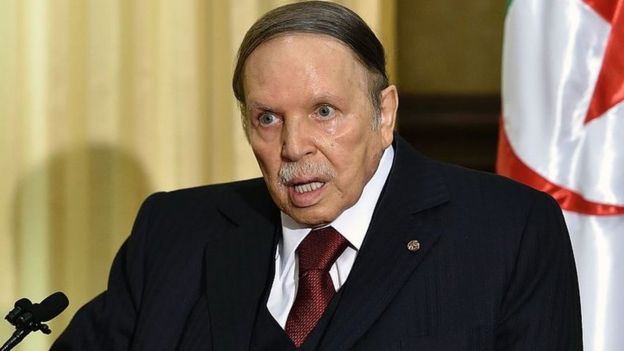
Image caption: President Abdelaziz Bouteflika has led Algeria since 1999
State TV then reported that this would be with immediate effect.
How did it come about?
Pressure had been building since February when the first demonstrations were sparked by Mr Bouteflika's announcement that he would be standing for a fifth term.
Tens of thousands protested across the country on 1 March. Mr Bouteflika's promise not to serve out a fifth term if re-elected, along with a change of prime minister, failed to quell the discontent.
Leaders of the protests also rejected Mr Bouteflika's offer this week that he would go by the end of his current term - 28 April - as not quick enough.
It seems the powerful military agreed. Its chief, Lt Gen Ahmed Gaed Salah, said earlier on Tuesday: "There is no more room to waste time."
Why have the protests grown?
The demonstrations have also called for the whole political system, in which the military plays a significant role, to be overhauled.
Many of the protesters are young and say they want a new system of government.
There were accusations that Mr Bouteflika was being used as a front by "le pouvoir" - a group of businessmen, politicians and military officials - to retain their power.
Elections originally scheduled for 18 April were postponed and the governing National Liberation Front (FLN) vowed to organise a national conference on reforms.
The FLN has ruled Algeria since the country won independence from France in 1962 after seven years of conflict.
Mr Bouteflika, who came to power in 1999, strengthened his grip after a bloody civil war against Islamist insurgents which left 150,000 dead.
The chairman of the upper house of parliament, Abdelkader Bensalah, is expected to become caretaker president for three months until elections.
What has the reaction been?
Car horns could be heard in the streets of the capital, Algiers, as hundreds of people waving flags celebrated.
One protest leader, Mustapha Bouchachi, told Reuters before the announcement that any decision by Mr Bouteflika to quit would still change nothing and that the protests would continue.
Latest Stories
-
Mission schools have the right to remain 100% Christian – Christian Apologetic Alliance
4 minutes -
UG reopens portal for applicants to review entries after WASSCE results
46 minutes -
Ampem Darkoa Ladies miss out on CAF Champions League qualification after penalty shootout loss
2 hours -
Herbal Medicine: Less than 15% practitioners registered
5 hours -
Road inspections not a witch-hunt against contractors — Agbodza
5 hours -
HTU clinic upgraded to primary hospital after HeFRA inspection
5 hours -
“When I am gone, just like Kwame Nkrumah people will appreciate me” – Kurt Okraku
6 hours -
“I love people who are not only critical but constructive” – Kurt Okraku
6 hours -
TECNO’s Modular Phone and TAURUS win gold at IFA 2026, recognising breakthroughs in mobile and gaming technology
6 hours -
Youth Forum in Accra calls for debt cancellation, reparations and African economic independence
6 hours -
Dr Abu Sakara urges African youth to seize global upheaval for economic emancipation
6 hours -
Fulham booed off after third defeat in a row
6 hours -
Joy FM Back-to-School Fair 2026 ends in massive success after two days of discounts and one-stop shopping
6 hours -
Man City maintain 100% start with win over Coventry
7 hours -
Kwesi Pratt urges African youth to reject ‘Gen Z revolution’, reclaim Africa’s resources
7 hours