


Audio By Carbonatix
In an unprecedented move, Eritrean bishops in the Orthodox church have expelled their former patriarch, Abune Antonios.
Antonios, who was the head of the church until 2006, was accused of heresy in a statement signed by a group of top bishops.
He has for a long time been a critic of the government and was deposed and put under house arrest 13 years ago.
His followers accuse the government of interfering in church affairs.
He was deposed in 2006 after he refused to excommunicate 3,000 members of a Sunday school movement.
But analysts believe he was deposed so the Eritrean government could have full control of the Eritrean Orthodox Church, reports BBC Tigrinya's Teklemariam Bekit.
When he was deposed he was put under house arrest, where he remains.
In April he secretly filmed a video where he objected to the church being led by layman Yoftahe Dimetros.
The letter from the bishops said that his recent activities made the church realise that "his repentance was not genuine" and that the church was "becoming a congregation of heretics" so they decided to expel him.
"His name should never be mentioned and remembered and those who do will be punished severely," the letter added.
Five of the six most powerful bishops in the country signed the letter. It is not clear why one signature is absent.
Although he was expelled from being a member of the church, the bishops promised he could still live in a church building.

What is heresy?
The Oxford English Dictionary defines heresy as "religious opinion or doctrine maintained in opposition, or held to be contrary, to the 'catholic' or orthodox doctrine of the Christian Church".
It's a controversial term with negative connotations as critics say it is an example of religious intolerance and repression and used to silence free discussion.
Orthodox Christians make up one of the main religious groups within Eritrea.
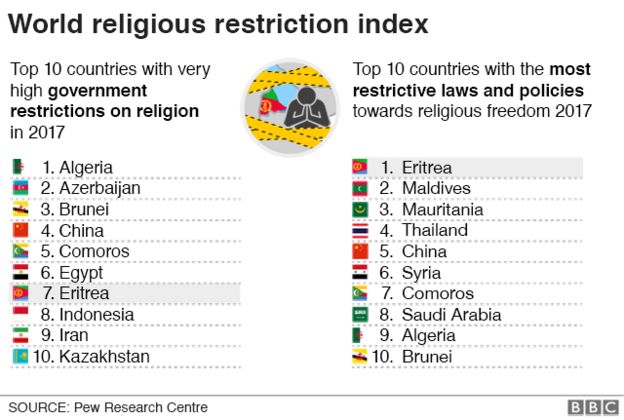
Only four religious groups are allowed to operate in the country; the Eritrean Orthodox, Evangelical Lutheran and Catholic churches, and Sunni Islam.
In June the Catholic church said that the government had closed down all their health centres after the church called for reforms to stem the tide of migration to Europe.
Eritrea became an independent state in 1993, and has been under President Isaias Afwerki's rule ever since.
His critics accuse him of leading a repressive state, but his supporters deny this.
Latest Stories
-
Mission schools have the right to remain 100% Christian – Christian Apologetic Alliance
55 minutes -
UG reopens portal for applicants to review entries after WASSCE results
2 hours -
Ampem Darkoa Ladies miss out on CAF Champions League qualification after penalty shootout loss
3 hours -
Herbal Medicine: Less than 15% practitioners registered
5 hours -
Road inspections not a witch-hunt against contractors — Agbodza
6 hours -
HTU clinic upgraded to primary hospital after HeFRA inspection
6 hours -
“When I am gone, just like Kwame Nkrumah people will appreciate me” – Kurt Okraku
7 hours -
“I love people who are not only critical but constructive” – Kurt Okraku
7 hours -
TECNO’s Modular Phone and TAURUS win gold at IFA 2026, recognising breakthroughs in mobile and gaming technology
7 hours -
Youth Forum in Accra calls for debt cancellation, reparations and African economic independence
7 hours -
Dr Abu Sakara urges African youth to seize global upheaval for economic emancipation
7 hours -
Fulham booed off after third defeat in a row
7 hours -
Joy FM Back-to-School Fair 2026 ends in massive success after two days of discounts and one-stop shopping
7 hours -
Man City maintain 100% start with win over Coventry
7 hours -
Kwesi Pratt urges African youth to reject ‘Gen Z revolution’, reclaim Africa’s resources
7 hours