

Audio By Carbonatix
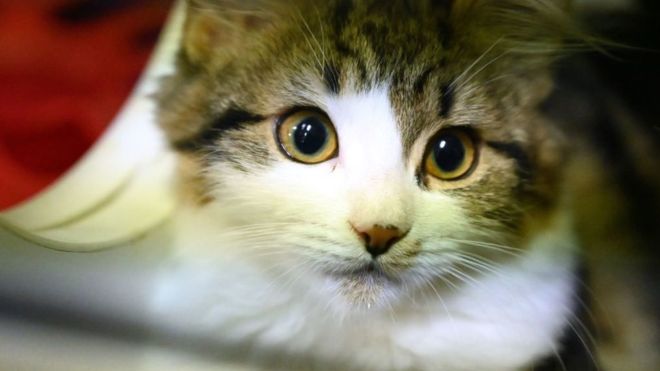
Shenzhen has become the first Chinese city to ban the sale and consumption of dog and cat meat.
It comes after the coronavirus outbreak was linked to wildlife meat, prompting Chinese authorities to ban the trade and consumption of wild animals.
Shenzhen went a step further, extending the ban to dogs and cats. The new law will come into force on 1 May.
Thirty million dogs a year are killed across Asia for meat, says Humane Society International (HSI).
However, the practice of eating dog meat in China is not that common - the majority of Chinese people have never done so and say they don't want to.
"Dogs and cats as pets have established a much closer relationship with humans than all other animals, and banning the consumption of dogs and cats and other pets is a common practice in developed countries and in Hong Kong and Taiwan," the Shenzhen city government said, according to a Reuters report.
"This ban also responds to the demand and spirit of human civilization.
Animal advocacy organisation HSI praised the move.
"This really could be a watershed moment in efforts to end this brutal trade that kills an estimated 10 million dogs and 4 million cats in China every year," said Dr Peter Li, China policy specialist for HSI.
However, at the same time as this ruling, China approved the use of bear bile to treat coronavirus patients.
Bear bile - a digestive fluid drained from living captive bears - has long been used in traditional Chinese medicine.
The active ingredient, ursodeoxycholic acid, is used to dissolve gallstones and treat liver disease. But there is no proof that it is effective against the coronavirus and the process is painful and distressing for the animals
Brian Daly, a spokesman for the Animals Asia Foundation, told AFP: "We shouldn't be relying on wildlife products like bear bile as the solution to combat a deadly virus that appears to have originated from wildlife."
A wildlife market
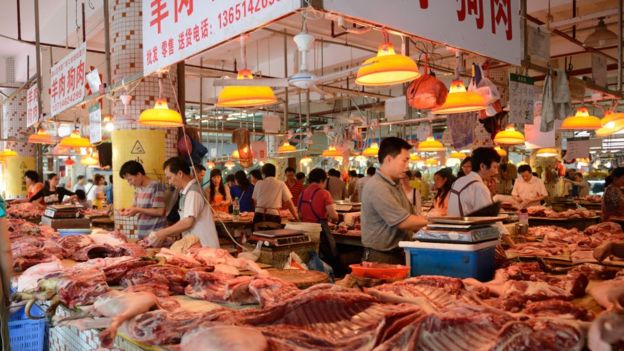
In February, Chinese authorities banned the trade and consumption of wild animals.
The move came after it emerged that a market in Wuhan selling wild animals and wildlife meat could have been the starting point for the outbreak of the new coronavirus, providing the means for the virus to travel from animals to humans.
News of this led the Chinese government to crack down strongly on the trade and on the markets that sold such products.
There are now close to one million confirmed cases of the virus worldwide, and more than 47,000 deaths, according to a Johns Hopkins University tally.
In China alone, there are 81,589 confirmed cases and 3,318 deaths, said the National Health Commission.
Scientists and researchers are still no closer to finding out what the source of the virus is and how it could have spread to humans.
Latest Stories
-
UHAS halts semester exams over administrative, logistical issues
2 hours -
ECG announces planned maintenance outages in parts of Ashanti Region
2 hours -
Sexual harassment has no place in educational institutions – Education Ministry
2 hours -
The growing culture of vacation classes in Ghana: Should students rest or continue schoolwork?
3 hours -
E.P. Church secures radio frequency, prepares to launch Bremen Radio
3 hours -
Two dead and hundreds evacuated as twin fires break out on Greek island
3 hours -
EPCG clears over GH¢11.7m in debt as outgoing moderator calls for tighter controls on borrowing
3 hours -
Mövenpick Ambassador Hotel Accra marks 15 years of premium hospitality
3 hours -
T-bills auction: Government exceeds target by 88%, interest rates tumble
4 hours -
Western North: Confusion erupts over NPP chairmanship election results
5 hours -
Bawumia congratulates newly elected NPP regional executives
5 hours -
Bawumia urges unity after NPP regional elections ahead of 2028
5 hours -
Russia says at least seven killed in largest Ukrainian attack of 2026
5 hours -
Ghana and Netherlands sign pact to combat illicit drugs and drug markets
5 hours -
Akandoh warns Boards against interfering in day-to-day management of health institutions
5 hours