

Audio By Carbonatix
Conspiracy theories claiming 5G technology helps transmit coronavirus have been condemned by the scientific community.
Videos have been shared on social media showing mobile phone masts on fire in Birmingham and Merseyside - along with the claims.
The posts have been shared on Facebook, YouTube and Instagram - including by verified accounts with hundreds of thousands of followers.
But scientists say the idea of a connection between Covid-19 and 5G is "complete rubbish" and biologically impossible.
The conspiracy theories have been branded "the worst kind of fake news" by NHS England Medical Director Stephen Powis.
Conspiracy theory
Many of those sharing the post are pushing a conspiracy theory falsely claiming that 5G - which is used in mobile phone networks and relies on signals carried by radio waves - is somehow responsible for coronavirus.
These theories appear to have first emerged via Facebook posts in late January, around the same time the first cases were recorded in the US.
They appear to fall broadly in to two camps:
- One claims 5G can suppress the immune system, thus making people more susceptible to catching the virus.
- The other suggests the virus can somehow be transmitted through the use of 5G technology.
Both these notions are "complete rubbish," says Dr Simon Clarke, associate professor in cellular microbiology at the University of Reading.
"The idea that 5G lowers your immune system doesn't stand up to scrutiny," Dr Clarke says.
"Your immune system can be dipped by all sorts of thing - by being tired one day, or not having a good diet. Those fluctuations aren't huge but can make you more susceptible to catching viruses.
"Radio waves can disrupt your physiology as they heat you up, meaning your immune system can't function. But 5G radio waves are tiny and they are nowhere near strong enough to affect the immune system. There have been lots of studies on this."
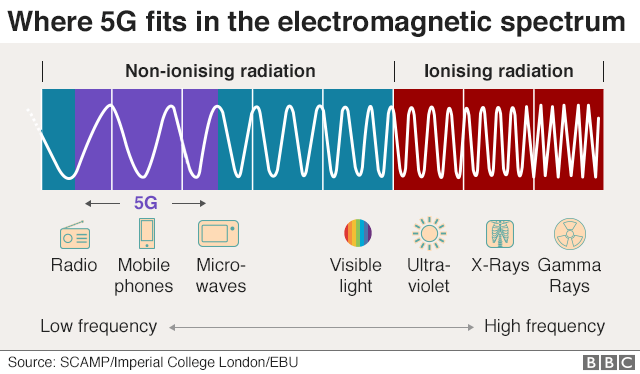
It would also be impossible for 5G to transmit the virus, Adam Finn, professor of paediatrics at the University of Bristol, adds.
"The present epidemic is caused by a virus that is passed from one infected person to another. We know this is true. We even have the virus growing in our lab, obtained from a person with the illness. Viruses and electromagnetic waves that make mobile phones and internet connections work are different things. As different as chalk and cheese," he says.
It's also important to note another major flaw with the conspiracy theories - coronavirus is spreading in UK cities where 5G has yet to be deployed, and in countries like Iran that have yet to roll out the technology.
There were plenty of scare stories about 5G circulating before the coronavirus outbreak which Reality Check has already looked into, such as this piece: Does 5G pose health risks?
Earlier this year, a long-running study from the watchdog the International Commission on Non-Ionizing Radiation Protection (ICNIRP) rebutted these claims, saying there was no evidence that mobile networks cause cancer or other illnesses.
But if anything, the misinformation seems to have escalated.
Trade body Mobile UK has said false rumours and theories linking 5G and coronavirus were "concerning," while the Department for Digital, Culture, Media and Sport has reiterated there is "absolutely no credible evidence for the link".
Viruses invade human or animal cells and use them to reproduce, which is what causes infection. Viruses cannot live very long outside a living thing, so they have to find a way in - usually via droplets of liquid from coughs or sneezes.
Genome sequencing of this coronavirus suggests it jumped from animals to humans - and then began to pass from human to human.
Latest Stories
-
MTN Media Republic, Ghana Wildlife Society embark on bird, butterfly walk
3 minutes -
Fuel Prices: Star Oil holds petrol at GH¢14.97, raises diesel to GH¢16.97
10 minutes -
DR Congo Ebola outbreak surges past 6000 cases as death toll nears 3000
17 minutes -
Telecel Ghana CEO urges mining industry to build agile people for tech-driven future
20 minutes -
Ghana Digital Centres’ loss nearly triples to GH¢6.06m as revenue falls
21 minutes -
The private school teacher crisis: A silent exodus
23 minutes -
NPC Ghana congratulates Farida Iddriss on Africa Aquatics Zone II leadership role
23 minutes -
Zanetor pledges to protect Ghana’s natural resources for future generations
25 minutes -
2024 defeat was due to demoralised base, poor preparation – Boakye Agyarko
29 minutes -
Ghana welcomes UN report backing reparations for transatlantic slavery
30 minutes -
Fidelity Bank convenes debt capital markets conference to turn Ghana’s recovery into long-term growth
31 minutes -
RTI Commission marks 2026 RTI month with focus on information integrity in digital age
33 minutes -
GoldBod now owns all the risk: What the Bank of Ghana’s exit from the Gold Programme really means
38 minutes -
GEA moves to reset MSME support with new 2026–2030 strategic plan
40 minutes -
Ghana records $4.3bn trade surplus in Q1 2026, driven by gold – GSS
46 minutes