

Audio By Carbonatix
Egyptians have been witnessing a historic procession of their country's ancient rulers through the capital, Cairo.
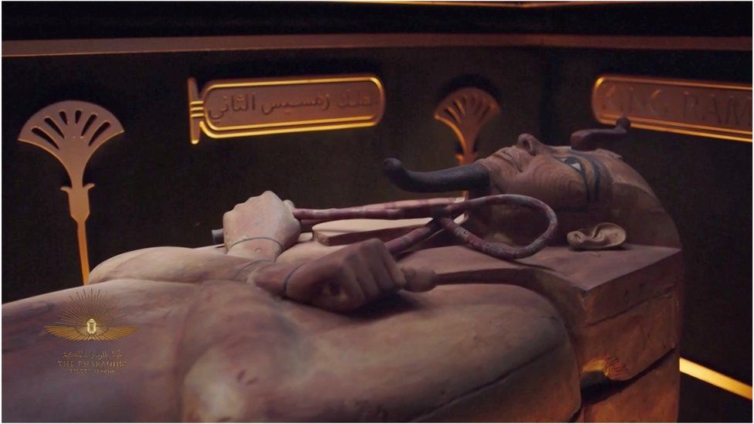
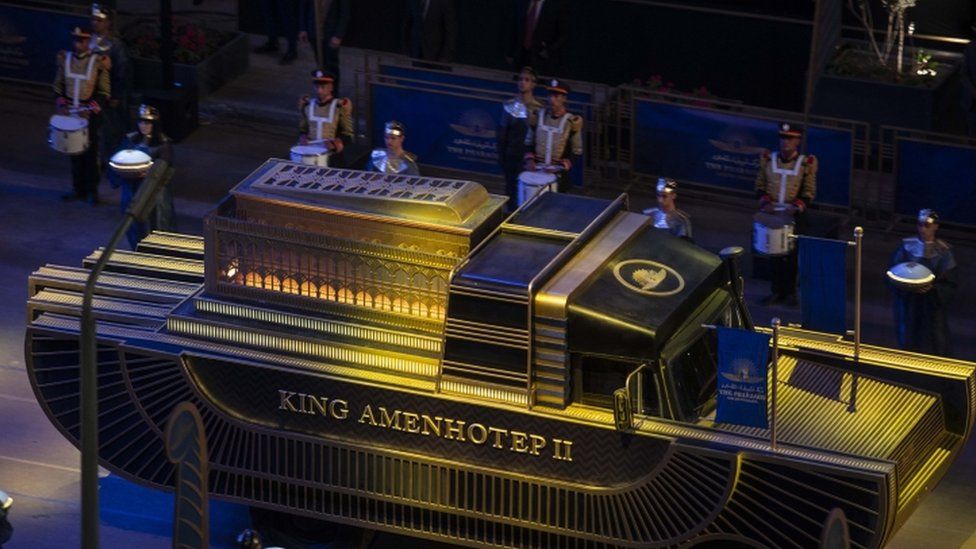
The lavish, multimillion-dollar spectacle saw 22 mummies - 18 kings and four queens - transported from the peach-coloured, neo-classical Egyptian Museum to their new resting place 5km (three miles) away.
With tight security arrangements befitting their royal blood and status as national treasures, the mummies were relocated to the new National Museum of Egyptian Civilisation in what is called The Pharaohs' Golden Parade.
They were transported with great fanfare in chronological order of their reigns - from the 17th Dynasty ruler, Seqenenre Taa II, to Ramses IX, who reigned in the 12th Century BC.
Egypt experienced a sharp rise in Covid-19 infections a year ago, but following a decline in the number of cases and deaths, restrictions on open-air gatherings were later lifted.
One of the main attractions of Saturday's event is King Ramses II, the most famous pharaoh of the New Kingdom, who ruled for 67 years and is remembered for signing the first known peace treaty.
Another is Queen Hatshepsut, or Foremost of Noble Ladies. She became ruler even though the customs of her time were that women did not become pharaohs.
Each mummy was carried on a decorated vehicle fitted with special shock-absorbers and surrounded by a motorcade, including replica horse-drawn war chariots.
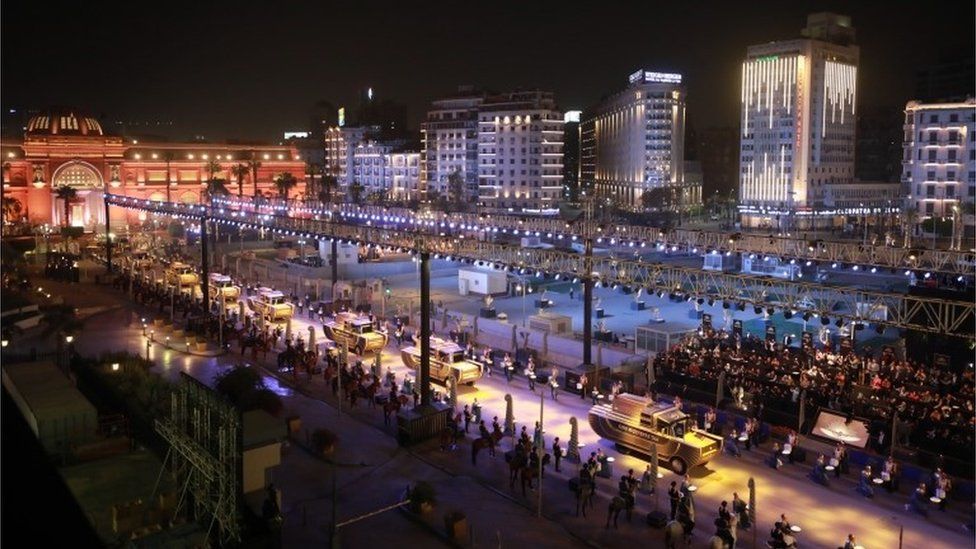
While ancient mummification techniques originally preserved the pharaohs, for the move they have been placed in special nitrogen-filled boxes to help protect them against external conditions. Roads along the route have also been repaved to keep the journey smooth.
"The Ministry of Tourism and Antiquities has done its best to make sure that the mummies have been stabilised, conserved, and are packed in a climate-controlled environment," said Salima Ikram, professor of Egyptology at the American University in Cairo.
The mummies were discovered in 1881 and 1898 in two caches in the ruins of Thebes, Egypt's ancient capital - modern day Luxor in Upper Egypt.
"They have already seen a lot of movement in Cairo and before that in Thebes, where they were moved from their own tombs to other sepulchres for safety," Dr Ikram pointed out.
While most of the ancient rulers' remains were brought from Luxor to Cairo via boat on the Nile, a few were transported in the first-class carriage of a train.
They were housed in the iconic Egyptian Museum and visited by tourists from around the world for the past century.
Valley of the Kings
Egypt's authorities are hoping that the new museum, which opens fully this month, will help revitalise tourism - a prime source of foreign currency for the country.
The industry has been battered by political turbulence over the past decade, and more recently by the pandemic.
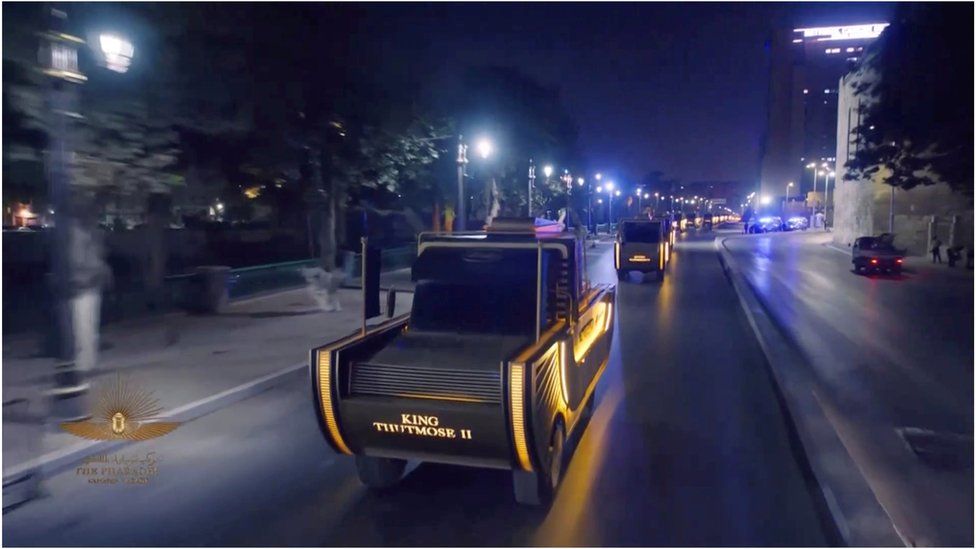
Saturday's move of the mummies will be streamed online for all enthusiasts of ancient Egypt to watch.
The new exhibits will now be housed in the Royal Hall of Mummies and will go on display to the general public from 18 April.
The hall has been designed so that visitors will experience the illusion of being in the Valley of the Kings in Luxor.
Separately, a new Grand Egyptian Museum which will house the famous Tutankhamun collection is due to open next year, close to the Great Pyramids at Giza.
'Curse of the pharaohs'
While it is being seen as a grand - and even fun - event, Egypt's mummies have historically been associated with superstition and foreboding.
Recently, Egypt has had a string of disasters. Last week alone dozens of people were killed in a train crash in Sohag, Upper Egypt, while at least 18 people died when a building collapsed in Cairo.
Then, as preparations were in full swing to transfer the mummies, the Suez Canal was blocked by the MS Ever Given cargo ship for almost a week.
Social media users have questioned whether the myth of "the curse of the pharaohs" might be to blame.
The ethics of displaying ancient Egyptian mummies has long been debated. Many Muslim scholars believe that the dead should be treated with dignity and respect and not be exhibited as curiosities.
In 1980, President Anwar Sadat ordered the Royal Mummy Room at the Egyptian Museum closed, arguing that it desecrated the dead. He wanted the mummies to be reburied instead, though he did not get his wish.
Latest Stories
-
Be careful with cross-border lending, foreign currency exposures – BoG to financial institutions
2 hours -
GPL 2026/27: Medeama go three clear as Hearts of Oak recover and Bechem stage stunning comeback
2 hours -
Ntiamoah Foundation launches “BEYOND 20” anniversary campaign
2 hours -
Credit Risk Management Directive: BoG to begin implementation for banks, others from July 1, 2027
2 hours -
Ghana Brands Awards 2026: Leading brands, business trailblazers to shine on November 20
3 hours -
T-bills auction: Demand improves as government exceeds target by about 76%; interest rates soften
3 hours -
Ziope undertakes initiative to build a technologically inclined community, commissions self-help ICT lab
3 hours -
ECG announces power outage in parts of Tema, Central Region due to network fault, maintenance
4 hours -
When the Gospel Becomes a Weapon: The church, blackmail and the abuse of faith
4 hours -
JoyNews’ Jacqueline Ansomah Yeboah selected for UK Media Excellence for Emerging Technologies Fellowship
4 hours -
Mental Health Alliance urges government to operationalise Mental Health Fund
5 hours -
Ghana–Holy See agreement heads to Parliament after Cabinet approval
5 hours -
Luv FM Corporate Games 2026: Kumasi Central Prisons, Amanfiman Bank win big amid fun
5 hours -
WAFU B U17: Ghana top Group A after win over Togo
5 hours -
Ho Central Mosque reopens amid unresolved leadership dispute that led to closure
7 hours