

Audio By Carbonatix
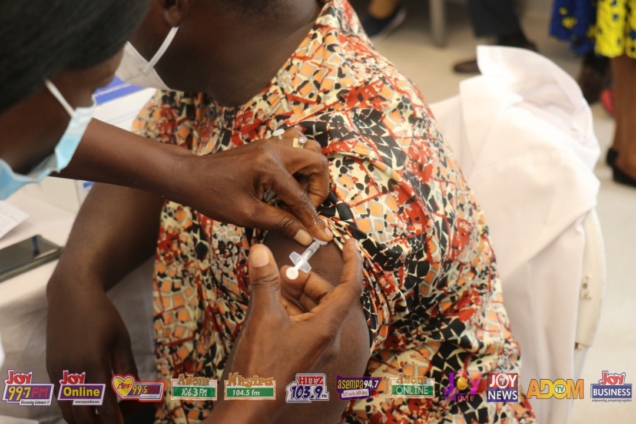
Research by scientists at the University of Southampton in the UK has revealed that the public’s willingness to take Covid-19 vaccines in Ghana decreases as vaccine hesitancy increases.
The team has conducted three surveys so far in August 2020, March 2021 and June 2021. Between August 2020 and March 2021, the data showed a decrease in vaccine hesitancy from 36.8% to 17.2%.
But the latest survey conducted in June 2021 shows vaccine hesitancy has increased from the March 2021 figure of 17.2% to 28.5%.
The reasons for the vaccine hesitancy include people not having enough information, some believing vaccines are dangerous and heightened government mistrust.
The first survey was conducted in August 2020 before any Covid-19 vaccines had been approved. The second round was in March 2021, when the Oxford AstraZeneca vaccines had arrived in the country.
Hesitancy significantly decreased between those two-time points – from 36.8% to 17.2%.
The latest report includes findings from the latest survey, which took place in June 2021, and includes 1,295 Ghanaian respondents.
“We saw a significant decrease in willingness, and therefore an increase in hesitancy – from 17.2% to 28.5%. Within this 28.5% subgroup, 15.1% reported that they were undecided, and 13.4% indicated they would not accept the vaccine if offered.
"Both of these proportions had increased since the previous survey in March,” one of the researchers Dr Michael Head, as Senior Research Fellow in Global Health at the University of Southampton, explained during a media briefing organised in collaboration with the Africa Science Media Center.
Around one-third of respondents had read stories about the Oxford AstraZeneca vaccine's indecision in Europe and North America on social media.
Worryingly, a high proportion of respondents suggested that these stories made them feel concerned about accepting a COVID-19 vaccine in the future.
“We found the groups more likely to be hesitant were women, Christians, opposition party supporters and people with higher education,” he explained.
Research in higher-income settings often shows that more years of education correlates with stronger vaccine confidence.
But in other research covering African nations, there is a mixed set of findings regarding education status. For example, it may be that younger urban populations are more likely to be educated and also have access to the internet and thus be exposed to a mixture of good and bad information about vaccines.
There may also be different voting patterns in younger education groups that affect the level of trust in government messaging.
In Togo as well, the team carried out one survey in January 2021. Again, hesitancy was higher than in Ghana – at 32.3%. The two main reasons provided were that the vaccines were dangerous (stated by 90% of the hesitant respondents) and did not trust the current government (40% of the hesitant respondents).
The researchers say considering the results across Ghana and Togo, there is a clear need for strong health promotion ahead of any future arrivals of vaccine doses.
“It is difficult to push good public health messages through the noise of uncertainty, misinformation, and outright conspiracy theories. For maximum impact, the information must come from trusted sources, and this may differ depending upon the receiving demographic,” they observed.
Packs Africa, Center for Research and Opinion Polls, and Congate Systems were the other collaborators in the research.
Kirchuffs Atengble, Executive Director of PACKS Africa, said: “In recent times, the political terrain in Ghana has become very fluid and volatile, influencing policy response by a good number of citizens.
"Following positive vaccine response from the leadership of the two major political parties, the Ghana Health Service may want to pursue multidimensional strategies to increase Covid-19 vaccination uptake, including vaccine communication through political agents across the divides, community opinion leaders and repentant anti-vaccine campaigners.”
Daniel Otunge of Africa Science Media Center urged the media to educate the public about the Covid-19 vaccines.
Latest Stories
-
The GIPA Act: Resetting Ghana’s investment framework
49 minutes -
GIPA secures investor leads at Invest Fest 2026
55 minutes -
Ghana’s missing billions: What 16 years of Auditor-General reports show
55 minutes -
Police disown viral flyer on AirPods, earphones use while driving
57 minutes -
Stop using media to challenge judicial decisions – Thaddeus Sory to lawyers
58 minutes -
The next generation expects more than degrees from universities
1 hour -
Ebenezer Dwomoh to stage fourth stand-up comedy special in Kumasi
1 hour -
Central Regional Minister urges traditional leaders to hold public officials accountable
1 hour -
Ada Traditional Council suspends four members for defying cancellation of 2026 Asafotufiami durbar
1 hour -
Association of Small-scale Industries, GEA strengthen artisans through mentorship, coaching
1 hour -
Two arrested over alleged galamsey activities in Tanoso
1 hour -
Ghana rises to sixth-largest gold producer globally after record 2025 output
1 hour -
Five injured in road crash at Ahwerase
2 hours -
Ghana needs copyright protection for Kente designs – Agortime-Ziope MP
2 hours -
BDCs lobby NPA for regional fuel depots amid concerns over BOST’s role
2 hours