

Audio By Carbonatix
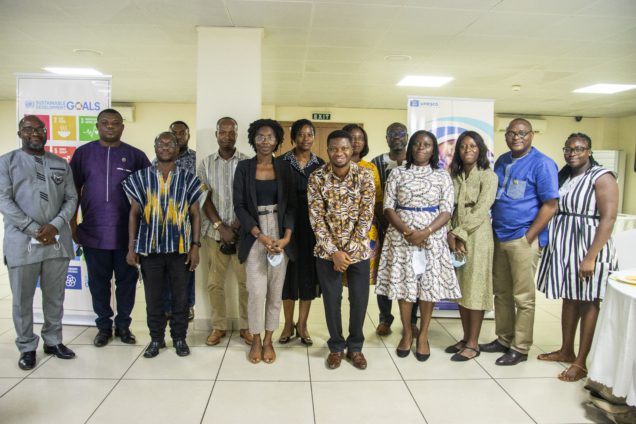
The United Nations Educational, Scientific, and Cultural Organization (UNESCO) hosted a national capacity-building workshop in Ghana to support the country in developing policies that are SMART (Specific, Measurable, Attainable, Relevant and Timely) to ensure that Science, Technology, and Innovation (STI) are reflected across all sectors of the economy.
The two-day hybrid workshop held at the Oak Plaza Hotel in Accra forms part of an ongoing project in six African countries (Congo, Ghana, Namibia, Sierra Leone, Tanzania, and Zimbabwe) funded by the Swedish International Development Cooperation Agency (Sida) to strengthen national and regional STI policies and governance, and institutions in research and innovation in line with the UNESCO Recommendation on Science and Scientific Researchers (RS|SR).
The RS|SR is a standard-setting instrument adopted in 2017 by all UNESCO member states, including Ghana, to serve as a checklist in ensuring that societies use knowledge from all scientific fields responsibly, protect scientific researchers' rights and conditions, and provide adequate financial and institutional support to scientists.
Science in the context of STI includes not only natural sciences but also social and human sciences.
Addressing participants, UNESCO’s Science Policy Consultant, Guillermo Lemarchand explained the key concepts of STI policies and policy instruments using global and regional examples; as well as the methodological approach and analytical units of UNESCO's Global Observatory of Science, Technology, and Innovation Policy Instruments (GO-SPIN).
He further demonstrated how to use the GO-SPIN platform's survey to collect important data on the country's STI institutions, legal frameworks, and policy instruments in order to evaluate Ghana's implementation of the 2017 RS|SR.
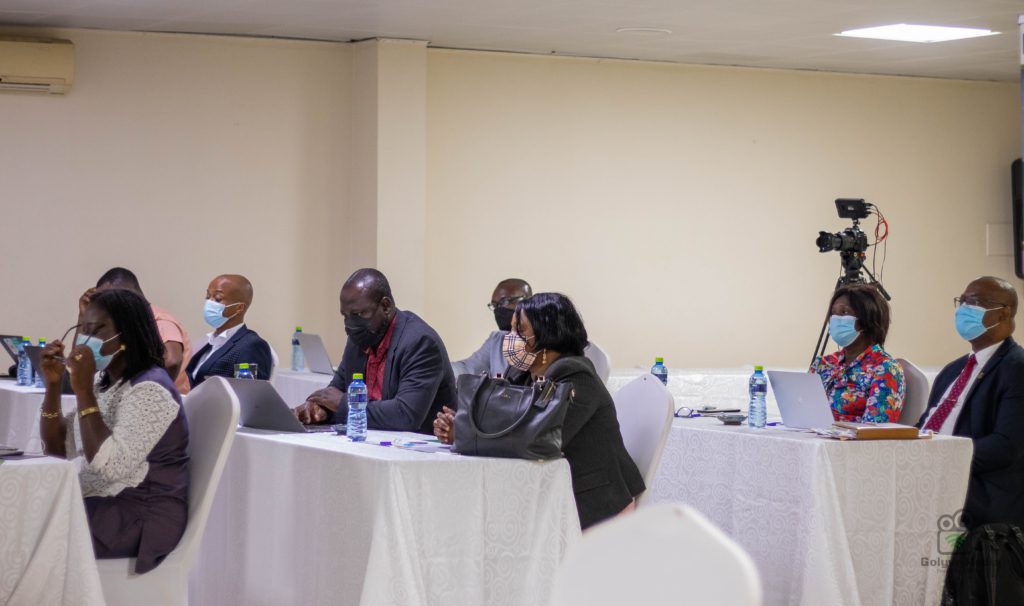
He stressed that “policy without any structures in place is just a piece of literature. We need an understanding of the previous data before we can make decisions. Those societies that get to learn how things work will be in a better situation to address future events. You need to reduce the reality to variables and correct the trajectory all the time.”
Mr. Lemarchand also discussed Ghana's Gross Domestic Expenditure on Research and Experimental Development (GERD), noting that the country's R&D strength appeared to be skewed toward medical research.
He emphasized the importance of the government, in partnership with the private sector, investing more in diverse scientific research to reduce the country's reliance on foreign aid for its R&D.
The Deputy Director of the STI Directorate at the Ministry of Environment, Science, Technology, and Innovation (MESTI), Cephas Adjei Mensah; spoke about the measures the ministry and its agencies are undertaking with the support of UNESCO to strengthen the country’s STI system.
Throughout the workshop, stakeholders actively participated in concluding that Ghana's current STI policy requires a SMART review to ensure complementarity and synergy with other developmental policies for its effective execution. In interviews with the media, participants at the two-day training highlighted the view that the event had strengthened their capacities to design policy responses in national priority areas and establish a community of practice to underpin sustainable STI.
Participants for the two-day workshop which was held on 17th and 20th December 17 and 20, 2021, included representatives from MESTI, Council for Scientific and Industrial Research (CSIR), CSIR – Science and Technology Policy Research Institute (STEPRI), Ghana Statistical Service, Kwame Nkrumah University of Science and Technology (KNUST), Environmental Protection Agency (EPA), National Development Planning Commission (NDPC), CSIR-Soil Research, Food and Drugs Authority (FDA), Ministry of Communication and Digitization, African Institute of Mathematical Sciences (AIMS)-Ghana, Ashesi University, Ghana Institution of Engineering (GhIE), Forum for Agricultural Research in Africa (FARA), University of Ghana, Ghana Atomic Energy Commission (GAEC), Association of Ghana Industries (AGI), Institute for Sustainable Energy and Environmental Solutions (ISEES), UNESCO Accra Office, the media, etc.
Latest Stories
-
EOCO grants Suame MP John Darko enquiry bail in GH¢27m SIC investigation
45 seconds -
NPP cannot question EC appointment after appointing own people to Commission – Kwakye Ofosu
6 minutes -
BoG deepens public trust with regional stakeholder forum in Techiman
16 minutes -
‘We have turned the tide’ – Ato Forson says Ghana is ready to take off
21 minutes -
Police arrest man captured in viral video assaulting wife in Agona Nkwanta
23 minutes -
KATH Mother and Baby Unit construction stalled for 14 months over unpaid contractor arrears
37 minutes -
Government wanted to ‘tilt the balance’ with new EC appointments – Kwakye Ofosu
43 minutes -
Angry Tema Community 25 residents threaten to sleep at GWL over water shortage
56 minutes -
BoG takes financial literacy drive to Techiman, vows to protect depositors
56 minutes -
‘Stop the distractions’ – Akosua Manu demands answers over GH¢49.7m South Africa evacuation cost
57 minutes -
Formula 1 to return to Africa with Rwanda Grand Prix in early 2030s
1 hour -
Mahama says Ghana is safer today as he commissions 85-bed ward at Police Hospital
1 hour -
LA 2028: Black Queens face Zambia in final Olympic qualifier
1 hour -
WAFU Zone B: Black Starlets seal semifinal place with 3-1 win over Benin
1 hour -
Black Queens thrash Mauritius 7-0 to advance 10-0 on aggregate in Olympic Qualifiers
2 hours