

Audio By Carbonatix
Marvel is changing the name and design of a character that debuted in a recent issue of the comic miniseries "King Conan" after it was criticized for its portrayal of an Indigenous woman.
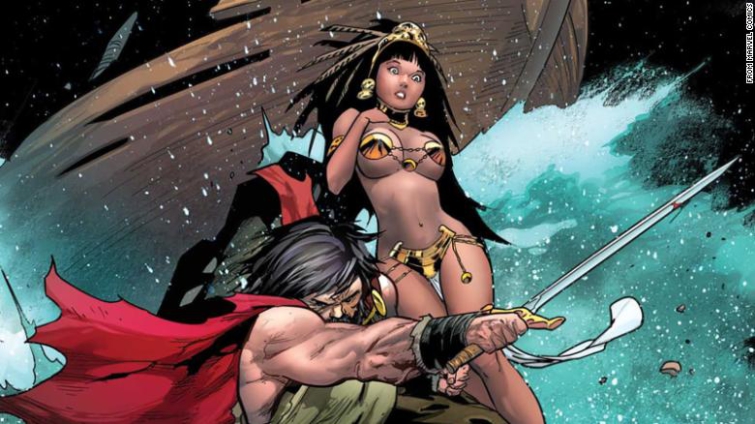
The third issue of "King Conan," published on February 16, finds its protagonist stranded on an island with a scantily clad princess named Matoaka. The princess, as it turns out, has a dark past: She hails from "a land far to the west," and once fell in love with a man who tried to colonize her people.
When the man ransacked her home, she killed him, but her father nonetheless exiled her to the island, where she's now cursed to lure other would-be colonizers away from her native land.
To people in Indian Country, Matoaka's name and backstory were a clear reference to the real-life Pocahontas, who privately went by the same name.
For centuries, Pocahantas has been romanticized and mythologized as a woman who defied her father to save the English colonist John Smith from execution.
In reality, she was around 11 or 12 when she first met Smith, and historians have disputed Smith's claims that she rescued him at all. Later, she was kidnapped by the English and raped in captivity, according to the Mattaponi tribe's oral history.
Given that history, some Indigenous comic book artists and fans found the character in "King Conan" -- and the hypersexualized way she was depicted -- to be demeaning and disrespectful.
"The real Matoaka was a pre-teen girl who suffered at the hands of her English captors," Arigon Starr, a comic book artist who is an enrolled member of the Kickapoo Tribe of Oklahoma, wrote in an email to CNN. "What's even more shocking is that most of this information is online; a quick search would have informed the writer, artist, editor and publisher that it was a poor choice to give this character the name of a famous victim of violence.
"Kayla Shaggy, a Two-Spirit comic book artist who is Diné and Anishinabe, said she felt that the character reduced Indigenous women to an offensive stereotype.
"The fact that they depict an Indigenous woman as this nubile prize to be won by non-natives in stereotypical, fetish-y clothing contributes to the current, ongoing harm and ignorance of missing and murdered Indigenous women," she wrote to CNN.
In light of the criticism, writer Jason Aaron apologized for the character, calling his decision to use the name Matoaka "ill-considered."
"This new character is a supernatural, thousand-year-old princess of a cursed island within a world of pastiche and dark fantasy and was never intended to be based on anyone from history," he said in a statement shared by Marvel.
"I should have better understood the name's true meaning and resonance and recognized it wasn't appropriate to use it. I understand the outrage expressed by those who hold the true Matoaka's legacy dear, and for all of this and the distress it's caused, I apologize."
Aaron added that he had donated the money he made from the issue to the National Indigenous Women's Resource Center. A spokesperson for Marvel said that Matoaka's name and appearance would be changed in future printings, upcoming issues and digital editions, though the details were still being finalized.
Still, Shaggy was disappointed that the company didn't pull the issue from stands and halt distribution altogether.
"The character is still an Indigenous stereotype, her story is a rehash of racist narratives, and overall continuing the story still puts money in the company's pocket at the expense of native people," she said.
Native Americans have long been marginalized and misrepresented in comic books, "from the bloodthirsty barbarians and noble savages of dime novels, to formulaic secondary characters and sidekicks" as Michael Sheyahshe explored in his book "Native Americans in Comic Books: A Critical Study."
"To paraphrase from Michael's work -- Native people have been relegated to the sidekick, shaman, overly sexualized or super tracker characters," Starr said. "We are rarely the main character or the hero."
In recent years, however, projects helmed by Native artists and writers have provided more authentic representation in the comic book world. Starr and Shaggy said they hoped the "King Conan" controversy would result in more opportunities for Indigenous creators in the industry.
"The support for authentic Native characters and comics is out there," Starr added. "Maybe one day, Marvel and DC will catch up to us."
Latest Stories
-
Africa World Airlines unveils first Embraer E190 as part of 10-aircraft fleet expansion
1 hour -
Civilian hospitalised after alleged machete attack by prison officers, inmates
1 hour -
Toobu rejects calls to recall Parliament over 3.9-tonne cocaine shipment
2 hours -
Residents in 5 Northern Regions warned of approaching rainstorm
2 hours -
Constituency Games still a work in progress – Sports Minister
2 hours -
Team Ghana set for historic Karting Africa Showrun in Angola
2 hours -
52-year-old South African arrested with suspected heroin after arriving from Accra
3 hours -
Shatta Wale challenges UPSA students to build entrepreneurial mindsets
3 hours -
Finance Minister advises African governments to strengthen regional tax cooperation
5 hours -
NPP accuses NDC of master-minding demolition of Ho regional office fence
5 hours -
Ghana plans stronger regional power trade with Nigeria
5 hours -
GRA Commissioner-General calls for stronger tax cooperation to boost regional revenue mobilisation
5 hours -
NACOC needs more personnel to tackle drug trafficking – Toobu
5 hours -
Railway workers resist KMA eviction order, demand consultation
5 hours -
Legacy Leadership Africa Institute to host boardroom women’s leadership programme
5 hours