

Audio By Carbonatix
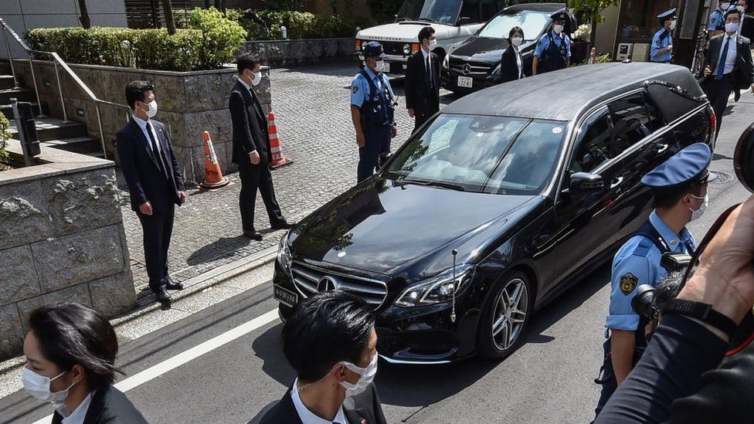
A motorcade carrying the body of former Japanese Prime Minister, Shinzo Abe has arrived at his home in Tokyo.
Abe was shot dead while speaking at a political campaign event on Friday morning in the southern city of Nara.
Police investigating the assassination have said the suspect held a grudge against a "specific organisation".
The alleged gunman, named as Tetsuya Yamagami, 41, believed Abe was part of it, they said.
Yamagami has admitted shooting him with a homemade gun, according to police.
As a hearse carrying Abe's body arrived at his residence in Tokyo, members of his ruling Liberal Democratic Party (LDP), dressed in black, lined up to pay their respects.
Current Prime Minister Fumio Kishida is expected to visit this afternoon.
According to local media reports, a night vigil will be held on Monday and Abe's funeral is due to take place on Tuesday.
Abe was Japan's longest-serving prime minister and his death at the age of 67 has profoundly shocked a country where gun crime is very rare.
He was killed while campaigning for his party in the run-up to upper house parliamentary elections on Sunday.
Prime Minister Kishida, also an LDP member, said he was "simply speechless", vowing that Japan's democracy would "never yield to violence".
He said the election campaign would continue on Saturday with tightened security, with Sunday's vote still set to go ahead.
Gunman made no attempt to flee
Police are investigating why Abe was targeted and whether his killer acted alone.
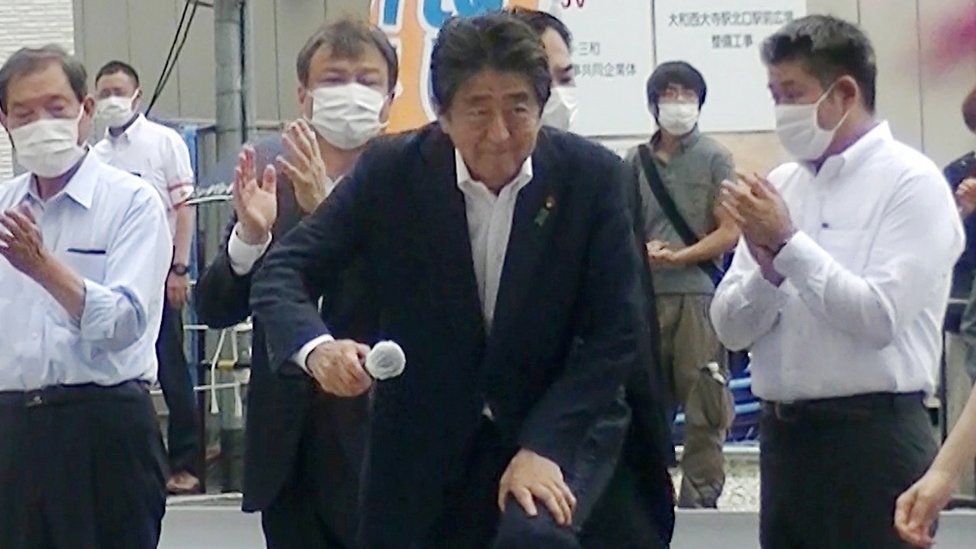
He was giving a speech on behalf of a political candidate at a road junction in the southern city of Nara when he was shot from behind.
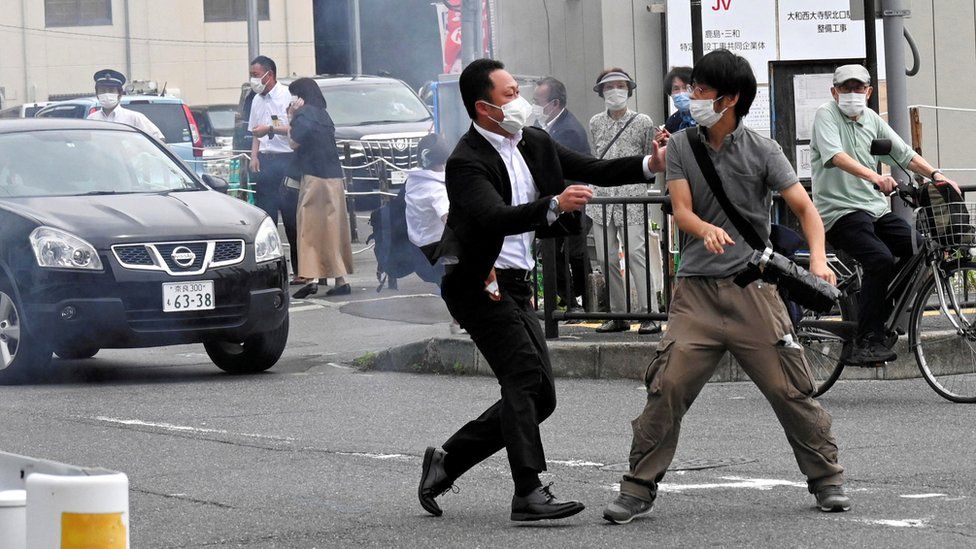
Photos from the event show the suspect standing close to Abe moments beforehand.
Witnesses described seeing a man carrying a large gun moving within a few metres of Abe and firing twice. The former prime minister fell to the ground as bystanders screamed in shock and disbelief.
Security officers dived on to the gunman who made no attempt to run.
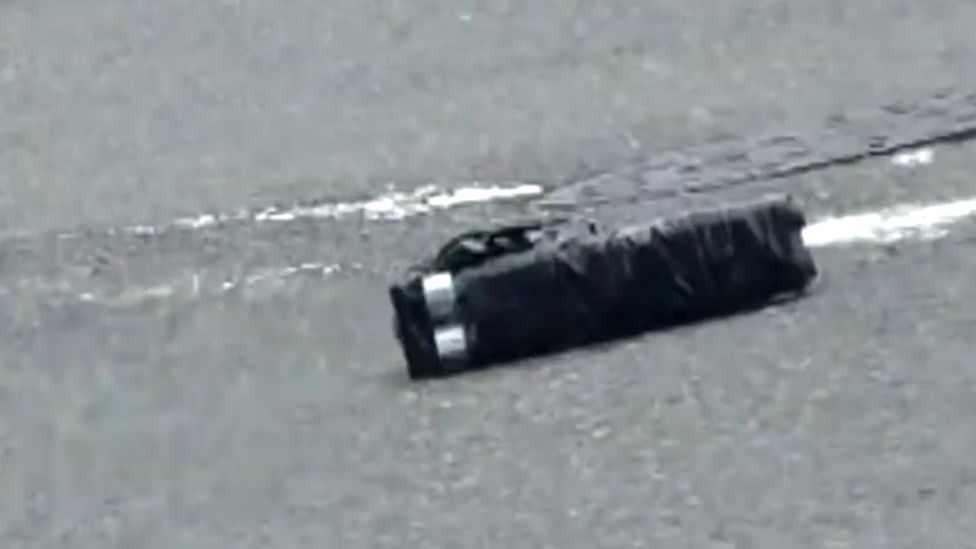
The weapon that killed Abe was made using metal and wood, officers said, and appeared to be wrapped in duct tape.
Several other handmade guns and explosives were later found at the suspect's home.
Abe suffered two bullet wounds to his neck and damage to his heart during the attack.
He was said to be conscious and responsive in the minutes after the attack, but doctors said no vital signs were detected by the time he was transferred for treatment.
Medics worked for hours to save him before he was pronounced dead at 17:03 local time (08:03 GMT) on Friday.
On Japanese social media, the hashtag "We want democracy, not violence" was trending throughout Friday, with many users expressing their horror and disgust over the incident.
Gun violence is extremely rare in Japan, where handguns are banned and incidents of political violence are almost unheard of.
In 2014, there were just six incidents of gun deaths in Japan, compared to 33,599 in the US. People have to undergo a strict exam and mental health tests in order to buy a gun. Even then, only shotguns and air rifles are allowed.
Abe first held office for a year in 2006 and then again from 2012 to 2020 before stepping down, citing health reasons.
While he was in office, he pushed more assertive policies on defence and foreign policy and had long sought to amend Japan's pacifist post-war constitution.
He also pushed for an economic policy that came to be known as "Abenomics", built on monetary easing, fiscal stimulus and structural reforms.
He was succeeded by his close party ally Yoshihide Suga, who was later replaced by Mr Kishida.
'Despicable attack'
Prominent voices across the world condemned the incident, with UK Prime Minister Boris Johnson calling it a "despicable attack".
US President Joe Biden called Prime Minister Kishida to express his "outrage, sadness and deep condolences" on Abe's shooting. He said the assassination was "a tragedy for Japan and for all who knew him [Abe]".
Mr Biden ordered US flags to be flown at half-mast over the weekend.
In Brazil, President Jair Bolsonaro declared three days of national mourning, expressing outrage and sadness, while Indian Prime Minister Narendra Modi described Abe as a global statesman.
South Korean President Yoon Suk-yeol called the attack an "unacceptable act of crime" and extended condolences to "the Japanese people for having lost their longest-serving prime minister and a respected politician".
On Saturday, China's President Xi Jinping sent his condolences to Mr Kishida on the death of the former Japanese prime minister.
On Friday, comments gloating over the attack on Abe dominated Chinese social media and also surfaced on Korean platforms.
China and South Korea have historically had complicated and fraught relationships with Japan. Abe, known for his military hawkishness, was unpopular with citizens of both countries during his term in office.
Latest Stories
-
‘Resign and join NDC’ – NPP tells Chief Justice over alleged political commentary
2 minutes -
Minority caucus demands immediate recruitment of qualified graduates with disabilities
12 minutes -
Underage riders driving motorcycle crashes, union claims
15 minutes -
About 14,800 candidates with aggregates 6–12 apply for 1,300 Achimota places – CSSPS
28 minutes -
PETROSOL engages dealers to strengthen retail network and improve customer experience
40 minutes -
GRIDCo warns encroachers as activities under high-voltage lines threaten power supply
46 minutes -
The coup doesn’t need soldiers anymore: Social media and the new assault on African democracy
56 minutes -
Works and Housing Minister pushes to cut Kaneshie road closure from one year to 6–9 months
59 minutes -
Joy FM Back-to-School Fair: Patrons to enjoy up to massive discounts from vendors
1 hour -
Mahama gives TMA, TDC 14 days to resolve development control dispute
1 hour -
‘We cannot arrest the entire school, but we know the ringleaders’ –– Police warns Okuapem, Mount Sinai students
1 hour -
UN warns of ‘supersized’ El Niño as countries prepare for impact
1 hour -
Channel smuggling gangs resort to ‘mega-dinghies’ as crackdown limits small boat supply
1 hour -
Embattled Spanish PM Sánchez insists no prior warnings before Ceuta crisis
1 hour -
Palestinian teens killed during settler attack on West Bank village, officials say
1 hour