

Audio By Carbonatix
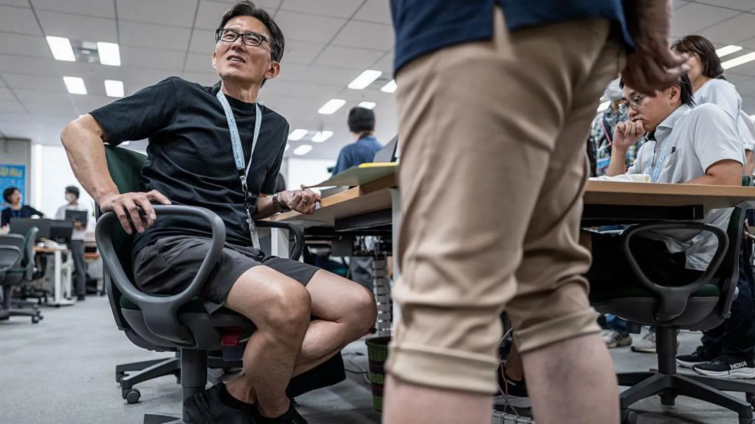
As temperatures rise this summer, Japanese men are baring more leg at work than ever before.
The Tokyo Metropolitan Government is pushing company employees to ditch their usual suit and tie for more casual attire, featuring T-shirts, trainers - and shorts.
Tokyo Governor Yuriko Koike introduced "Tokyo Cool Biz" in April, hoping to expand on her signature cool down initiative, which has now become a widely recognised annual summer tradition.
Almost four months in, the newly allowed shorts in the office policy is getting mixed reviews.
Some commentators enjoy the relaxed rules, helping them work more comfortably. Others say the policy is unfair to women since they are still expected to wear tights when showing a part of their legs. And a few women describe the experience of "leg hair harassment" or a term coined online as "sunehara", referring to the discomfort of being forced to see their colleague's leg hair.
"We want to give people more options in the severe heat, not tell them what to wear. There should be no issue as long as the work attire is not offensive to anyone," Tokyo Metropolitan Government environmental official Noboru Watanabe told the BBC.
A June survey by Gorilla Clinic found 53.5% opposed wearing shorts to work in the summer while 46.5% were in favour of the new recommendation.
For those against shorts in the office, the main reason, for both genders, was the concern over body shape and body hair. The clinic says women significantly outnumbered men in their response, indicating that women may be more resistant to seeing a male colleague's bare legs.
In recent years, more Japanese workers, notably those working at startups and tech companies, have started wearing casual clothes. But this year, the Tokyo government recommendation has made it more socially acceptable. Still, some men have been feeling self-conscious about their leg hair.
Akifumi Funatsu, the director of Gorilla Clinic, says he has noticed more clients coming to the clinic not just for cosmetic reasons, but as a matter of "social etiquette when wearing shorts". He thinks women believe that "men should have less leg hair", which has prompted them to seek laser hair removal so as not to offend those around them.
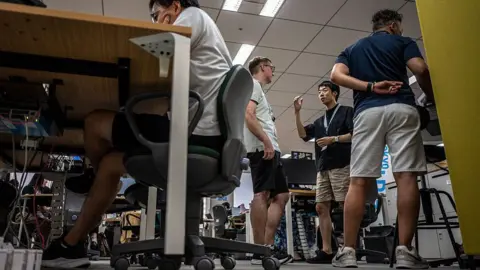
Koike first introduced the summer wardrobe shift as Japan's environment minister in 2005. She launched a national energy-saving campaign called "Cool Biz" to encourage company workers to opt for short-sleeve shirts.
Government leaders participated in the initiative, with then Prime Minister Junichiro Koizumi often seen in public without wearing a tie or jacket, helping get the word out.
A few years later following the Tohoku earthquake and tsunami in March 2011, the government launched "Super Cool Biz" which expanded the guidelines to help reduce energy use both at work and at home.
As with other parts of the world, Japan has been experiencing record heat in recent months while grappling with soaring energy prices driven by instability in the Middle East.
Forecasters have warned of extreme heat this summer, with the Japan Meteorological Agency trying to raise public awareness by announcing the word "kokusho-bi", which means "brutally hot day" when the mercury exceeds 40C.
The latest weekly data shows seven people died in Japan from heatstroke and 4,580 people were admitted to hospitals in the seven days from 6-12 July, according to the Fire and Disaster Management Agency.
Besides staying hydrated and turning on the air conditioning, some of the most basic actions repeatedly encouraged by government officials, residents have turned to new products and gadgets to beat the heat.
Items such as clothes with built-in fans, disposable wet-towels, UV and heat blocking umbrellas, and portable handheld fans have been popular and sold in shops nationwide.
Experts from the Japan Academic Network for Disaster Reduction are stressing the need for heat acclimatisation as it takes several weeks for the body to adapt to high temperatures.
They say the key is to start preparing for hot weather and taking measures to prevent heatstroke during the country's rainy season, before the full summer heat arrives.
Japan also faces high humidity which makes it harder for sweat to evaporate, reducing the body's ability to cool itself.
Latest Stories
-
Power restoration fault suspected in Kumasi Central Market fire
2 hours -
The 7-foot giant of Ngleshie Amanfro: Seven-foot Ghanaian Ephraim Saawa dreams of joining the national basketball team
2 hours -
Government promises support for Kumasi Central Market fire victims
3 hours -
Vibes The Movie: Big Ghun’s Ghanaian film earns five nominations at 2026 REFFA
3 hours -
MamaCare CEO warns unresolved conflicts among health workers could undermine maternal and neonatal care
3 hours -
Health professionals urged to translate medical knowledge into practice to save mothers
4 hours -
Conflicts among care providers linked to maternal, neonatal deaths – Expert
5 hours -
GIS marks 10th TIME conference, champions improved teaching practices
5 hours -
BRICS Or Balance? What Ghana’s bid really means
6 hours -
GPRTU wants full TRAFFITECH-GH implementation to start in 2027
6 hours -
Mahama announces plans to import electric wheelchairs for PWDs
6 hours -
KGL U17 Colts 2026: Western beat Prempeh Elite Academy to set up final final with Greater Accra Region
6 hours -
Late Solanke strike salvages 10-man Spurs draw at Man United
7 hours -
Gender Ministry to monitor welfare of Nana Akua Addo’s children amid domestic violence case
7 hours -
Benedict Okyere Yeboah: Ghana’s football problem goes beyond sacking a coach
7 hours