

Audio By Carbonatix
The Institute of Fiscal Studies (IFS), a policy think tank, has asked the Government to pay attention to limitations stated in the current International Monetary Fund (IMF) programme and find ways to circumvent them.
While commending the IMF programme for suggesting proposals to strengthen Fiscal Responsibility Act, review government flagship programmes, among others, IFS warned that the programme had shortfalls that could be inimical to the country’s economic development.
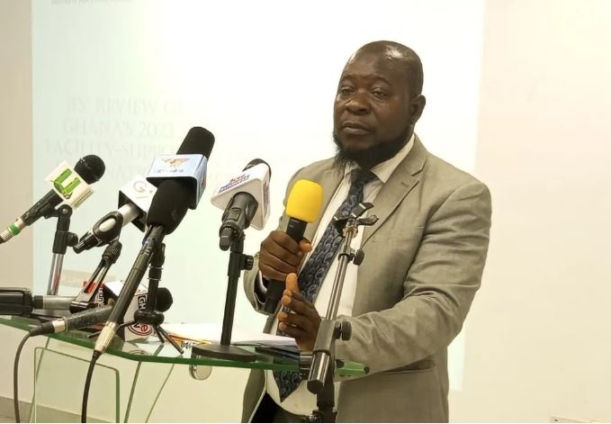
Highlighting the limitations of the Extended Credit Facility (ECF) programme at a press briefing in Accra, Dr Said Boakye, Acting Executive Director of IFS, noted that the effort to improve revenue mobilisation under the programme overly relied on taxes.
“Over reliance on taxation is certain to hurt businesses and industries, and ultimately harm the economy’s competitiveness and long-term growth potential,” he said, urging the government to consider improving its earnings in the extractive sector as part of the medium-term revenue mobilisation strategy under the programme.
Dr Boakye said going forward, active state participation or production sharing arrangement should be the model for agreements between government and private sector in the extractive sector.
“We at IFS strongly believe that any review that results in a continuous reliance on royalty-tax approach under concession arrangement will not lead to any significant revenue inflows to the government of Ghana in the long run,” Dr Boakye said.
The Institute also identified the policy of introducing a more flexible exchange rate regime by getting rid of the Bank of Ghana (BOG)’s export surrender requirements as a limitation of the IMF programme.
Dr Boakye explained that the surrender requirements policy had presented an appropriate back-door approach to guarantee, while some of the limited foreign exchange from export proceeds was retained to strengthen the cedi.
“The dominance of multinationals in Ghana’s extractive sector means that they control a sizeable proportion of export proceeds, limiting foreign exchange inflows to the country from these exports.
“Until this situation is remedied, it is necessary that the BoG adopts measures, such as the export surrender requirements, to secure foreign exchange inflows to help defend the cedi and build up its foreign reserves,” he said.
The IFS also warned that in adhering to the programme requirement that prohibited the Central Bank from financing the government, care must be taken not to do away with the role of BoG as a lender of last resort.
IFS called on the government to shoot down the suggestion of adjusting fuel levies in line with inflation or exchange rate hikes to raise more revenue.
Dr Boakye said the introduction of such a policy could create a vicious cycle of higher fuel prices leading to increased inflation, bearing in mind the impact of fuel on inflation
“Adjusting fuel levies in line with inflation, which is bound to raise fuel prices also in line with inflation, will feed back into inflation, requiring further raise in the fuel levies, thereby creating a vicious cycle of higher and higher fuel prices and thus worsening inflation/macroeconomic instability in Ghana.
“Similarly, since exchange rate depreciation usually causes fuel and other prices to rise, leading to inflation, adjusting fuel levies in line with currency depreciation will further raise fuel prices generating more inflation,” he explained.
The policy think tank also raised concerns over the slow speed of external debt restructuring under the programme, which it said, “has not been given the urgency it deserves”.
It observed that external debt component of Ghana’s public debt had serious exchange rate implications, which could trigger macro-economic instability.
“We expected the government and its IMF/World Bank partners to pay greater attention to the restructuring of external debt,” the think tank said.
Latest Stories
-
Tano North chiefs petition Mahama over galamsey destruction in River Tano
10 minutes -
Kalpohin SHS, NOBISCO qualify to represent Northern Region at National Public Speaking Competition
17 minutes -
Missing records of illegal gold purchases in Ghana raise concern – Duncan-Williams
39 minutes -
Duncan-Williams warns of powerful interests targeting GoldBod
1 hour -
We need to pray for GoldBod – Duncan-Williams
2 hours -
Strong favourites or tougher task – will Arsenal defend their title?
2 hours -
Passengers escape death as VIP travelling from Kumasi to Sunyani catches fire
2 hours -
Ariana Grande leaves problems at home as her tour hits the UK
2 hours -
Multiple suspects at large after five shot at Virginia State University, police say
2 hours -
Three killed as Russia launches fresh aerial attacks across Ukraine
3 hours -
Boxing: John Laryea disqualified in WBA Featherweight title eliminator
3 hours -
Hawaii battles strong winds and rain as Hurricane Lala threat looms
3 hours -
Twelve killed as Polish bus veers off Hungarian motorway
4 hours -
Building Ghana better: Why architects must be at the heart of national development
6 hours -
GMet warns of severe rainstorm across northern Ghana
7 hours